On this day in military history…
On 1 August 1914 Germany declared war on the Russian Empire, turning what had begun as a political crisis in the Balkans into a conflict between two of Europe’s greatest military powers and taking another decisive step towards the First World War. The declaration came at the end of the July Crisis, a chain of diplomatic and military decisions that had followed the assassination of Archduke Franz Ferdinand, heir to the Austro-Hungarian throne, and his wife Sophie at Sarajevo on 28 June 1914. Austria-Hungary blamed Serbia for allowing the nationalist movement behind the assassination to operate and, with strong German support, delivered a severe ultimatum to the Serbian government on 23 July.
Serbia accepted most of the demands but rejected or qualified several that threatened its sovereignty. Austria-Hungary considered the reply insufficient and declared war on Serbia on 28 July. Within days the carefully constructed alliance system of Europe began drawing the continent’s major powers towards confrontation. Russia regarded itself as the protector of Serbia and of wider Slav interests in the Balkans. The Russian government also feared that allowing Austria-Hungary to crush Serbia would dramatically strengthen Austrian and German influence in south-eastern Europe. Russian military preparations therefore began as the crisis worsened.
At first Tsar Nicholas II attempted to authorise only a partial mobilisation directed against Austria-Hungary, but Russian generals argued that their mobilisation plans could not easily be divided in this way. On 30 July the Tsar finally approved general mobilisation of the Russian armed forces. For Germany this decision was critical. German military planning was dominated by the possibility of having to fight Russia in the east and France in the west at the same time. Russia possessed enormous reserves of manpower, but German planners believed its huge geographical size and railway system meant that full mobilisation would take considerably longer than Germany's.
Germany therefore depended upon speed. Its existing war planning envisaged rapidly concentrating the majority of the German Army against France before transferring forces eastwards to confront Russia. Anything allowing Russia additional days or weeks to mobilise threatened the entire German strategy. When confirmation of Russian general mobilisation reached Berlin, German leaders regarded it as a direct military threat.
On 31 July Germany proclaimed a state of imminent danger of war, known as the Kriegsgefahrzustand. This was not yet full mobilisation, but it brought important military precautions into effect, including measures affecting transport, communications and the movement of troops and reservists. The German government then sent an ultimatum to St Petersburg, demanding that Russia cease its military measures against both Germany and Austria-Hungary and giving the Russian government approximately twelve hours to provide a satisfactory answer.
The demand was delivered by the German ambassador in St Petersburg, Count Friedrich von Pourtalès, to the Russian Foreign Minister Sergei Sazonov around midnight on 31 July and 1 August. Sazonov explained that Russia could not simply halt the mobilisation machinery once it had been put into operation. Russian officials also continued to insist that mobilisation did not necessarily mean that Russia intended to attack Germany. That distinction carried little weight in Berlin.
To the German General Staff, mobilisation by a neighbouring Great Power was effectively the beginning of war. Railway timetables, mobilisation centres, reservist call-ups, ammunition movements and the concentration of millions of soldiers were all parts of carefully prepared plans. German commanders feared that waiting while Russia completed these preparations would surrender the military initiative. Throughout the morning and early afternoon of Saturday 1 August, tension in Berlin became intense, with thousands of people gathering around the Berlin Palace waiting for news as Europe appeared to be balanced between continued negotiation and general war.
The personal relationship between Kaiser Wilhelm II and Tsar Nicholas II produced one of the most remarkable episodes of the crisis. The two monarchs, who were cousins, exchanged a series of telegrams that became known as the “Willy-Nicky” correspondence. Nicholas attempted to reassure Wilhelm that Russian mobilisation did not automatically mean war and urged him to continue negotiations, while Wilhelm insisted that Russian military preparations placed Germany in an impossible position. Despite their family relationship and increasingly desperate messages, neither monarch was able to stop the military machinery gathering momentum around them.
During the afternoon another extraordinary episode briefly raised hopes in Berlin. A message from London appeared to suggest that Britain might guarantee French neutrality if Germany refrained from attacking France. Wilhelm immediately seized upon the possibility, believing that if France could remain outside a German-Russian war, Germany might be able to concentrate its forces against Russia rather than implementing the western offensive already prepared by the General Staff. The Kaiser reportedly told his military commanders that they could therefore march the entire army eastwards.
General Helmuth von Moltke, Chief of the German General Staff, was horrified. Germany's mobilisation and railway plans had been prepared in extraordinary detail around the deployment of the main German armies towards France and Belgium, and Moltke argued that the army could not simply reverse the mobilisation timetable and send millions of men in another direction at a few hours' notice without creating enormous confusion. The supposed British proposal also proved to have been misunderstood, and the possibility disappeared almost as quickly as it had arisen.
At approximately 5 p.m. on 1 August Kaiser Wilhelm II signed the German general mobilisation order at the Berlin Palace. The order stated that the German Army and Imperial Navy were to be placed on a war footing according to the established mobilisation plans, with 2 August designated as the first official day of mobilisation. Germany's railway network immediately became one of the most important instruments of the coming war, as carefully prepared timetables began moving reservists, horses, artillery, ammunition, food and equipment towards assembly areas.
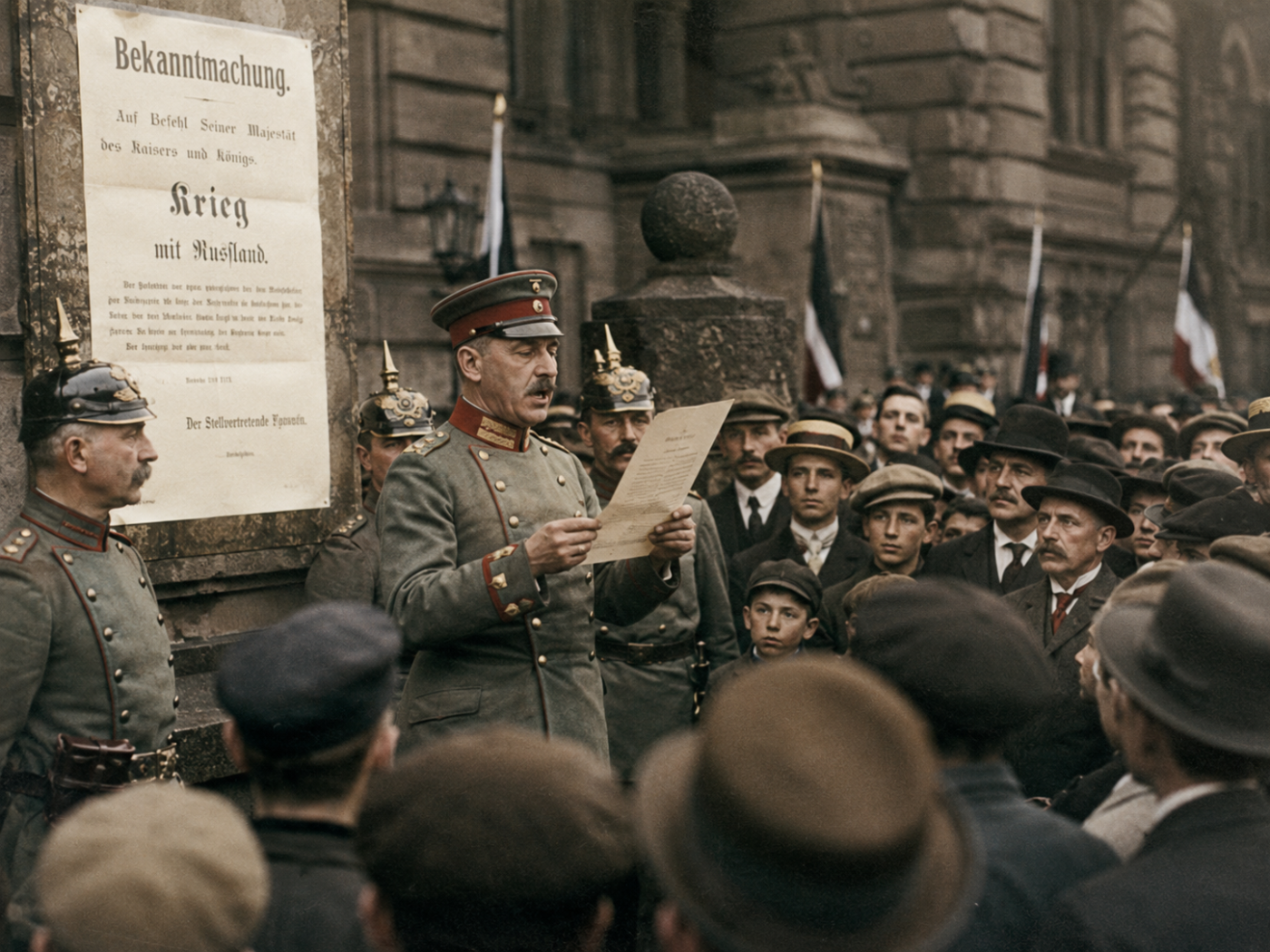
Hundreds of thousands of men received instructions to report to their units, while railway stations across the empire filled with soldiers and civilians saying hurried farewells. Crowds outside the Berlin Palace soon learned that mobilisation had been ordered, and the atmosphere was a mixture of excitement, patriotism, uncertainty and fear. Photographs taken during these days would later become some of the most famous images of the so-called August experience, showing crowds filling German streets as mobilisation notices appeared.
The formal declaration of war, however, still had to be delivered to Russia, and that responsibility fell again to Count Friedrich von Pourtalès in St Petersburg. At around 7 p.m. the German ambassador arrived at the Russian Foreign Ministry and met Sergei Sazonov. Pourtalès was deeply distressed by what he had been instructed to do, as the two diplomats had spent days attempting to navigate the worsening crisis and both understood that the document the ambassador carried could lead to the deaths of hundreds of thousands, perhaps millions, of men.
Before handing over the declaration, Pourtalès reportedly asked Sazonov several times whether Russia would halt its mobilisation, but Sazonov's answer remained that it could not. The ambassador then produced the German declaration, stating that Germany had attempted to achieve a peaceful settlement during the crisis but that Russia had proceeded with general mobilisation of its land and naval forces. The German government maintained that Russian mobilisation placed Germany in grave and immediate danger and that Berlin had therefore demanded the suspension of Russian military measures.
Because Russia had failed to comply, the declaration concluded that the German Emperor, acting in the name of the German Empire, considered Germany to be in a state of war with Russia. The meeting became intensely emotional, with contemporary accounts describing Pourtalès as visibly shaken. After handing over the declaration he is said to have moved towards a window, overcome with emotion and tears, and Russian archival accounts even describe the German ambassador embracing Sazonov before leaving.
It was an extraordinary human moment during one of the most consequential diplomatic meetings in modern history. The two men personally understood one another, yet they represented governments whose military and political decisions had now made war unavoidable. There was even a curious administrative detail surrounding the declaration itself, as Berlin had prepared alternative wording depending upon whether Russia formally rejected the German ultimatum or simply failed to give a satisfactory response.
Accounts of the meeting indicate that versions of both possible phrases appeared in the document handed to Sazonov, apparently because of haste or confusion while the declaration was being prepared. Such a small bureaucratic oddity stood in remarkable contrast to the enormous consequences of the paper. News that war had been declared spread rapidly through St Petersburg, where crowds gathered along Nevsky Prospekt and elsewhere in the Russian capital.
Patriotic demonstrations began and people gathered outside foreign embassies, and later that night tens of thousands reportedly assembled near the British Embassy, hoping that Britain would join Russia and France if the conflict widened. In Germany the declaration was presented as a defensive response to Russian mobilisation, with officials arguing that Russia had forced Germany's hand by creating a military situation in which delay might leave the country exposed to attack from both Russia and France.
The wider question of responsibility for the outbreak of the First World War would become one of the most fiercely debated subjects of twentieth-century history. What is certain is that by the evening of 1 August diplomatic manoeuvring was being overtaken by military timetables, and Germany and Russia were now officially at war. France, Russia's principal ally, was already mobilising, and Germany demanded to know whether France would remain neutral in a German-Russian conflict, but France avoided giving the assurance Germany wanted.
The consequences came almost immediately. On 2 August German troops occupied Luxembourg and Germany demanded permission to move its armies through neutral Belgium. On 3 August Germany declared war on France, and German forces entered Belgium on 4 August. Britain's government had repeatedly emphasised Belgian neutrality and, after Germany failed to comply with a British demand to respect it, Britain declared war on Germany that evening.
Within only three days of Germany's declaration against Russia, most of Europe's greatest powers were at war. The conflict that many politicians and generals had imagined might be short instead became a struggle lasting more than four years. Germany eventually mobilised millions of men, and Russia did the same on an even greater scale, with their armies fighting enormous campaigns across East Prussia, Poland, Lithuania, Galicia and the Russian Empire.
These included the battles of Tannenberg and the Masurian Lakes and later the immense campaigns of 1915 and 1916. Russia itself would eventually collapse under the military, economic and political pressures created by the war, with revolution overthrowing Tsar Nicholas II in 1917, followed later that year by the Bolshevik Revolution. The new Soviet government eventually signed the Treaty of Brest-Litovsk with Germany in March 1918, formally ending the war on the Eastern Front.
Germany's victory over Russia came too late to save the German Empire. Germany was defeated on the Western Front later in 1918, Kaiser Wilhelm II abdicated and went into exile, and the monarchies of Germany, Russia and Austria-Hungary all disappeared as a consequence of the conflict. The events of 1 August 1914 therefore represented far more than another diplomatic declaration.
That evening in St Petersburg, when an emotional German ambassador placed a declaration of war into the hands of the Russian Foreign Minister, two enormous empires began a struggle that would help destroy them both. Across Europe mobilisation orders were already sending millions of ordinary men towards railway stations and military barracks, most of whom could have had little understanding of the scale of what was beginning. The diplomatic crisis that had started with two gunshots in Sarajevo only five weeks earlier had now become a European war, and within days it would become the First World War.