On this day in military history…
On 1 July 1942, in the heat and dust of the Egyptian desert, the First Battle of El Alamein began. It was not the most famous of the El Alamein battles, because the later battle in October 1942 would become forever associated with General Bernard Montgomery and Winston Churchill’s famous words about “the end of the beginning”. Yet the battle that opened on 1 July was just as important in one vital sense: it stopped Erwin Rommel’s drive towards Alexandria, Cairo, and the Suez Canal at the very moment when the British Empire’s position in the Middle East looked dangerously close to collapse.
To understand why 1 July mattered so much, it is necessary to look at what had happened in the weeks before. In June 1942, the British Eighth Army had suffered a severe defeat in the Gazala battles in Libya. Rommel, commanding the German and Italian Panzer Army Africa, had outmanoeuvred his opponents and captured Tobruk on 21 June. Tobruk had been a symbol of resistance since its long siege in 1941, and its sudden fall was a tremendous shock. Around 30,000 Allied troops were taken prisoner, and large quantities of fuel, supplies, vehicles, and ammunition fell into Axis hands. Rommel was promoted to field marshal, and his reputation as the “Desert Fox” reached its height.
After Tobruk, the British and Commonwealth forces retreated eastwards across the desert. Their retreat was not simply a movement from one battlefield to another; it was a desperate race to prevent the Axis from breaking into Egypt. If Rommel could seize Alexandria, he would threaten the British Mediterranean fleet. If he could reach Cairo, the political and military consequences would be enormous. If he could take the Suez Canal, Britain’s communications with India, the Middle East, and the wider empire would be gravely endangered. For Britain, this was not a remote desert campaign. It was a struggle over one of the great strategic lifelines of the war.
The place chosen for the stand was El Alamein, a small railway halt on the Mediterranean coast about 60 miles west of Alexandria. Its importance lay not in the settlement itself, but in the geography around it. Unlike much of the Western Desert, where armies could often sweep around each other’s open flanks, El Alamein offered a rare defensive advantage. To the north was the sea. To the south lay the Qattara Depression, an enormous area of soft sand, salt marsh, and broken ground that was almost impossible for large armoured forces to cross. This meant that Rommel could not easily outflank the British position. The front was narrowed to a corridor of roughly 40 miles, giving the defenders a chance to block the road to the Nile Delta.
The British Eighth Army was commanded at this critical moment by General Claude Auchinleck, who had taken direct control after losing confidence in his field commanders during the retreat. Auchinleck was under immense pressure. His army was tired, battered, and in some places disorganised. Many units had been fighting and retreating for weeks. Equipment had been lost, formations had been broken up, and morale had been shaken by the fall of Tobruk. Yet Auchinleck understood the importance of El Alamein. If the Eighth Army could hold here, Rommel’s advance might finally be stopped.
Rommel, on the other hand, was also in a difficult position, though this was not immediately obvious from the speed of his advance. His army was victorious but exhausted. The men had driven hundreds of miles across desert roads and tracks. Vehicles were worn out. Tanks needed repair. Fuel was scarce. Supplies had to be brought forward over long distances from ports far behind the front, and Allied air attacks made the problem worse. Rommel hoped that one more hard blow would break the Eighth Army before it recovered. He believed speed and pressure could achieve what strength alone might not.
On the morning of 1 July 1942, Rommel launched his attack against the El Alamein position. His immediate aim was to smash through the British defences and continue eastwards before the Allies could properly reorganise. The fighting quickly centred on key defensive areas, especially around the El Alamein “box” near the coast and the ridges and depressions inland. In desert warfare, ridges were crucial. Even a low rise could allow artillery observers to see movement for miles. Control of such ground could decide whether guns, tanks, and infantry operated with confidence or under deadly observation.
Rommel expected the Eighth Army to be close to breaking, but he discovered that the defenders were more determined than he had hoped. British, Australian, New Zealand, South African, and Indian troops, along with other Allied units, held on under pressure. The desert battlefield was confusing and brutal. Dust clouds hid movements. Navigation was difficult. Minefields, anti-tank guns, artillery fire, and sudden armoured clashes turned the open desert into a deadly maze. Men fought in extreme heat by day and cold at night, often short of water, sleep, and certainty about where the enemy was.
One of the important features of the First Battle of El Alamein was that it was not a single neat clash, but a series of attacks, counterattacks, and local struggles spread across nearly four weeks. Rommel’s first attacks on 1 and 2 July failed to achieve a decisive breakthrough. Auchinleck then counterattacked, trying not merely to defend but to throw the Axis army off balance. The battle became a contest of endurance. Both sides were tired, both had suffered losses, and both were trying to impose their will before the other could recover.
The fighting around Ruweisat Ridge became especially significant. This long, low ridge lay inland from the coast and was tactically important because it offered observation and influence over the surrounding desert. New Zealand and Indian troops were heavily involved in the attempts to seize and hold parts of the ridge. Their attacks showed great courage, but they were often made under difficult conditions, with infantry advancing faster than supporting armour or anti-tank guns could consolidate the gains. In desert warfare, infantry who captured ground without enough anti-tank protection were dangerously exposed to counterattack by enemy tanks. This happened more than once at Ruweisat, leading to heavy losses and bitter frustration.
The Australians also played a major role, particularly in the northern sector. The 9th Australian Division, already famous for its defence of Tobruk in 1941, was brought into the El Alamein fighting and helped apply pressure near the coast. Australian attacks around Tel el Eisa and nearby positions disrupted Axis plans and forced Rommel to divert attention and resources. The battle was no longer simply Rommel attacking and the British defending. It had become a grinding struggle in which the Eighth Army repeatedly struck back, denying the Axis the freedom to regroup and renew the advance.
Air power was another crucial element. The Desert Air Force, made up of British and Allied squadrons, attacked Axis supply lines, vehicle columns, and forward positions. In the desert, where armies depended on long and vulnerable supply routes, air attacks could have an effect far beyond the immediate damage caused. Every destroyed truck, every delayed fuel convoy, and every bombed concentration of vehicles made Rommel’s situation harder. The Axis army had advanced so far and so fast that its logistics were stretched almost to breaking point.
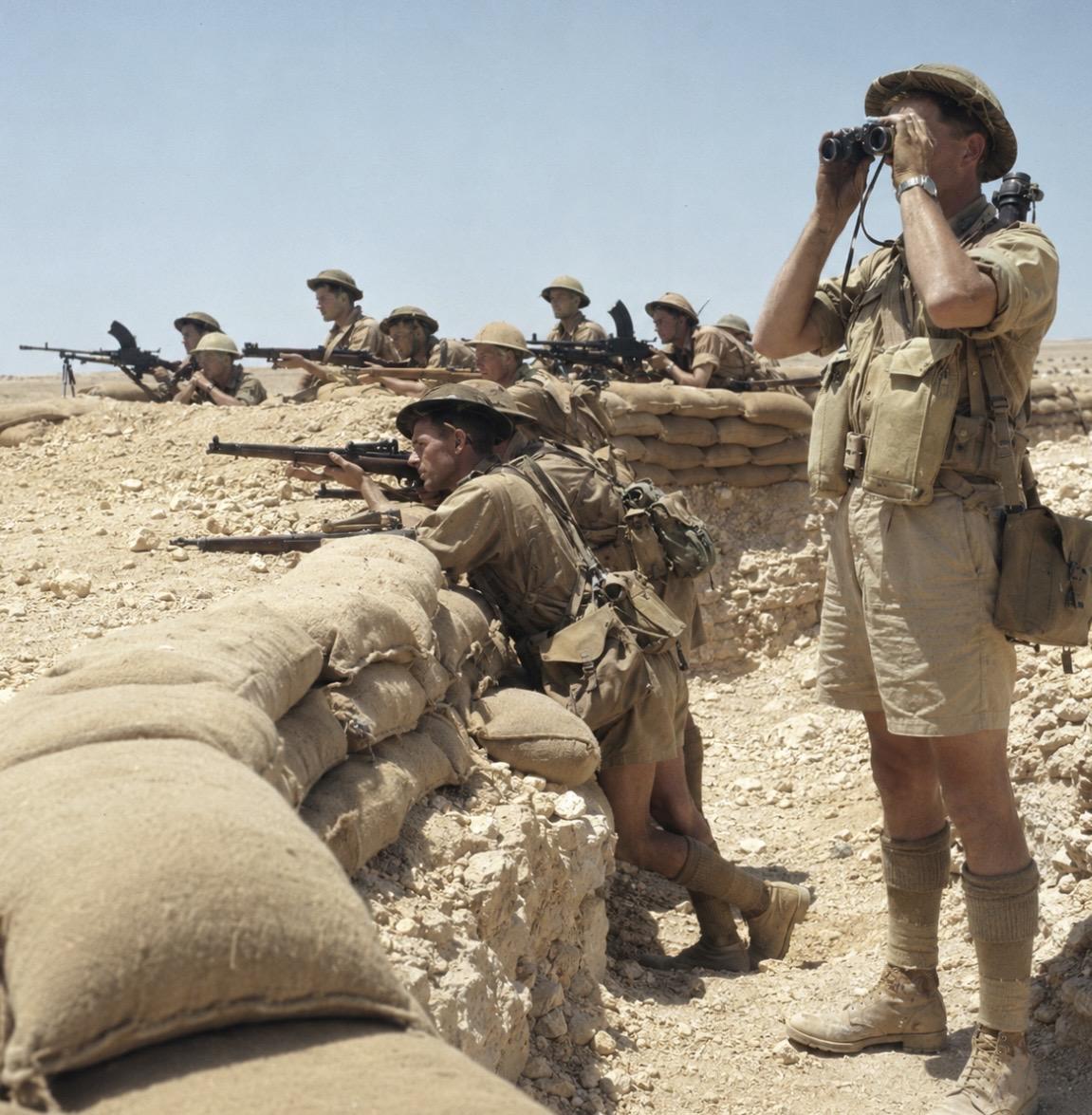
For the ordinary soldier, the battle was a harsh and bewildering experience. The desert offered little cover. Foxholes scraped into hard ground might be the only protection from shellfire. Sand got into weapons, engines, food, eyes, and wounds. Water was precious, and thirst was a constant companion. The enemy might be invisible one moment and suddenly appear through dust and mirage the next. At night, patrols moved through minefields and broken ground, listening for movement in the darkness. The battlefield was not only physically exhausting but mentally draining.
By late July, neither side had achieved a decisive victory in the dramatic sense. Rommel had not broken through to Alexandria or Cairo. Auchinleck had not destroyed Rommel’s army. The First Battle of El Alamein ended in stalemate around 27 July 1942. But this stalemate was strategically important. For the first time after the disasters of Gazala and Tobruk, the Axis advance had been stopped. Rommel had reached the furthest point of his drive into Egypt and could go no farther. The road to the Suez Canal remained closed.
The battle also bought the Allies time. Time was exactly what they needed. More men, tanks, guns, aircraft, and supplies could be brought into Egypt. The Eighth Army could be reorganised and strengthened. Command arrangements would change: Auchinleck would later be replaced, and Montgomery would take command of the Eighth Army before the Second Battle of El Alamein in October. But the later victory in October was made possible because the line had first been held in July.
The First Battle of El Alamein deserves to be remembered as the battle that stopped the Desert Fox at the gates of Egypt. It lacked the clean, triumphant ending of the later battle, but its importance was immense. On 1 July 1942, Rommel still seemed capable of changing the course of the war in the Middle East. By the end of the month, his momentum had been checked. The British and Commonwealth forces had absorbed the blow, stood firm, and prevented a strategic disaster.
In that sense, the first day of the battle marked a turning point before the famous turning point. The sands west of Alexandria became the place where retreat ended and resistance hardened. The men who fought there in July 1942 did not yet know that El Alamein would become one of the great names of the Second World War. They only knew that they had to hold. And by holding, they changed the course of the North African campaign.