On this day in military history…
On 29 June 1944, the German fortress city of Bobruisk fell to the Red Army. It was not merely the capture of another town on the Eastern Front. It was the moment when the southern wing of German Army Group Centre was torn apart and the full scale of the Soviet summer offensive, Operation Bagration, became impossible to hide. In less than a week, the German front in Belorussia had gone from apparently stable to catastrophic collapse. By the end of the day, thousands of German soldiers were dead, wounded, captured, or fleeing westward in broken groups, while Soviet mobile forces were already driving beyond the ruins toward Minsk.
Operation Bagration had begun on 22 June 1944, exactly three years after Hitler’s invasion of the Soviet Union. That date was chosen deliberately. The Red Army was no longer the shattered force of 1941. By the summer of 1944 it had become a vast, experienced, mechanised and artillery-heavy instrument of war. Its aim in Belorussia was not simply to push the Germans back, but to destroy Army Group Centre, the German formation that had once advanced toward Moscow and had since held the great Belorussian salient known as the “Belorussian balcony”.
The German high command expected the main Soviet summer blow to fall farther south, in Ukraine. This was a serious intelligence failure, but it was also the result of Soviet deception. The Red Army used maskirovka, or camouflage and deception, to conceal the build-up in Belorussia. Troops moved by night, radio silence was enforced, false concentrations were created elsewhere, and Soviet units rehearsed their attacks behind the lines. Even civilian populations were moved away from sensitive areas to reduce the risk of information leaking to the Germans. The deception worked. German reserves, especially armour, were drawn away from Army Group Centre, leaving it dangerously weakened when the real offensive began.
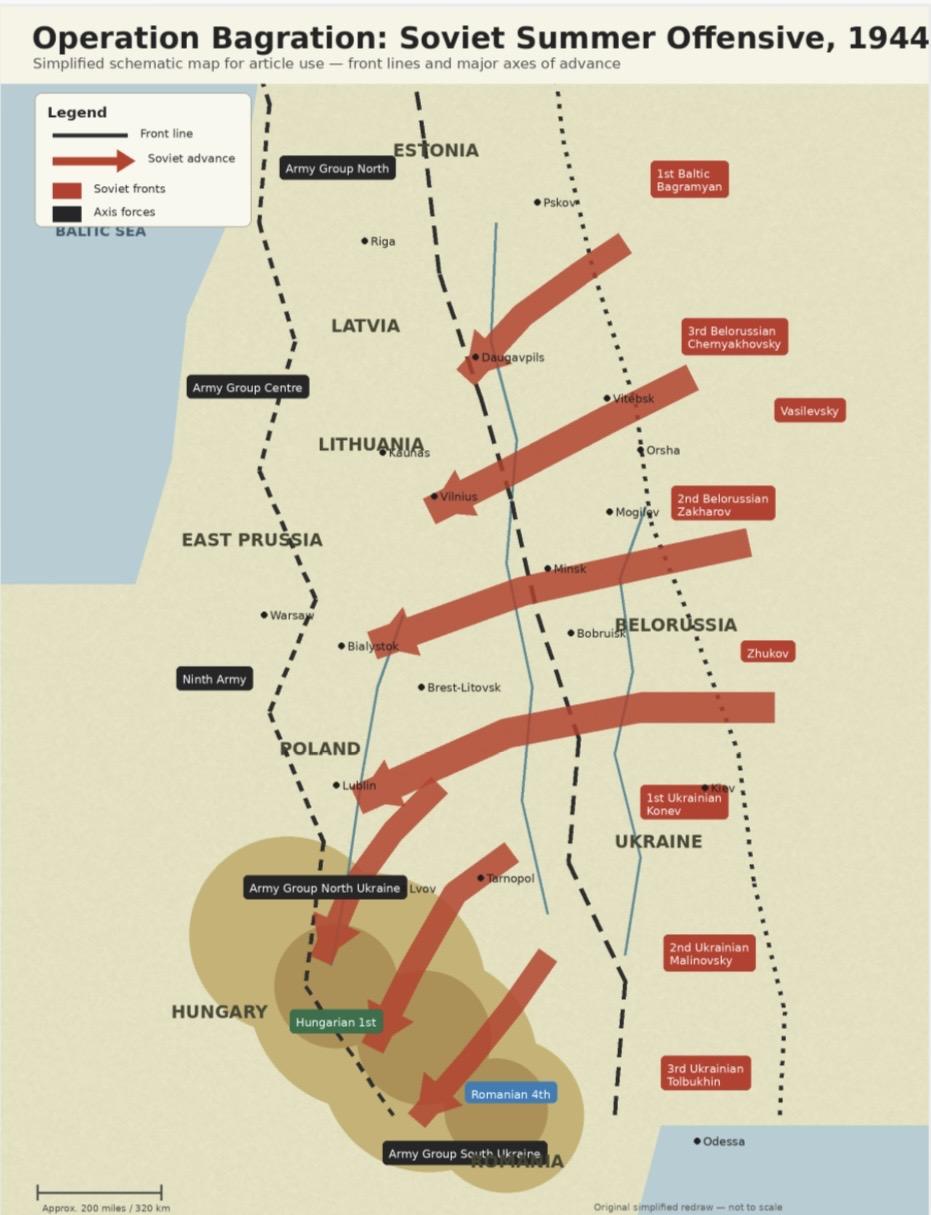
The Soviet attack was controlled at the highest level by Stavka, the Soviet supreme command. Joseph Stalin gave more freedom than usual to his senior commanders, and two of the Red Army’s most famous marshals helped coordinate the offensive. Marshal Aleksandr Vasilevsky supervised the northern part of the operation, while Marshal Georgy Zhukov coordinated the southern thrusts. The four main Soviet fronts involved were Ivan Bagramyan’s 1st Baltic Front, Ivan Chernyakhovsky’s 3rd Belorussian Front, Georgy Zakharov’s 2nd Belorussian Front, and Konstantin Rokossovsky’s 1st Belorussian Front. On 29 June, the decisive action at Bobruisk belonged above all to Rokossovsky.
Rokossovsky was one of the most remarkable Soviet commanders of the war. A former cavalryman, he had survived Stalin’s purges, imprisonment and torture, only to return to command and become one of the Red Army’s finest operational leaders. For the Bobruisk operation he insisted on a double attack rather than a single breakthrough. According to the well-known account, Stalin questioned him repeatedly, but Rokossovsky held his ground. His plan was to strike the German Ninth Army from more than one direction, rupture its defences, send mobile forces deep into the rear, and trap the Germans before they could withdraw across the Berezina River.
Facing Rokossovsky was the German Ninth Army, commanded by General Hans Jordan during the opening phase of the offensive. Ninth Army formed the southern part of Army Group Centre. Above it stood Field Marshal Ernst Busch, commander of Army Group Centre, a loyal officer who followed Hitler’s insistence on rigid defence. That rigidity was fatal. Some German commanders understood the danger and wanted permission to pull back to more flexible positions, but Hitler’s orders emphasised holding ground, fortified places and road centres. In theory, strongpoints such as Bobruisk were to delay the Soviets and anchor the front. In practice, they became traps.
The German defence had several strengths on paper. Army Group Centre still contained experienced infantry divisions, prepared defensive lines, minefields, anti-tank guns, artillery positions, and knowledge of the local terrain. Bobruisk itself was important because it guarded roads, rail links and crossings near the Berezina. German infantry could still fight hard from trenches, villages, woods and urban ruins. Units such as the 20th Panzer Division offered some armoured counterattack capability. German soldiers were also skilled at improvising defensive positions and using anti-tank weapons, machine guns, mortars and assault guns to slow Soviet attacks.
Yet the weaknesses were overwhelming. Army Group Centre was stretched across a huge front, understrength, short of reserves and badly depleted of armour. Soviet deception had persuaded the Germans that the decisive blow would come elsewhere, so many mobile reserves were positioned too far away. Hitler’s refusal to permit timely withdrawals meant that German formations had to hold forward positions even when their flanks were being torn open. The Luftwaffe could not contest the skies effectively, and Soviet partisans had already struck at railways, bridges and communications in the German rear, making movement and supply even harder.
The Soviet firepower brought against Ninth Army was immense. The Red Army opened its attacks with massed artillery and rocket bombardments. Guns such as the 76mm ZiS-3 divisional gun, 122mm M-30 howitzer and heavier 152mm pieces hammered German forward positions, command posts, batteries and routes of movement. Katyusha multiple rocket launchers added sudden, terrifying barrages over wide areas. Soviet artillery had become far more sophisticated since the early years of the war. It did not merely shell the front line; it struck German depth, communications and reserves, helping to paralyse the defence before the infantry and armour moved.
The Soviet infantry attacked in dense, carefully prepared formations, backed by engineers, sappers, anti-tank guns and self-propelled artillery. Mine-clearing teams opened paths through obstacles. Assault groups moved against bunkers, trenches and village strongpoints. Tanks were not simply thrown forward blindly. Where possible, the Soviets used infantry and artillery to crack the front and then pushed armour through the gaps. The T-34, by now often appearing in its improved 85mm-gunned version, remained the most famous Soviet tank of the campaign. It was joined by self-propelled guns such as the SU-76, SU-85, SU-122 and heavier assault guns used against strongpoints and armour.
Air power also mattered. The Soviet air forces had gained a level of control over the battlefield that would have seemed impossible in 1941. Ilyushin Il-2 Shturmovik ground-attack aircraft attacked German columns, vehicles, gun positions and troops caught on roads. Fighters protected Soviet spearheads, while bombers struck deeper targets. For German units trying to withdraw, regroup or counterattack, daylight movement became extremely dangerous. The combination of artillery, aircraft and mobile armour meant that once the German line cracked, retreat could quickly become slaughter.
At Bobruisk, Rokossovsky’s 1st Belorussian Front attacked with several major formations. General Alexander Gorbatov’s 3rd Army attacked from the north in the Rogachev direction. General Pavel Batov’s 65th Army attacked from the south, where the terrain around the Pripet Marshes was assumed by the Germans to be difficult for large-scale mechanised operations. General Alexander Luchinsky’s 28th Army and other formations helped widen the breach and protect the flanks. One of the most interesting formations was General Issa Pliev’s cavalry-mechanised group, combining horse cavalry with mechanised forces. This was not a romantic throwback, but a practical Soviet solution for broken, wooded and marshy terrain where horsemen and armour together could move faster than ordinary infantry.
The Germans did not collapse immediately. In the northern sector, Soviet attacks met heavy resistance and suffered losses. German infantry and artillery still fought stubbornly from prepared positions. But the southern breakthrough developed with frightening speed. Soviet engineers and forward troops forced routes through terrain the Germans had not expected to carry a major armoured thrust. Once the Soviet mobile group was through, it moved into the German rear, threatening roads, crossings and escape routes. The German front was no longer a line; it was a series of fragments being bypassed, surrounded and cut off.
General Jordan tried to use the 20th Panzer Division to counterattack, but the situation changed too quickly. German armour was too scarce, and orders shifted as new Soviet breakthroughs appeared. A panzer division that might have been useful as part of a planned mobile defence was instead thrown into crisis response. It could not be everywhere at once. German command and control began to fail as communications were cut, headquarters displaced, roads jammed, and Soviet air attacks struck moving columns. The very idea of a rigid defence became meaningless once Soviet spearheads were behind the German infantry divisions.
By 27 June, the Bobruisk pocket had been closed. German corps east of the Berezina were trapped. Bobruisk was declared a strongpoint, but it no longer served a useful defensive purpose. The Soviets could attack it, bypass it, or isolate it while continuing westward. Inside and around the pocket, German troops faced a desperate choice: hold and be destroyed, or break out through Soviet fire, air attack, artillery and partisan-infested rear areas. The breakout attempts were chaotic. Vehicles ran out of fuel, roads became blocked, wounded men were abandoned, and units lost cohesion. Some groups fought their way west, but many were killed or captured.
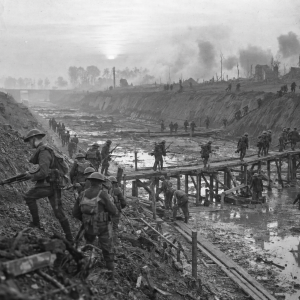
The fighting around Bobruisk was brutal even by Eastern Front standards. German columns trying to escape were caught on roads and in wooded areas. Soviet artillery and aircraft smashed vehicles, guns and horse-drawn transport. The Red Army found the battlefield littered with abandoned equipment, wrecked guns, burnt-out vehicles and dead horses. Soviet accounts described roads and fields covered with German bodies. While such descriptions carried a tone of revenge after three years of Nazi occupation, they reflected the scale of destruction in the pocket. The German Ninth Army had not merely been pushed back; large parts of it had been annihilated.
On 29 June, Bobruisk fell. The city had already suffered terribly under German occupation and during the battle. Its capture marked the destruction of the southern shield of Army Group Centre. The Soviet victory opened the route toward Minsk from the south, while other Soviet fronts were already advancing from the north and east. Army Group Centre was now being dismembered. Its Third Panzer Army had been struck in the north around Vitebsk, Fourth Army was being driven back toward Minsk and the Berezina, and Ninth Army had been shattered at Bobruisk. What had been one of the Wehrmacht’s great army groups was becoming a collection of pockets, fugitives and emergency blocking forces.
The German failure was not caused by one mistake alone. It came from the collision of several disasters. German intelligence misread Soviet intentions. Soviet deception drew attention away from Belorussia. Army Group Centre had been stripped of armour and reserves. Hitler’s orders prevented timely withdrawal. The fortified-place concept trapped troops in positions the Soviets could bypass or encircle. German logistics were disrupted by partisans and air attack. The Red Army had learned how to coordinate artillery, infantry, armour, engineers, cavalry-mechanised groups and aircraft in a single deep operation. By the time German commanders understood the scale of the danger, the battle had moved beyond their ability to control it.
The replacement of Ernst Busch by Walter Model on 28 June showed how serious the crisis had become. Model was known as Hitler’s “fireman”, a commander sent to rescue collapsing fronts. But even he could not restore Army Group Centre. There were too few reserves, too little time and too much Soviet momentum. The Germans tried to hold lines along rivers and road centres, but Soviet spearheads repeatedly outflanked them. Minsk would fall on 3 July, trapping much of German Fourth Army east of the city. In the weeks that followed, Army Group Centre effectively ceased to exist as a coherent fighting force.
The scale of Operation Bagration was enormous. The Soviets assembled vast numbers of rifle divisions, tanks, self-propelled guns, artillery pieces, Katyusha rocket launchers and aircraft. They concentrated their strength at selected breakthrough sectors so that local superiority became overwhelming. The Germans, by contrast, were forced to defend everywhere and could not mass enough strength at the decisive points. This was the essence of Soviet deep battle: break the front in several places, push mobile groups through the gaps, attack the enemy rear, encircle whole formations, and prevent the defender from restoring a continuous line.
The events of 29 June 1944 therefore deserve more attention than they often receive. In the West, the summer of 1944 is usually remembered through Normandy, the bocage and the liberation of Paris. But in the east, on a far larger front, the Red Army was inflicting one of the greatest defeats in German military history. Bobruisk was one of the decisive blows. It showed that the Wehrmacht could no longer rely on discipline, local counterattacks and Hitler’s orders to hold ground. Against a Soviet army that had mastered deception, mass firepower and operational manoeuvre, rigid defence became a death sentence.
For Army Group Centre, 29 June was the day the catastrophe could no longer be disguised. The fall of Bobruisk destroyed the southern escape routes, opened the road to Minsk and confirmed that the Soviet offensive was not a limited attack but a campaign of annihilation. The Germans had defended with courage in many places, but courage could not compensate for strategic blindness, lack of reserves, broken communications and impossible orders. The Red Army had chosen the place, prepared the blow, deceived the enemy, concentrated overwhelming force and struck with a speed and violence that the German command could not match. By the time Bobruisk fell, Army Group Centre was already dying.