On this day in military history…
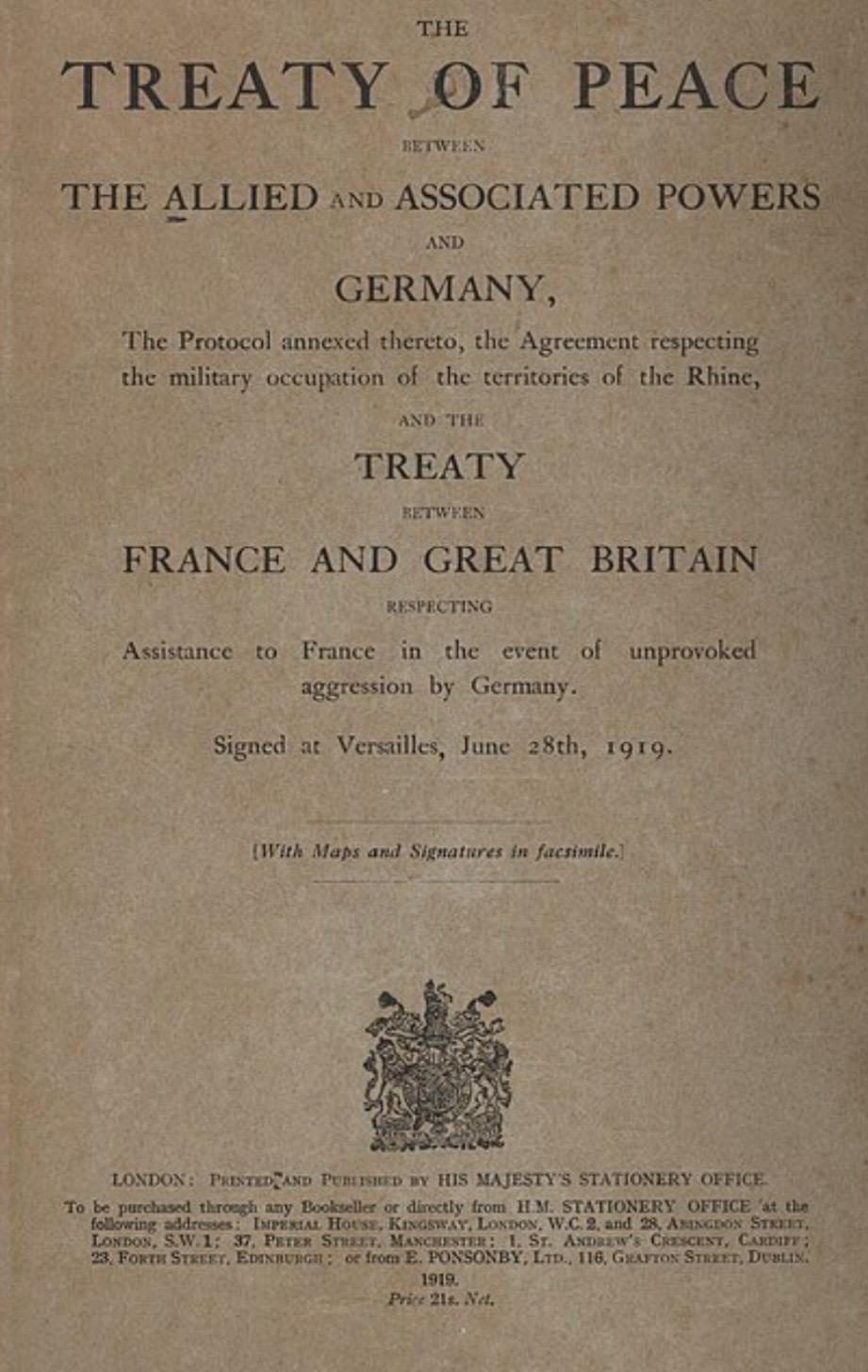
On 28 June 1919, exactly five years after the assassination of Archduke Franz Ferdinand in Sarajevo, the Treaty of Versailles was signed in France. That assassination in 1914 had helped trigger the chain of events that led to the First World War, so the date chosen for the signing was deeply symbolic. The treaty was meant to bring a formal end to the war between Germany and the Allied Powers, although the fighting itself had already stopped with the Armistice of 11 November 1918.
The signing took place in the Hall of Mirrors at the Palace of Versailles, just outside Paris. This was one of the most famous and grand rooms in Europe, lined with mirrors, chandeliers, painted ceilings, and windows looking out over the palace gardens. Its beauty made it a dramatic setting for such an important moment, but the choice of location also carried a much deeper meaning. In 1871, after France was defeated in the Franco-Prussian War, the German Empire had been proclaimed in that very same Hall of Mirrors. For the French, making Germany sign the peace treaty there in 1919 was a powerful act of symbolism. It turned the room from a place of French humiliation into a place of German defeat. The setting reminded everyone present that the treaty was not only about ending a war but also about power, revenge, memory, and national pride.
The most important leaders involved in shaping the treaty were known as the “Big Four.” They were Georges Clemenceau, the Prime Minister of France; David Lloyd George, the Prime Minister of Britain; Woodrow Wilson, the President of the United States; and Vittorio Orlando, the Prime Minister of Italy. These men had different aims. Clemenceau wanted Germany weakened so that France would never again face such a terrible invasion. Lloyd George wanted Germany punished, but not destroyed, because Britain still saw Germany as important for European trade. Wilson wanted a new world order based on his Fourteen Points, including self-determination and a League of Nations to prevent future wars. Orlando wanted territorial gains for Italy, though he was disappointed by what Italy received.
Germany did not take part in the main negotiations. German representatives were presented with the terms and told to sign. The two men who signed for Germany were Hermann Müller, the Foreign Minister, and Johannes Bell, the Minister of Transport. Many Germans later called the treaty a “diktat,” meaning a dictated peace, because they felt they had been forced to accept it without fair negotiation.
The treaty placed heavy responsibility on Germany. One of its most famous and controversial parts was Article 231, often called the “War Guilt Clause.” This article stated that Germany and its allies accepted responsibility for causing the loss and damage of the war. This clause became deeply hated in Germany, not only because of the humiliation it caused but also because it was used as the basis for demanding reparations.
Germany was ordered to pay huge reparations, though the exact total was fixed later. The figure eventually set was 132 billion gold marks, an enormous sum. Germany also lost territory. Alsace-Lorraine was returned to France, the Saar was placed under League of Nations control, and parts of eastern Germany were given to the newly recreated Poland, creating what became known as the Polish Corridor. Germany also lost all of its overseas colonies, which were handed over to the victorious powers as mandates.
The treaty also severely limited Germany’s military strength. The German army was reduced to 100,000 men. Germany was forbidden to have tanks, military aircraft, submarines, or a large navy. The Rhineland, an important region near the French border, was demilitarised, meaning German troops were not allowed there. These measures were intended to stop Germany from becoming a military threat again.
One of the most important results of the Treaty of Versailles was the creation of the League of Nations. This was strongly supported by Woodrow Wilson, who believed that nations should work together to settle disputes peacefully rather than go to war. Ironically, although Wilson helped create the League, the United States never joined it because the American Senate refused to approve membership.
There were many interesting and unusual details surrounding the signing. The ceremony was carefully staged and full of symbolism. The German delegates were brought into the Hall of Mirrors under the gaze of Allied leaders and military officials. The mood was not one of friendship or reconciliation. It was formal, tense, and cold. The Germans signed under protest, believing the terms were too harsh and unjust.
Another striking fact is that the treaty did not truly end all parts of the First World War at once. It ended the state of war between Germany and the Allied Powers, but separate treaties were later signed with Germany’s allies, including Austria, Hungary, Bulgaria, and the Ottoman Empire. The Treaty of Versailles was the most famous because Germany had been the strongest of the defeated powers.
The treaty also reshaped the map of Europe. New or restored countries appeared, including Poland, Czechoslovakia, and Yugoslavia. Empires that had dominated Europe for centuries collapsed or were broken apart, including the German, Austro-Hungarian, Ottoman, and Russian Empires. The treaty was therefore not just a peace agreement; it was part of a huge rearrangement of political power.
At the time, many people hoped the Treaty of Versailles would secure lasting peace. The First World War had caused destruction on a scale the world had never seen before. Millions had died, towns and villages had been destroyed, and whole societies had been traumatised. Yet the treaty left behind bitterness, resentment, and unresolved problems. In Germany, many people felt humiliated and betrayed. This anger was later exploited by Adolf Hitler and the Nazi Party, who promised to overturn the treaty.
The Treaty of Versailles remains one of the most debated agreements in modern history. Some historians argue that it was too harsh and helped create the conditions for the Second World War. Others argue that it was not harsh enough to permanently weaken Germany and that later failures of enforcement were more important. What is clear is that the treaty was both an ending and a beginning: it formally ended Germany’s role in the First World War, but it also planted tensions that would shape Europe for decades.
The signing on 28 June 1919 was therefore one of the most important moments of the twentieth century. In the glittering Hall of Mirrors, surrounded by the grandeur of Versailles, world leaders tried to settle the most devastating war humanity had yet experienced. The location itself gave the event added force, because Versailles stood for royal power, French history, European diplomacy, and the old rivalries that had shaped the continent. They hoped they were building a new peace, but the treaty they produced became a symbol of victory, punishment, resentment, and unfinished business.