On this day in military history…
The Korean War began in the early hours of Sunday, 25 June 1950, when the army of North Korea crossed the 38th parallel and invaded South Korea. The attack was sudden, large, and carefully prepared. It turned a divided country into one of the first major armed conflicts of the Cold War and brought the United States, China, the Soviet Union, and the United Nations into a dangerous confrontation.
To understand why the war began, it is necessary to go back to the end of the Second World War in 1945. Korea had been ruled by Japan since 1910, and when Japan was defeated, Koreans hoped their country would become independent again. Instead, Korea was divided temporarily by the victorious Allied powers. Soviet troops accepted the Japanese surrender in the north, while American troops accepted the surrender in the south. The dividing line chosen was the 38th parallel, a line of latitude that cut across the Korean peninsula. At first, this division was meant to be temporary, but as relations between the Soviet Union and the United States worsened, the line hardened into a political border.
In the north, the Soviet Union supported a communist government led by Kim Il-sung, a former guerrilla fighter who had fought against the Japanese and had spent time in the Soviet Union. In the south, the United States supported an anti-communist government led by Syngman Rhee, a nationalist who had spent many years in exile and was strongly opposed to communism. Both men claimed to be the rightful leader of all Korea. Neither accepted the permanent division of the country.
By 1948, two separate Korean states had been created. In August, the Republic of Korea was established in the south, with its capital at Seoul. In September, the Democratic People’s Republic of Korea was established in the north, with its capital at Pyongyang. The names suggested legitimacy and national unity, but in reality Korea had become two rival states, each backed by a major Cold War power.
Tension along the 38th parallel grew quickly. Border clashes, raids, and skirmishes became common before the full-scale war began. Both North and South Korea spoke openly about reunifying the peninsula, and both governments used harsh propaganda against the other. Syngman Rhee often talked about marching north, while Kim Il-sung was determined to bring the south under communist control. The difference was that North Korea had built a much stronger army.
North Korea’s forces were better equipped, better trained, and more heavily armed than those of South Korea. With Soviet assistance, the North Korean People’s Army received tanks, artillery, aircraft, and military training. One of its most important advantages was the Soviet-built T-34 tank, a powerful weapon that South Korean forces were poorly prepared to stop. South Korea, by contrast, had a weaker army and very limited heavy equipment. The United States had not provided it with tanks, heavy artillery, or combat aircraft in significant numbers, partly because Washington feared that Syngman Rhee might use such weapons to start a war himself.
Kim Il-sung wanted permission from Joseph Stalin, the Soviet leader, before launching an invasion. Stalin was cautious at first. He did not want a direct war with the United States, especially so soon after the Second World War. But by 1950, several developments made the situation seem more favourable to the communist side. The Soviet Union had successfully tested its first atomic bomb in 1949. Communist forces under Mao Zedong had won the Chinese Civil War, creating the People’s Republic of China. The United States had withdrawn most of its troops from South Korea. In January 1950, U.S. Secretary of State Dean Acheson gave a speech describing America’s defence perimeter in the Pacific, and South Korea was not clearly included in it. Kim Il-sung and Stalin may have interpreted this as a sign that the United States might not fight for South Korea.
Stalin eventually gave Kim Il-sung approval, but with conditions. The Soviet Union would supply weapons, advisers, and planning assistance, but it would not openly send Soviet soldiers to fight the war. Stalin also wanted Mao’s support, partly because China shared a border with Korea and would be directly affected by events there. Mao gave his approval, though China was still recovering from years of civil war.
The North Korean invasion plan was designed to be fast and decisive. The aim was to smash through South Korean defences, capture Seoul quickly, and destroy the South Korean government before outside powers could respond. North Korean leaders believed that many people in the south might rise up in support of them once the attack began. They also hoped that the United States would hesitate or decide that Korea was not worth a major war.
At around 4 a.m. on 25 June 1950, North Korean artillery opened fire along the 38th parallel. Soon after, North Korean troops crossed the border at several points. The invasion was not a small raid or a border incident. It was a full-scale attack by around 75,000 North Korean soldiers, supported by tanks and artillery. The main thrusts were aimed toward Seoul, the South Korean capital, which lay dangerously close to the border.
South Korea was caught badly off guard. Many South Korean soldiers were on leave, and the army was not fully prepared for a major assault. North Korean tanks pushed through defensive lines, while South Korean units often lacked the weapons needed to stop them. Communications were confused, and panic spread as the scale of the attack became clear. The South Korean army fought hard in places, but it was quickly overwhelmed.
Seoul fell on 28 June 1950, only three days after the invasion began. The capture of the capital was a severe blow to South Korea. During the retreat, South Korean forces blew up the Han River bridges in an attempt to slow the North Korean advance. Tragically, many civilians and some South Korean soldiers were still trying to cross when the bridges were destroyed. The fall of Seoul created chaos, but the South Korean government survived and continued to resist from farther south.
The international response came quickly. Because the Soviet Union was boycotting the United Nations Security Council at the time over the issue of China’s representation, it was not present to veto action. This absence proved extremely important. On 25 June, the United Nations Security Council condemned the North Korean invasion and called for North Korea to withdraw. Two days later, it recommended that member states assist South Korea. The United States, under President Harry S. Truman, decided to intervene.
Truman saw the invasion as more than a local war. To him and many of his advisers, it looked like a test of the free world’s willingness to resist communist expansion. The memory of the 1930s, when aggression by dictators had not been stopped early, shaped American thinking. Truman feared that if North Korea were allowed to conquer South Korea, communist movements elsewhere might be encouraged, and American allies might lose faith in U.S. protection.
American air and naval forces were first ordered into action, followed by ground troops. The United States fought under the banner of the United Nations, though American forces made up the largest part of the UN command. Other countries also contributed troops, ships, aircraft, medical units, and supplies, including Britain, Canada, Australia, Turkey, France, the Netherlands, New Zealand, South Africa, Greece, Belgium, Thailand, the Philippines, Colombia, and others.
In the first weeks, the situation for South Korea and the UN forces was desperate. North Korean troops drove rapidly southward, capturing territory and pushing their enemies into a shrinking defensive area around the port city of Busan, in the southeast corner of the peninsula. This became known as the Pusan Perimeter, using the older spelling of Busan. By late summer 1950, it seemed possible that South Korea might be completely overrun.
Yet the North Korean advance began to slow. Its supply lines stretched farther and farther south, while UN forces poured men, equipment, and supplies into Busan. South Korean and UN troops held the perimeter through bitter fighting. Then, in September 1950, General Douglas MacArthur launched a daring amphibious landing at Incheon, far behind North Korean lines. The landing was risky because of Incheon’s tides and narrow approaches, but it succeeded brilliantly. Seoul was recaptured, and North Korean forces in the south were thrown into retreat.
The war then changed direction. Instead of merely restoring the border at the 38th parallel, UN forces advanced into North Korea with the aim of destroying Kim Il-sung’s regime and reunifying Korea under the South. They moved rapidly northward, capturing Pyongyang and approaching the Yalu River, the border with China. This alarmed Mao Zedong, who feared hostile forces on China’s frontier. In October and November 1950, Chinese forces entered the war in large numbers, calling themselves the Chinese People’s Volunteers.
China’s intervention transformed the conflict. UN forces were driven back south in brutal winter fighting. Seoul changed hands again. What had begun as North Korea’s invasion of South Korea became a much larger and more dangerous war involving the world’s major communist powers and the United States-led UN coalition. For a time, there were fears that the Korean War might expand into a third world war.
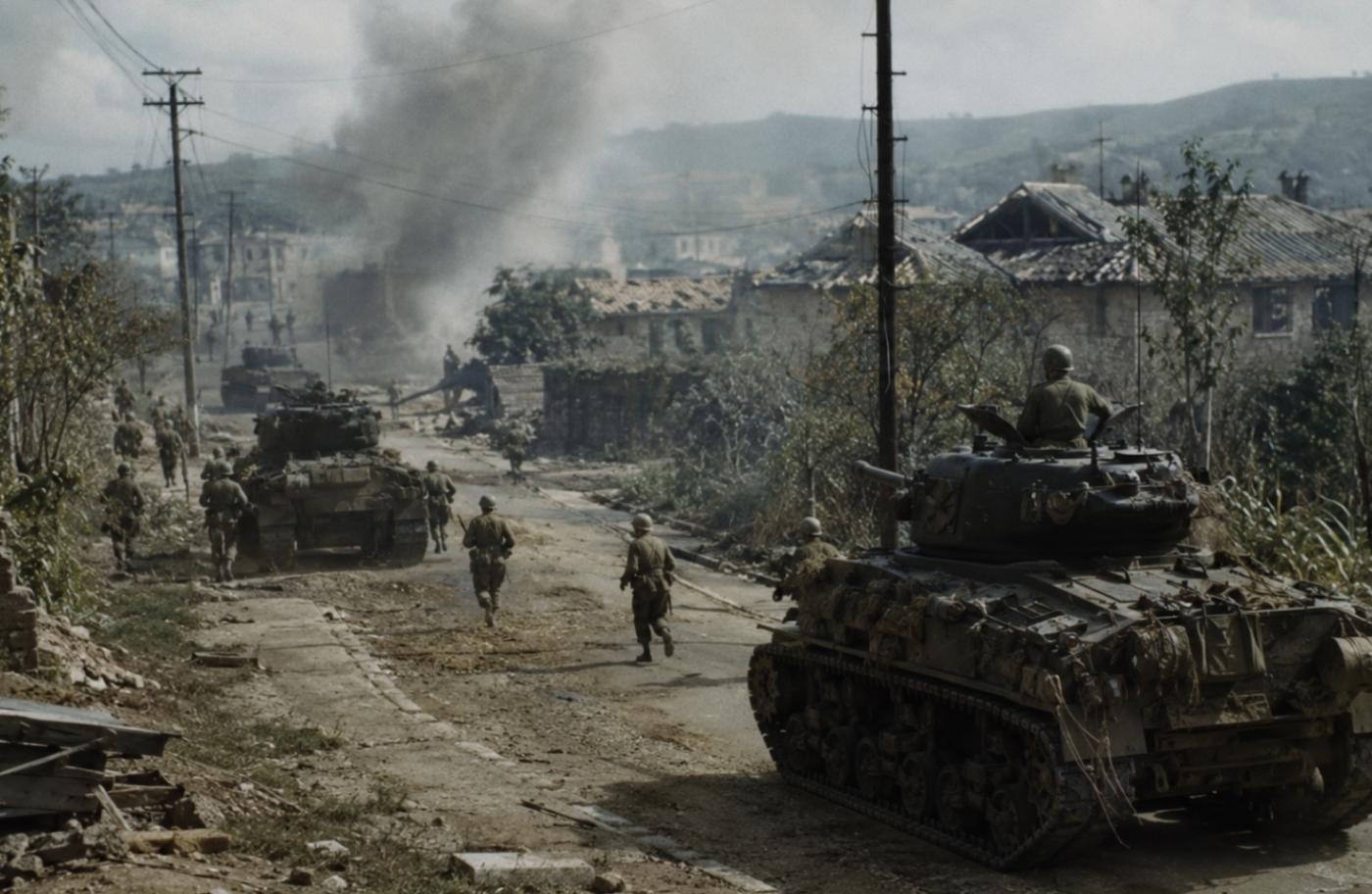
By 1951, the front stabilised near the 38th parallel. The war became a grinding conflict of trenches, artillery, patrols, hill battles, air raids, and political negotiations. Famous battles such as Heartbreak Ridge, Bloody Ridge, the Hook, Pork Chop Hill, and Old Baldy showed how costly the fighting became, even when only small areas of ground were at stake. Peace talks began in 1951 but dragged on for two years, largely because of disagreements over prisoners of war.
The fighting finally ended with an armistice signed on 27 July 1953. It was not a peace treaty. Technically, the war did not formally end; instead, the armistice stopped the fighting and created the Demilitarized Zone, or DMZ, which still divides North and South Korea today. The border after the war was close to where it had been before the invasion, meaning that three years of terrible destruction had ended with Korea still divided.
The human cost was immense. Millions of Korean civilians were killed, wounded, or displaced. Cities, villages, bridges, railways, and farms were devastated. Military casualties were also heavy on all sides. The war left deep scars in both North and South Korea and shaped the politics of East Asia for generations.
The Korean War started because Korea’s temporary division after the Second World War became trapped inside the larger Cold War struggle between communism and anti-communism. Both Korean governments wanted reunification, but Kim Il-sung, backed by Stalin and later supported by Mao, chose to attempt it by force. The invasion on 25 June 1950 was intended to be quick and decisive, but instead it opened the door to a long and brutal international war.
One of the most interesting things about the start of the Korean War is how many miscalculations were involved. Kim Il-sung believed South Korea could collapse quickly. Stalin believed the United States might not intervene. The United States had underestimated the danger of leaving South Korea weakly armed. China warned against UN forces approaching its border, but those warnings were not taken seriously enough. Each side made assumptions that helped turn a local invasion into a major Cold War battlefield.
The Korean War is sometimes called “the forgotten war,” especially in the West, because it came between the Second World War and the Vietnam War. But it should not be forgotten. It was the first major hot war of the Cold War, the first large military action fought under the United Nations flag, and the conflict that fixed the division of Korea into the tense and heavily guarded border that still exists today. Its beginning on 25 June 1950 remains one of the most important military events of the twentieth century.