On this day in military history…
The Soviet blockade of Berlin began on 24 June 1948 and became one of the first great confrontations of the Cold War. Although no major battle was fought in the streets, it was a military and political crisis of enormous importance. For almost a year, the Soviet Union tried to force the United States, Britain and France out of West Berlin by cutting off land and water access to the city. The crisis ended only on 12 May 1949, after the Western Allies had supplied the city by air in one of the most remarkable logistical operations in modern military history.
To understand why the Soviets began the blockade, it is important to understand the strange position of Berlin after the Second World War. Germany had been defeated in 1945 and divided into occupation zones controlled by the United States, Britain, France and the Soviet Union. Berlin, the former Nazi capital, was also divided into four sectors, even though the city itself lay deep inside the Soviet occupation zone. This meant that the American, British and French sectors of Berlin were an island of Western influence surrounded by Soviet-controlled territory.
At first, the four occupying powers were supposed to govern Germany together. In practice, their aims quickly moved in opposite directions. The Soviet Union had suffered terribly during the war and wanted security, reparations and control over Eastern Europe. Stalin did not want a revived, powerful Germany on the Soviet border. The Western Allies, especially the United States and Britain, gradually concluded that Germany had to be economically rebuilt if Europe was to recover. They feared that poverty, hunger and chaos would create instability and make communism more attractive.
This disagreement over Germany’s future was the deepest cause of the Berlin Blockade. The Western Allies wanted to revive the German economy and eventually create a stable democratic West Germany. The Soviets saw this as a threat. To Stalin, a rebuilt western Germany, tied economically and politically to the United States, looked like the beginning of an anti-Soviet bloc in Europe. Berlin, sitting inside the Soviet zone, became the obvious pressure point.
Tensions increased in 1947 when the American and British occupation zones were merged economically into what became known as Bizonia. France later moved closer to the same arrangement. To the Soviets, this looked like the Western powers were abandoning the idea of governing Germany jointly and were instead preparing to create a separate West German state. The Marshall Plan, announced by the United States to help rebuild Europe, deepened Soviet suspicion. Stalin believed American economic aid was also a political weapon designed to pull European countries into the Western camp.
Berlin was especially sensitive because it was both symbolic and practical. Symbolically, it was the former capital of Hitler’s Germany. Whoever held influence in Berlin could claim a share in the future of Germany. Practically, West Berlin was a Western outpost behind Soviet lines. Its existence was embarrassing to Stalin because it showed Berliners in the Soviet sector a visible alternative: Western supplies, Western political parties, Western newspapers and Western military protection.
The immediate trigger for the blockade was currency reform. By 1948, Germany’s old Reichsmark had become almost worthless. The black market flourished, rationing was common, and normal trade was difficult. The Western Allies believed that economic recovery required a stable new currency. On 20 June 1948, they introduced the Deutsche Mark in the western occupation zones. Soon afterwards, they also introduced it into West Berlin.
The Soviets reacted furiously. They argued that introducing a separate Western currency into Berlin threatened the economy of the Soviet zone. They feared that the new Western money would undermine their control, damage the eastern currency system, and accelerate the division of Germany. On 23 June 1948, the Soviets introduced their own currency for the Soviet zone and claimed it should apply to all of Berlin. The next day, 24 June 1948, they cut road, rail and canal links between West Germany and West Berlin.
The Soviet explanation was that technical and administrative difficulties had forced the restrictions. In reality, the blockade was a calculated act of pressure. Stalin hoped to make West Berlin impossible to hold. The city depended on outside supplies for food, coal, fuel and raw materials. If the Western Allies could not feed and heat the population, they might have to abandon the city or accept Soviet terms. The Soviets believed that geography was on their side: West Berlin was more than 100 miles inside the Soviet zone, and every land route into the city passed through Soviet-controlled territory.
The blockade was not simply about roads and railways. The Soviets also cut electricity supplies from the eastern sector to the western sectors of Berlin. This placed West Berlin under severe strain. Around two million people in the Western sectors faced shortages of food, fuel and power. The Soviet aim was to make daily life so difficult that Berliners would turn against the Western Allies or that the Western powers would decide the city was not worth the risk.
Stalin’s strategy was dangerous but carefully judged. He did not directly attack American, British or French troops, because that could have caused a war. Instead, he used blockade as a weapon just short of open combat. The Western Allies faced a serious dilemma. If they tried to force their way through by road or rail, it might lead to shooting. If they withdrew, it would be a huge victory for Stalin and a devastating blow to Western credibility in Europe.
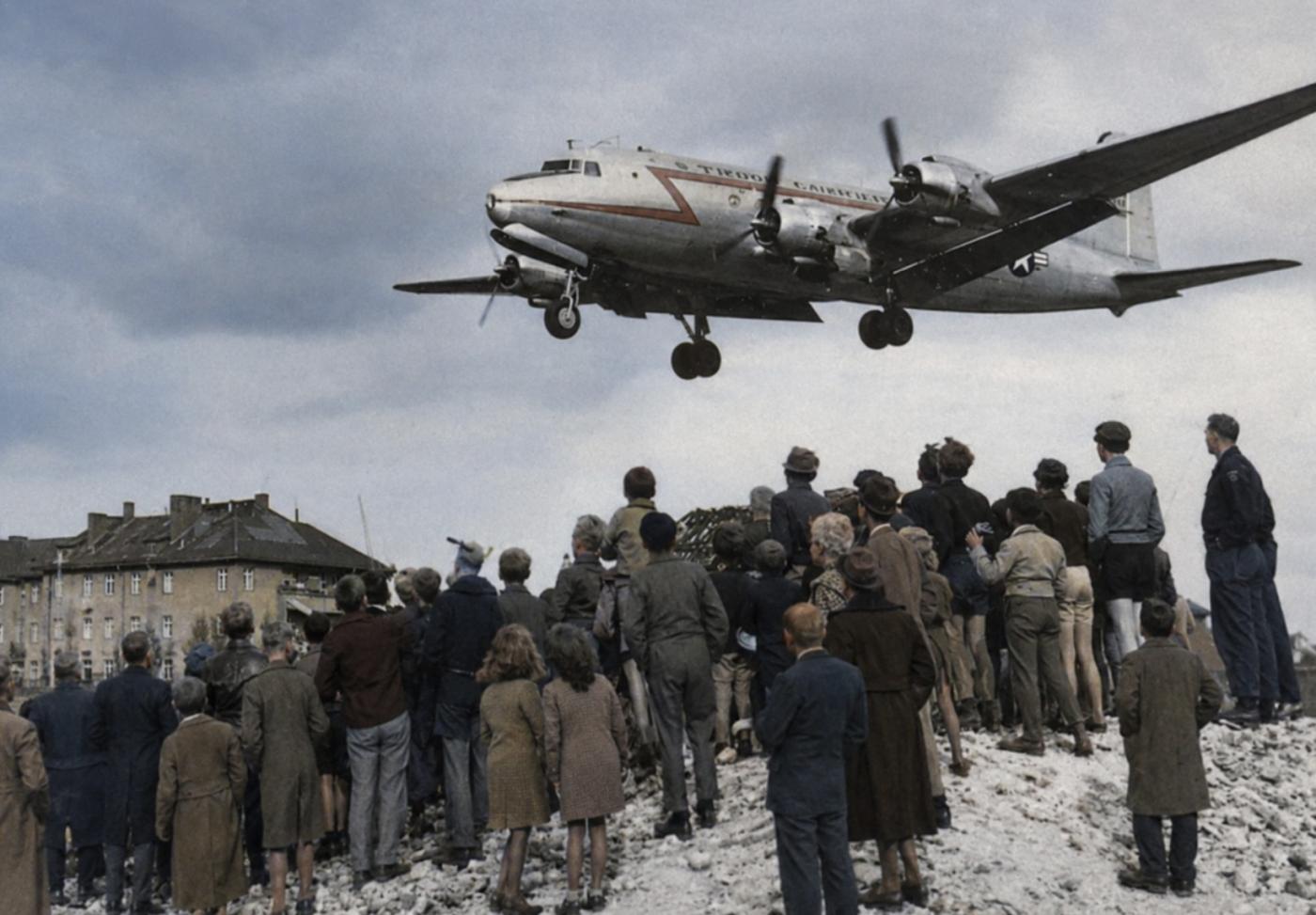
The Western response was the Berlin Airlift. Instead of abandoning the city or fighting their way in, the United States and Britain began flying supplies into West Berlin. The American operation was known as Operation Vittles, while the British called their effort Operation Plainfare. Aircraft brought in food, coal, medicine and other essentials. At first, many doubted whether an entire city could be supplied by air, but the operation grew into a huge success. Planes landed at short intervals, day and night, in all weather.
One of the most interesting features of the crisis is that the air corridors into Berlin had been agreed after the war. The Soviets could block roads, railways and canals, but interfering with aircraft in the agreed corridors would have risked direct military confrontation. The Western Allies used this legal and practical opening brilliantly. The airlift turned Soviet pressure into a propaganda defeat. Instead of making the West look weak, it made the United States, Britain and France appear determined, organised and humanitarian.
The people of West Berlin also played a major role. Their refusal to give in made the blockade harder for Stalin to win. West Berliners endured shortages, cold weather and uncertainty, but they did not rise against the Western Allies as the Soviets may have hoped. The city’s mayor, Ernst Reuter, became a powerful symbol of resistance. His appeals to the world helped turn West Berlin into a symbol of freedom during the early Cold War.
The blockade also had the opposite effect from what Stalin intended. Rather than stopping the division of Germany, it accelerated it. Western leaders became more convinced that they needed to create a strong West German state. In 1949, the Federal Republic of Germany was formed in the western zones. Later that year, the Soviet zone became the German Democratic Republic. The Berlin crisis therefore helped confirm the political division of Germany and Europe.
The blockade also encouraged the creation of NATO. The crisis showed Western governments that Soviet pressure could not be answered by diplomacy alone. In April 1949, while the blockade was still ongoing, the North Atlantic Treaty was signed. This created a military alliance between the United States, Canada and several Western European countries. The Berlin Blockade therefore helped turn the Cold War from a political rivalry into a formal military standoff.
Stalin finally lifted the blockade on 12 May 1949. By then, the airlift had proved that West Berlin could survive. The Soviet attempt to force out the Western Allies had failed. The blockade had lasted nearly eleven months, but instead of weakening the Western position, it strengthened it. West Berlin remained under Western protection, and the city became one of the most important symbols of the Cold War.
In the end, the Soviets began the Berlin Blockade because they wanted to stop the Western Allies from creating a separate, economically revived West Germany and because they wanted to force them out of West Berlin. The immediate cause was the Western introduction of the Deutsche Mark in June 1948, but the deeper cause was the growing Cold War struggle over Germany, Europe and postwar power. Berlin’s unusual position made it the perfect flashpoint: a divided city, deep inside Soviet-controlled territory, claimed by both sides as a symbol of their vision for the future.
The Berlin Blockade was important because it showed how the Cold War would be fought: not always by direct battle, but through pressure, logistics, propaganda, alliances and the threat of force. It was a siege without artillery, a battle fought with coal sacks and transport aircraft, and a crisis that proved Berlin would remain at the centre of world politics for decades.