On this day in military history…
Adolf Hitler’s visit to Paris on 23 June 1940 was one of the most symbolic moments of the Second World War. It came at the height of Nazi Germany’s triumph over France, just one day after the Franco-German armistice had been signed in the Forest of Compiègne. Although Hitler did not sign the armistice in Paris, his dawn tour of the French capital was part of the same act of domination. It was intended to show that France, a nation Germany had failed to defeat in the First World War, had now been humbled in a matter of weeks.
The military background to Hitler’s visit was dramatic. On 10 May 1940, German forces launched their western offensive against the Netherlands, Belgium, Luxembourg and France. The French Army, still regarded by many as one of the strongest in the world, was rapidly outmanoeuvred. German armoured divisions drove through the Ardennes, crossed the Meuse, and split the Allied armies. The British Expeditionary Force and many French troops were forced back to Dunkirk, where the evacuation saved hundreds of thousands of men but left France badly weakened. On 14 June, German troops entered Paris, which had been declared an open city to avoid its destruction. The French government had already fled. By late June, France was ready to ask for terms.
Hitler’s treatment of the armistice was deliberately theatrical. He chose the Forest of Compiègne as the place where France would surrender because it was the exact site where Germany had accepted defeat in November 1918. Even more deliberately, he ordered that the same railway carriage used in 1918 should be brought out of its museum building and placed back on the clearing. In Hitler’s mind, this was not merely a military agreement. It was revenge. The humiliation Germany had suffered after the First World War, especially under the Treaty of Versailles, had obsessed him for years. Now he wanted France to experience the same feeling of helplessness.
The scene at Compiègne on 21 and 22 June was arranged to reverse the symbolism of 1918. In 1918, defeated German representatives had sat in Marshal Ferdinand Foch’s railway carriage to receive Allied terms. In 1940, French representatives were made to enter that same carriage and listen to German terms. Hitler attended the opening ceremony on 21 June, sitting in the very place associated with the Allied victors of the previous war. After the preamble was read, he left the detailed negotiations to his generals and officials. He did not remain to haggle over terms. His presence had already served its purpose. He had come to witness France’s humiliation.
The armistice itself was signed on 22 June 1940. Its terms divided France into zones. Northern and western France, including Paris and the Atlantic coast, came under German occupation. A reduced French state, later known as Vichy France, would administer the unoccupied zone in the south under Marshal Philippe Pétain. The French Army was drastically limited, prisoners of war remained in German hands, and France had to pay the costs of German occupation. The arrangement allowed Germany to control France without having to administer the whole country directly, while also giving Hitler a political victory that looked complete.
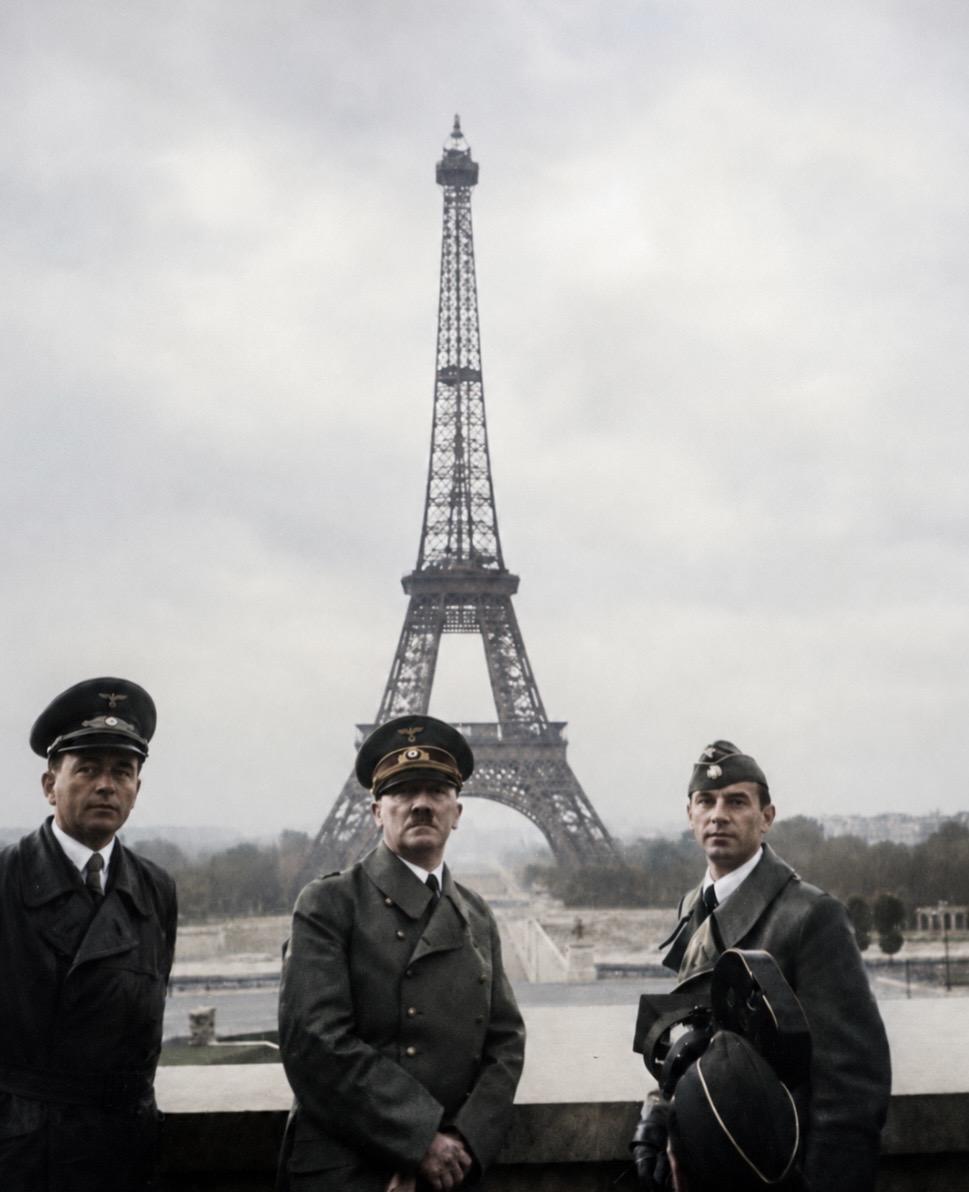
The next morning, 23 June, Hitler made his famous visit to Paris. He arrived very early, around dawn, partly for security reasons and partly because he wanted to see the city quietly, before crowds or traffic could interfere. He travelled with a small group of senior Nazi figures and artists, including Albert Speer, his favourite architect, and Arno Breker, a sculptor admired by the Nazi regime. Hitler had dreamed of architecture and monuments before he became a politician, and Paris was a city he both admired and resented. He wanted to see it not as a tourist, but as a conqueror.
The visit lasted only a few hours. Hitler’s party moved quickly through the city, visiting some of its most famous landmarks. One of the first stops was the Paris Opéra, also known as the Palais Garnier. Hitler was deeply impressed by the building and reportedly knew details of its design. He had long admired grand architecture, and the Opéra represented the kind of monumental urban beauty he wished to rival in Berlin. His later plans for a rebuilt German capital, which he wanted to call Germania, were meant to surpass cities like Paris in scale and grandeur.
Hitler also visited the Champs-Élysées, the Arc de Triomphe, the Place de la Concorde, the Trocadéro and the Eiffel Tower. Photographs of him standing with the Eiffel Tower behind him became some of the most famous images of Nazi triumph. Yet there was something curious about the visit. It was not a victory parade. Hitler did not drive through Paris in daylight before cheering crowds. He did not stage a long public celebration in the city. Instead, the tour was brief, controlled and almost private. He wanted the proof of conquest, but he did not want to expose himself unnecessarily.
One of the most symbolic places he saw was Les Invalides, where Napoleon Bonaparte is buried. Hitler had a complicated fascination with Napoleon. Like Napoleon, he saw himself as a man of destiny who had reshaped Europe by force. Standing in Paris, after defeating France, Hitler could imagine himself as the heir to a line of conquerors. But unlike Napoleon, who had entered many conquered capitals in triumph, Hitler’s Paris visit was strangely hurried. It showed both his arrogance and his caution.
The Eiffel Tower itself provided another small but memorable detail. Before the Germans entered Paris, the French had cut the lift cables so that Hitler could not easily ascend the tower. Whether this was done specifically to inconvenience him or as a general act of denial, it became part of the legend of occupied Paris. Hitler did not climb the Eiffel Tower. Later jokes claimed that Hitler conquered France but did not conquer the Eiffel Tower. The phrase captured a small act of French defiance amid a national catastrophe.
The humiliating nature of these events was not accidental. Hitler wanted the fall of France to look like historical revenge. France had been one of Germany’s principal enemies in the First World War. French leaders had played a major role in the post-war settlement. The occupation of the Rhineland, reparations, the loss of Alsace-Lorraine, and the restrictions imposed on Germany had all been used by Hitler in his propaganda as evidence that Germany had been shamed by its enemies. By forcing France to sign the 1940 armistice at Compiègne, in the same railway carriage associated with Germany’s defeat, Hitler was staging a reversal of history.
The railway carriage itself became a trophy. After the armistice, Hitler ordered it taken to Germany. The clearing at Compiègne was largely destroyed, except for the statue of Marshal Foch, which was left standing so that it could appear to gaze over the scene of France’s defeat. This was another act of symbolic cruelty. The French memorial to victory in 1918 was turned into a monument to humiliation in 1940. Later in the war, as Germany faced defeat, the carriage was destroyed, probably by the SS, to prevent it falling back into Allied hands.
Hitler’s visit to Paris also had a psychological purpose inside Germany. The Nazi regime presented the conquest of France as proof of Hitler’s genius. In 1914–18, Germany had fought France for four years and failed to secure final victory. In 1940, Hitler’s armies had defeated France in six weeks. For German propaganda, this seemed to prove that Hitler had overcome the shame of the past. It strengthened his prestige enormously. Many Germans who had doubted him before were swept up in the sense that he had achieved what the old German Empire had not.
Yet the visit also revealed Hitler’s priorities. He was not only a military dictator but a man obsessed with symbolism, monuments, revenge and spectacle. He saw cities as expressions of power. Paris represented civilisation, art, empire and prestige. By walking through it as conqueror, he was feeding his own myth. But he also wanted Berlin to outshine it. After the visit, he reportedly told Speer that Paris was beautiful, but Berlin must become far more beautiful. The conquest of Paris therefore became linked in his mind with his fantasy of rebuilding Germany into the centre of a Nazi-dominated Europe.
For the French, the armistice and the occupation were devastating. Paris had not been destroyed, but it had been captured. German flags flew over public buildings. German troops marched through its streets. The French Republic had collapsed, and Marshal Pétain’s government soon established itself at Vichy. Some French people accepted the armistice as a tragic necessity after military defeat. Others saw it as the beginning of shame, collaboration and resistance. Charles de Gaulle, who had escaped to Britain, rejected the armistice and called on Frenchmen to continue the struggle. His appeal from London on 18 June became one of the founding moments of Free France.
Hitler’s few hours in Paris did not decide the war, but they captured the mood of June 1940. Nazi Germany appeared unstoppable. Britain stood alone in western Europe. France, one of the great powers of the world, had been defeated and divided. Hitler had taken revenge for 1918 in the very place where Germany’s earlier defeat had been sealed. His visit to Paris was therefore not just sightseeing. It was an act of possession.
The irony is that Hitler’s triumph was temporary. Paris remained under German occupation for four years, but it was liberated in August 1944. The Nazi dream of a permanent European empire collapsed. The humiliating theatre Hitler had arranged at Compiègne did not become the final word in European history. Instead, it became a symbol of his arrogance and of the way he tried to turn historical grievance into conquest. His visit to Paris on 23 June 1940 stands as a chilling example of how much importance he placed on revenge, spectacle and the public humiliation of defeated enemies.