On this day in military history…
Operation Barbarossa was the code name for the German invasion of the Soviet Union during the Second World War. It began before dawn on 22 June 1941 and became the largest land invasion in history. It opened the Eastern Front, where the war reached a level of scale and brutality unlike anything seen in Western Europe. Millions of soldiers were thrown into battle, supported by thousands of tanks, aircraft, artillery guns, trucks, horses, and supply vehicles. What Germany expected to be a short and crushing campaign became a long war of exhaustion that helped bring about the defeat of Nazi Germany.
The operation was named after Frederick Barbarossa, a medieval Holy Roman Emperor. The name gave the invasion a sense of old German grandeur, but the purpose behind it was much darker. The attack grew from Adolf Hitler’s long-held belief that Germany needed Lebensraum, or living space, in the East. He wanted Soviet land for German settlement, Soviet food and raw materials for the war economy, and the destruction of communism, which the Nazi regime treated as its great ideological enemy. Britain had also refused to surrender after the fall of France in 1940, and Hitler believed that if the Soviet Union was destroyed, Britain would lose hope and make peace. These political, racial, economic, and military aims all came together in the decision to attack.
Although the broad idea came from Hitler, the German military leadership helped turn it into a practical invasion plan. Senior officers in the army high command prepared the routes of advance, the use of armoured forces, and the division of the invasion force into three great army groups. They believed the Red Army could be destroyed near the frontier and that the Soviet state would collapse after a few huge defeats. This confidence shaped the whole operation, but it also created one of Germany’s greatest mistakes, because the campaign was planned on the assumption that the enemy would break quickly.
The invasion was even more striking because Germany and the Soviet Union had signed a non-aggression pact less than two years earlier. The Molotov-Ribbentrop Pact was agreed on 23 August 1939. It shocked the world because the two regimes were supposed to be bitter enemies. Secret parts of the agreement divided areas of Eastern Europe between them. Germany invaded Poland on 1 September 1939, while the Soviet Union entered eastern Poland on 17 September. For a time the two powers traded with each other, and Soviet supplies of oil, grain, and raw materials helped the German war machine. The agreement was never meant to last. It had allowed Germany to avoid a two-front war while it defeated Poland and then turned west against France and Britain.
Formal planning for the eastern campaign began after France had been defeated in 1940. On 18 December 1940, Directive No. 21 ordered preparations for Operation Barbarossa. The aim was to destroy the Red Army in a short campaign before winter arrived. The plan relied on speed, surprise, air power, and encirclement. German armoured units were to break through Soviet lines, drive deep behind them, and trap whole armies in vast pockets. Infantry would then move up and complete the destruction, while aircraft attacked airfields, supply lines, railways, and troop movements.
The invasion force was divided into three main army groups. Army Group North would advance through the Baltic states towards Leningrad. Army Group Centre would drive through Belarus towards Smolensk and Moscow. Army Group South would move into Ukraine, aiming for Kiev and the rich agricultural and industrial regions beyond. On paper it looked like a powerful and carefully arranged plan, but it did not properly allow for the size of the Soviet Union, the weakness of the road system, the difficulties of supply, the autumn mud, the winter cold, or the ability of the Red Army to recover after disaster.
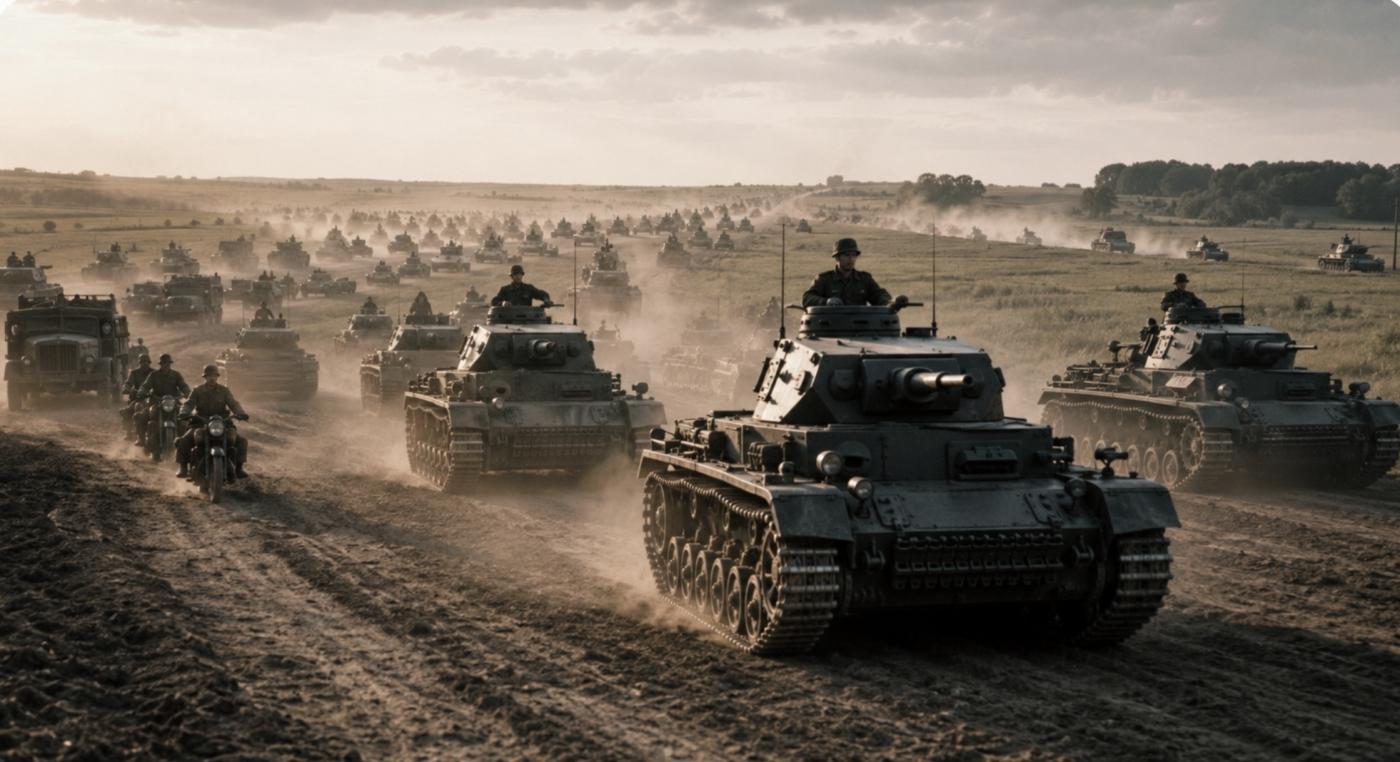
The German-led force was enormous. Around three million German soldiers took part at the beginning, with Axis allies including Romania, Finland, Hungary, Slovakia, and later Italy involved in the wider campaign. Altogether, roughly 3.3 to 3.8 million Axis troops were committed in the opening stages. The attackers also deployed about 3,300 to 3,600 tanks and assault guns, including Panzer III and Panzer IV tanks, lighter Panzer II models, and Czech-built vehicles taken into German service after earlier conquests. There were thousands of artillery pieces and more than 2,500 aircraft. The Luftwaffe was expected to smash Soviet air power immediately and clear the way for the advancing armies.
The German army is often remembered for tanks and fast-moving motorised columns, but much of it still depended on horses. Hundreds of thousands were used to pull guns, wagons, supplies, and equipment. This became a serious weakness as the advance went deeper into Soviet territory. The roads were often poor, railways had to be converted to fit German trains, and every mile added pressure to the supply system. Fuel, ammunition, food, spare parts, and winter clothing all had to be moved across a battlefield of immense size.
Facing them was the Soviet Union’s Red Army, a huge force that was powerful on paper but badly placed to meet the first blow. It had millions of men and a vast number of tanks and aircraft, but many units near the frontier were disorganised, poorly supplied, or still being reorganised. Stalin had received many warnings that an invasion was coming, yet he hesitated to believe that Germany would attack so soon. He feared provoking war before the Soviet Union was fully ready, and this delay helped make the first days even more disastrous.
The Soviet tank force was larger than Germany’s, and some models were excellent. The T-34 medium tank and KV-1 heavy tank were better armoured and more powerfully armed than most German tanks in 1941. The problem was that many Soviet vehicles were older types, poorly maintained, short of spare parts, or crewed by men without enough training. Communications were weak, with many tanks lacking radios. The air force was also large, but many aircraft were destroyed on the ground in the opening attacks. The army had also been damaged by Stalin’s purges in the late 1930s, when many experienced officers were executed, imprisoned, or removed. At the very moment when quick and confident leadership was needed, the command structure was still suffering from fear and disruption.
The attack began in the early hours of 22 June 1941. Artillery opened fire along the frontier, aircraft struck Soviet airfields, and German troops crossed into Soviet territory across a front stretching from the Baltic Sea to the Black Sea. The first hours were devastating. Communications were cut, aircraft burned on runways, forward positions were overwhelmed, and many commanders had no clear idea of what was happening. The German advance was fast and frightening. Armoured spearheads punched through the border defences and drove far behind Soviet lines, creating huge pockets of trapped troops.
In many places Soviet soldiers fought bravely, but surprise and confusion made organised resistance extremely difficult. During the first weeks, the losses in men, tanks, guns, and aircraft were catastrophic. German propaganda claimed the attack was a defensive move against a coming Soviet strike, but this was false. The invasion had been planned for months and was a deliberate war of conquest.
Army Group North moved through Lithuania, Latvia, and Estonia towards Leningrad, one of the great symbolic and industrial cities of the Soviet Union. Capturing it would have been a major victory and would have strengthened the German position in the Baltic region. The early advance was rapid, but the city did not fall. Instead, it was surrounded and placed under siege from September 1941. The siege became one of the longest and deadliest in history. Civilians endured starvation, cold, bombing, and shelling, yet the city survived and became a powerful symbol of Soviet resistance.
Army Group Centre carried the main weight of the offensive. It drove through Belarus towards Smolensk and then Moscow. Its early victories were enormous. At Minsk and Smolensk, large Soviet forces were surrounded, destroyed, or captured. These battles gave the impression that the Soviet Union might collapse, but the same victories created new difficulties. The deeper the advance went, the longer the supply lines became. Tanks needed fuel and spare parts, infantry needed food and ammunition, and the road system was not strong enough to support such a massive campaign.
The fighting in the centre also showed that the Red Army was not finished. Even when formations were surrounded, many men continued to fight, broke out, or slowed the advance long enough for new defensive lines to form farther east. By the autumn, the push towards Moscow resumed under Operation Typhoon. German troops came close to the capital, but they were exhausted and badly supplied. Rain turned roads into mud, then winter brought freezing conditions. The chance of a quick victory was slipping away.
Army Group South advanced into Ukraine, where the fighting was slower because the distances were great and Soviet resistance remained strong. The greatest German victory in the south came at Kiev in September 1941. Huge Soviet forces were encircled, and hundreds of thousands of prisoners were taken. It was one of the largest encirclement battles in military history. Yet this success also cost time, and the delay affected the later drive on Moscow.
Ukraine suffered terribly under occupation. Nazi rule brought mass shootings, starvation policies, forced labour, the destruction of villages, and the murder of Jewish communities. The campaign in the south showed clearly that the eastern war was not only about armies and territory. It was also a campaign of exploitation and terror against civilians.
Germany was supported by several Axis allies. Romania joined mainly to recover territory taken by the Soviet Union in 1940, especially Bessarabia and northern Bukovina, and its forces fought largely in the south. Finland fought what it called the Continuation War, seeking to regain land lost during the Winter War of 1939–1940. Finnish troops advanced from the north and helped threaten Leningrad, although Finland had its own war aims. Hungary, Slovakia, and Italy also provided forces, but Germany remained the dominant power in the invasion.
The scale of Barbarossa was almost beyond imagination. The front stretched for around 1,800 miles across forests, marshes, rivers, farmland, towns, villages, and open steppe. Millions of men were moving, fighting, retreating, or being captured across a vast area. In the first months, the attackers captured enormous territories and took huge numbers of prisoners, but the size of the battlefield began to work against them. The army could win battles, yet it could not easily feed, fuel, and equip itself so deep inside the Soviet Union.
As the advance continued, the practical problems multiplied. Vehicles broke down, horses died, fuel ran short, and men became exhausted. Railways had to be repaired or altered before they could carry German supplies. The poor road network slowed everything, and partisan attacks behind the lines made movement even more dangerous. Every success created a longer front, a longer supply route, and more occupied territory to control.
Soviet resistance was far stronger than expected. Although the Red Army suffered terrible losses, it did not collapse. New armies were raised, reserves were brought forward, and factories were moved east beyond the Ural Mountains, where they continued producing weapons. Soviet industry recovered and began turning out large numbers of tanks, guns, and aircraft. Civilians dug defences, worked in factories, transported supplies, and endured bombing, hunger, occupation, and terror. The conflict was presented inside the Soviet Union as the Great Patriotic War, a national fight for survival.
The war in the East was marked by terrible crimes. Before the invasion, German troops were given orders that made brutality easier and protected many soldiers from punishment for acts against civilians. Political commissars in the Red Army could be shot, and behind the front lines SS killing units followed the army. These units murdered Jews, communists, Roma people, and others targeted by Nazi rule.
One of the worst massacres took place at Babi Yar near Kiev in September 1941, where more than 33,000 Jews were murdered in two days. Across occupied Soviet territory, mass shootings became a major part of the Holocaust before the wider use of extermination camps. Soviet prisoners of war were also treated with extreme cruelty. Millions were captured during the early months. Many were starved, exposed to cold, denied medical care, or worked to death. This treatment showed how savage the campaign had become.
Operation Barbarossa failed because Germany did not destroy the Soviet Union before the campaign lost momentum. The plan depended on speed, shock, and collapse, but the Red Army kept fighting, the government remained in control, and the country’s vast size absorbed the invasion. The same method that had worked in Poland and France could not deliver the same result across the immense spaces of the east.
Autumn and winter exposed the weakness of the operation. Heavy rain turned roads into deep mud during the rasputitsa. Vehicles sank, horses struggled, and movement slowed. Then freezing weather arrived. German troops lacked proper winter clothing and equipment because victory had been expected before the cold set in. The fighting strength of the army was worn down by battle, distance, breakdowns, supply shortages, and exhaustion.
There were also disputes over priorities. Some commanders wanted a direct push towards Moscow, while Hitler also insisted on the importance of Ukraine, Leningrad, and economic targets. These divided aims stretched the army and cost time. By the time the final drive on the capital began, the troops were tired, the weather was turning, and Soviet reserves were ready to defend the city.
The Battle for Moscow became the great test of the invasion. In October 1941, Operation Typhoon was launched to capture the capital. At first, German forces again surrounded large Soviet formations and pushed towards the city. Some units came close enough to see the glow and outline of Moscow in the distance. The defence then hardened. Stalin remained in the capital, which helped morale, and fresh troops were brought from Siberia and the Far East after intelligence suggested Japan was unlikely to attack from that direction.
In early December 1941, the Red Army launched a major counteroffensive. German troops, exhausted and freezing, were pushed back from Moscow. This was the moment when the failure of Barbarossa became clear. The invaders had won enormous victories and caused terrible destruction, but the main aim had not been achieved. The Soviet Union had not collapsed, Moscow had not fallen, and the quick war had become a long war of attrition.
The consequences were immense. From 1941 onwards, the Eastern Front consumed most of Germany’s military strength. The battles that followed at Stalingrad, Kursk, and across Eastern Europe grew out of the failure to win in 1941. Barbarossa opened a war Germany could not finish and could not afford to lose.
For the Soviet Union, the invasion was a disaster on a vast scale, but also the beginning of a struggle that would eventually lead to victory. Millions of soldiers and civilians died, cities were ruined, villages were burned, and whole communities were destroyed. Yet the country survived the first blow and gradually turned the tide.
Operation Barbarossa remains one of the most important events of the Second World War. It involved millions of men, thousands of tanks and aircraft, and three huge advances towards Leningrad, Moscow, and Ukraine. Against the attackers stood the Red Army, shocked and badly damaged at first, but not broken. The invasion achieved spectacular early success, but it failed strategically. Germany misjudged the enemy, the distances, the weather, the supply problems, and the ability of the Soviet system to survive. Its failure became one of the great turning points of the war.