On this day in military history…
The sinking of RMS Lancastria off Saint-Nazaire on 17 June 1940 remains one of the darkest and least understood disasters in British wartime history. Although the ship is often remembered by her civilian title, RMS Lancastria, by the time of her loss she had been requisitioned for military service and was operating as His Majesty’s Troopship Lancastria. Her destruction came during the chaotic final phase of the Battle of France, when British forces, Allied personnel and civilians were being evacuated from ports along the French Atlantic coast after the fall of Dunkirk.
Lancastria had begun life not as a troopship, but as a passenger liner. Built on the Clyde by William Beardmore and Company, she was launched in 1920 under the name Tyrrhenia and entered service in 1922. She was later renamed Lancastria by Cunard, a name chosen to reflect Lancashire and to make her more appealing to British passengers. Before the war she carried passengers across the Atlantic and later served as a cruise ship, part of the familiar peacetime world of ocean travel that the Second World War would so violently interrupt.
By June 1940, Britain’s military situation in France was desperate. Operation Dynamo, the evacuation from Dunkirk, had ended earlier that month, rescuing hundreds of thousands of men but leaving many British troops still scattered across western and southern France. These included support units, air force personnel, administrative staff, engineers, medical personnel and others who had not been trapped in the Dunkirk perimeter. As German forces advanced rapidly across France, Britain began Operation Aerial, a second evacuation effort from ports including Cherbourg, Brest, Saint-Malo, La Pallice and Saint-Nazaire.
Saint-Nazaire, situated on the Loire estuary, became one of the crucial evacuation points. The port was crowded with troops and refugees trying to escape before German forces arrived. Ships of many kinds were pressed into service: naval vessels, merchant ships, liners, trawlers and small craft. Lancastria was sent to assist in this effort. Under Captain Rudolph Sharp, she arrived off Saint-Nazaire on 17 June 1940 and anchored several miles offshore because the port itself could not easily accommodate her.
The situation on shore was confused and urgent. France was collapsing, communications were strained, and there was pressure to embark as many people as possible before the evacuation route was cut off. Lancastria’s normal capacity was far below the number eventually taken aboard. Troops and civilians were ferried out to her from the harbour in smaller vessels. Men were placed wherever space could be found: on decks, in passageways and deep inside the ship’s holds. Among them were soldiers from various British Army units, Royal Air Force personnel, embassy staff, civilians and some women and children.
The exact number aboard Lancastria has never been firmly established. In the speed and confusion of the evacuation, proper records were not kept or were incomplete. Estimates vary, but it is generally accepted that several thousand people were on board, far more than the ship would ever have carried in peacetime service. This uncertainty is one reason why the final death toll remains disputed. What is beyond doubt is that the disaster became the greatest single loss of life from the sinking of a British ship.
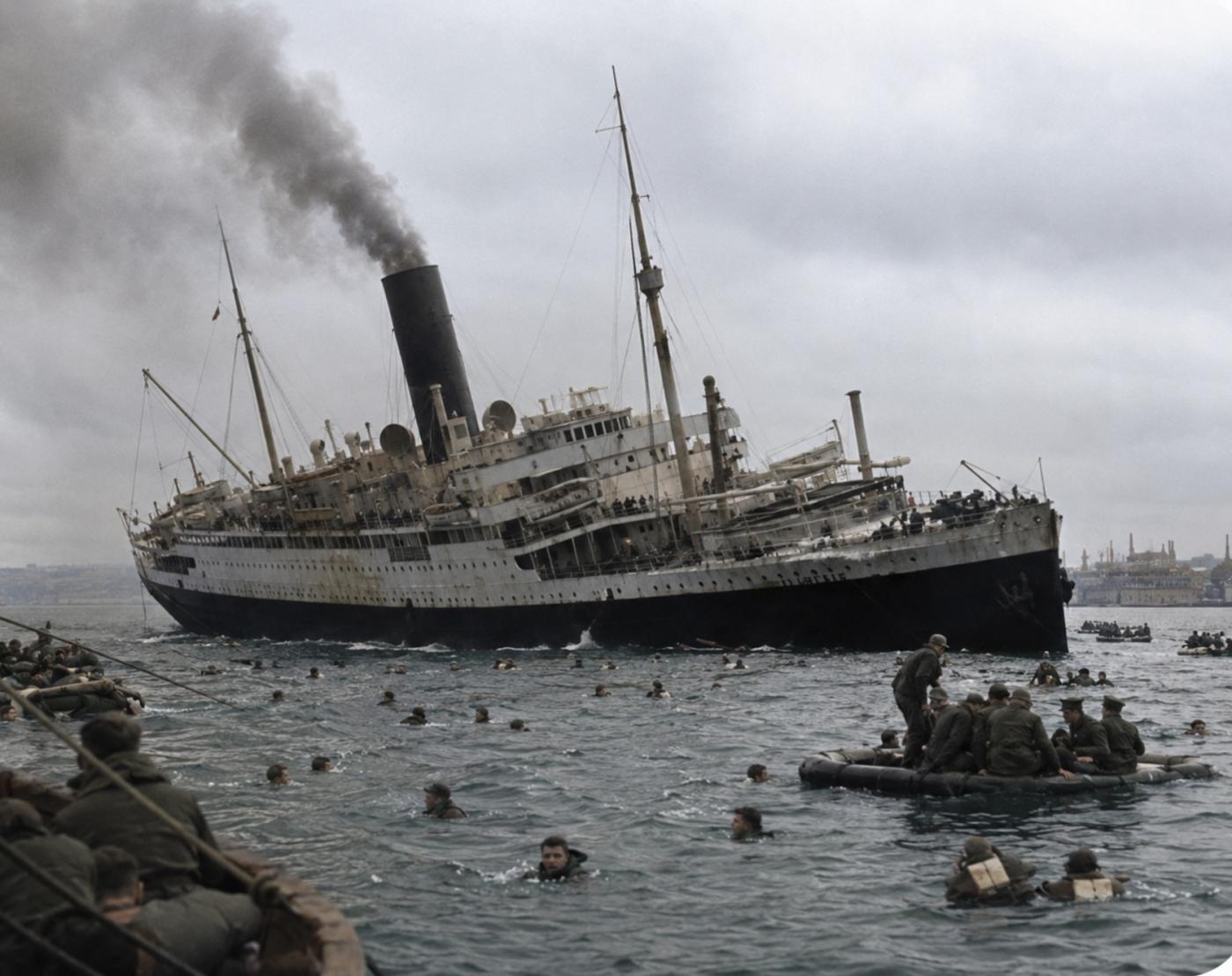
During the afternoon, German aircraft appeared over the Loire estuary. The Luftwaffe had already been attacking evacuation shipping, and Lancastria, large, crowded and stationary, was a vulnerable target. At about 3.45 p.m., she was attacked by German bombers. Several bombs struck the ship. One is believed to have gone down the funnel or exploded near the engine room; others tore into the holds where large numbers of men were sheltering. The damage was catastrophic.
Panic spread rapidly through the ship. The impact of the bombs caused severe internal destruction, killing many instantly below decks. Power and order broke down. The ship began to list heavily, and within a short time it became clear that she was doomed. For those trapped below, escape was almost impossible. For those on deck, the only hope was to jump into the sea, cling to wreckage, or reach one of the lifeboats. Many men could not swim. Others were injured, stunned or weighed down by clothing and equipment.
Lancastria sank with terrible speed. Within roughly twenty minutes she had rolled over and gone beneath the surface. Survivors later described men singing as the ship went down, including popular songs and patriotic tunes, a detail that has become part of the tragedy’s memory. Around the sinking ship, the sea filled with oil, wreckage, bodies and desperate survivors. Fuel oil from the ship spread across the water, coating men who were trying to stay afloat. Some accounts describe the oil catching fire, while others remember the choking, blinding effect of it on those in the water.
Rescue efforts began almost immediately, despite continuing danger from air attack. Nearby vessels moved in to pick up survivors. Among the rescuing craft were naval ships, merchant vessels, trawlers and smaller boats. HMT Cambridgeshire, an armed trawler, played a notable part in rescuing hundreds of men. Other ships and boats also risked attack to pull survivors from the water. Some men were rescued after hours at sea, exhausted, injured and covered in oil. Others died within sight of safety.
The human loss was immense. Because no complete passenger list existed, the number who died cannot be known with certainty. Estimates have ranged from around 3,500 to as many as 6,000 dead. Fewer than 2,500 people are often cited as having survived. Even the lower estimates make the sinking of Lancastria a disaster of staggering scale. It cost more lives than the sinking of Titanic and Lusitania combined, and it remains the worst maritime disaster in British history.
The tragedy occurred at a moment when Britain was already facing grave danger. France was seeking an armistice with Germany, British forces had only just escaped from Dunkirk, and the threat of invasion seemed real. Prime Minister Winston Churchill decided that news of the disaster should be suppressed, fearing the effect it might have on public morale. A press restriction was placed on the story, and survivors were discouraged from speaking openly about what had happened.
The attempt at silence could not last completely. News of the sinking appeared abroad, including in the American press, and British newspapers eventually reported it. Yet the delay and the lack of full official disclosure created a lasting sense among survivors and bereaved families that the dead had been forgotten. Many relatives received little detail about how their loved ones had died. Some never had a grave to visit. The wreck itself lay off the French coast, a silent witness to a disaster that remained overshadowed by Dunkirk, the Battle of Britain and other events of 1940.
The sinking of Lancastria also raises difficult questions about wartime necessity. The decision to load the ship with so many people was made under extreme pressure, with German forces advancing and evacuation time running out. From one perspective, every available space on the ship represented a chance to save a life. From another, the overcrowding greatly increased the scale of the disaster once the ship was hit. Those responsible were operating in conditions of fear, urgency and incomplete information, but the consequences were devastating.
Captain Rudolph Sharp survived the sinking. Tragically, he would later die at sea in 1942 when another vessel under his command, the liner Laconia, was torpedoed in the South Atlantic. His connection with both disasters is one of the many haunting personal threads that run through the history of wartime merchant shipping. Like many merchant seamen, he served in a world where civilian vessels and crews were drawn into the front line of total war.
For the survivors of Lancastria, memory was often painful and complicated. Many had endured not only the bombing and sinking, but also hours in oil-covered water, the sight of comrades drowning, and the knowledge that thousands had been trapped below. Some spoke of the event only late in life. Others campaigned for greater recognition, arguing that the loss had never received the public place in British memory that it deserved.
Commemoration has grown over time. Memorials, services and survivor associations have helped preserve the story. The ship’s bell, memorial windows, plaques and annual remembrance events have all contributed to keeping the name Lancastria alive. In Liverpool, Scotland, France and elsewhere, families and historians have worked to ensure that the dead are not simply a statistic hidden within the chaos of 1940.
The wreck of Lancastria remains off Saint-Nazaire. It is not merely the remains of a ship, but a war grave. For those whose relatives died there, the site carries deep emotional weight. The uncertainty over the precise death toll does not diminish the scale of the loss; rather, it underlines the confusion and terror of the circumstances in which the ship went down.