On this day in military history…
The attack by 2 Para on Wireless Ridge was one of the final and most important actions of the Falklands War. It took place on the night of 13 to 14 June 1982, only hours before the Argentine surrender in Port Stanley. By that stage the British land campaign had reached the ring of high ground west and north-west of Stanley. The Argentine capital could not be approached safely until those hills were taken, because they overlooked the roads, valleys and open ground that any attacking force would have to cross. Wireless Ridge was one of those key positions. It was not the highest mountain in the area, but it was tactically vital because it overlooked the northern approaches to Stanley and sat close to the final line of Argentine defence.
The battalion chosen to attack it was the 2nd Battalion, The Parachute Regiment, known as 2 Para. This was the same battalion that had fought the hard and costly battle at Goose Green at the end of May. At Goose Green, 2 Para had won a famous victory but had also suffered serious casualties, including the death of its commanding officer, Lieutenant Colonel Herbert “H” Jones, who was later awarded a posthumous Victoria Cross. By the time of Wireless Ridge, the battalion was under a new commanding officer, Lieutenant Colonel David Chaundler. He had been flown south at short notice to take command of a unit that was exhausted, short of sleep and carrying the physical and emotional weight of its earlier battle.
One of the most important differences between Goose Green and Wireless Ridge was the amount of fire support available. At Goose Green, 2 Para had attacked with limited artillery and little heavy support. At Wireless Ridge, Chaundler was determined not to repeat that experience. The battalion was supported by two batteries of 105mm guns from 29 Commando Regiment Royal Artillery, naval gunfire from HMS Ambuscade, mortars, heavy machine guns, Milan anti-tank missiles and a troop of light tanks from the Blues and Royals. These were Scorpion and Scimitar armoured reconnaissance vehicles, small and fast compared with main battle tanks, but very useful in the Falklands because they could move across difficult ground and bring accurate fire from their 76mm and 30mm guns. Their night sights were especially valuable in the dark, freezing conditions.
Wireless Ridge was defended mainly by men of the Argentine 7th Infantry Regiment, with detachments from other units also involved. Many of the Argentine soldiers were young conscripts, but it would be wrong to imagine that they simply ran away at the first sign of attack. Some positions collapsed under the enormous British bombardment, but other Argentine groups fought stubbornly, especially when 2 Para reached the later stages of the ridge. The defenders had machine guns, mortars, artillery support and prepared positions. The ground itself helped them. Wireless Ridge was not a single neat hill but a broken feature of rocky knolls, slopes, folds and defensive pockets. At night, in snow flurries and freezing wind, it was a confusing place to fight.
Before the attack began, the plan had to be changed. Intelligence revealed that some positions were not exactly as expected, and one area thought to be in British hands was still occupied by the enemy. This mattered because a night attack depends heavily on timing, direction and knowing where friendly forces are. If one company starts from the wrong line or moves through an area still held by the enemy, the whole plan can become confused. Chaundler reorganised the attack so that D Company, commanded by Major Philip Neame, would begin the operation by taking the first objective, known by the code name Rough Diamond. Other objectives had code names too, including Apple Pie and Blueberry Pie. Such names sound almost comic, but they were used to simplify orders over radios and maps in the middle of battle.
The battalion had already endured a punishing approach. 2 Para had been moved from Fitzroy by helicopter to a lying-up area west of Mount Kent, then marched forward across harsh ground. The men were carrying heavy weapons, ammunition, radios, cold-weather kit and personal equipment. They were tired before the battle even began. Chaundler later recalled that the men had gone for days with very little sleep and little food. This is one of the often overlooked features of the final battles around Stanley. They were not fought by fresh troops stepping out of warm barracks, but by exhausted soldiers operating in bitter cold after long marches and previous combat.
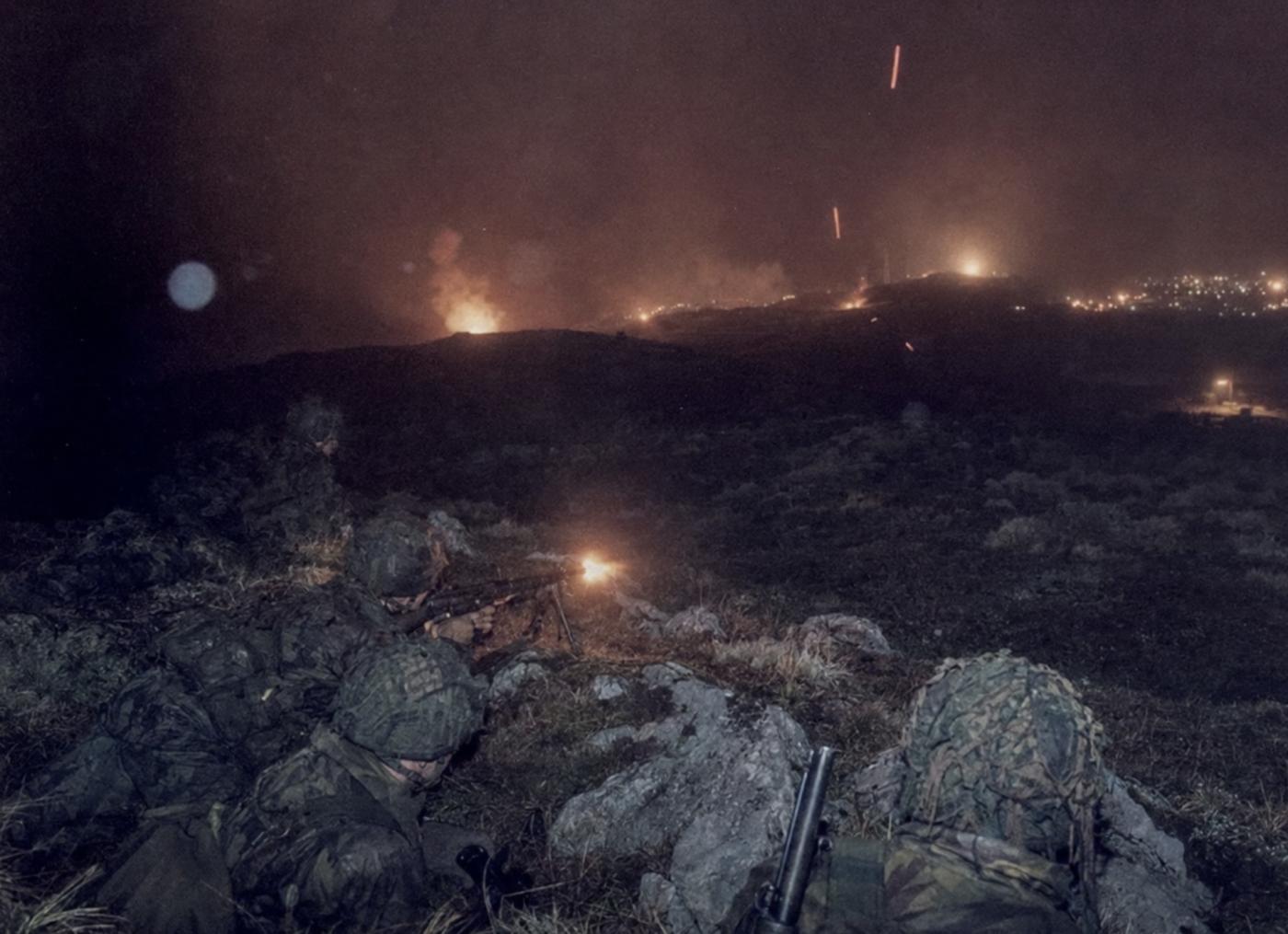
The attack opened with a massive British bombardment. Artillery, naval gunfire, mortars and direct fire were used to smash suspected Argentine positions before the Paras moved in. It was a deliberately “noisy” attack. Surprise was less important than overwhelming the defence. British guns fired thousands of rounds during the battle, and Chaundler later described the fire plan as one of the largest British Army fire plans since the Korean War. The intention was to keep Argentine heads down, cut communications, destroy strongpoints and break morale before the infantry closed in.
D Company began the first assault towards Rough Diamond. The barrage had been so heavy that when the Paras reached the position, they found that many of the Argentines had already pulled back. That did not mean the battle was easy. As D Company consolidated, Argentine artillery and mortar fire continued to fall. The British were advancing through a battlefield lit by explosions, tracer, illuminating rounds and the occasional flash of tank fire. The conditions were cold enough for frost and snow. Visibility came and went. Men had to keep direction in the dark while crossing open ground where mines, shell holes and enemy fire were constant dangers.
After Rough Diamond, A and B Companies moved against Apple Pie. This was a more dangerous stage. The British believed the bombardment had badly damaged the defence, but as the companies advanced they came under heavy machine-gun fire. The response was immediate and fierce. British machine guns, mortars, artillery and the guns of the light tanks poured fire onto Argentine positions. The tanks were particularly useful because they could engage targets directly and because their night sights helped them pick out movement and muzzle flashes. The use of armour at Wireless Ridge is one of the most interesting aspects of the battle. The Falklands are often remembered as an infantry war fought across mountains and peat, but at Wireless Ridge the small Scorpion and Scimitar vehicles played a real role in supporting the infantry assault.
The Argentine defenders on Apple Pie eventually withdrew under the pressure. A and B Companies secured the objective, giving 2 Para a firm base from which to support the next movement. Heavy weapons were brought forward. Machine-gun teams, Milan crews and the light tanks were positioned so they could fire across the ridge and help D Company as it moved on. This was classic infantry tactics: one part of the force seizes ground, then supports another part as it pushes further forward. The difference at Wireless Ridge was the intensity of the supporting fire and the speed with which the Argentine defensive system began to break apart.
C Company also moved forward during the battle and occupied ground that helped complete the battalion’s hold on the area. By this stage, Argentine communications were failing and commanders were struggling to understand what was happening. The British fire plan had not only killed and wounded men; it had disrupted command, movement and confidence. Isolated Argentine groups were still fighting, but the overall defence was becoming less coordinated.
The final part of the attack was the move along the main part of Wireless Ridge, sometimes associated with the objective Blueberry Pie. D Company again played a central role. At first the advance went well, but resistance increased as the Paras moved along the ridge. Argentine soldiers fought from bunkers, trenches and rocky positions. In places the fighting became close and confused. The British had to clear positions one by one, using small-unit tactics, grenades, automatic fire and the support of weapons behind them. The terrain made the defenders difficult to see until they fired, and the darkness made every movement more dangerous.
At one stage, Argentine counter-attacks and defensive fire caused serious concern. Elements from Argentine cavalry reconnaissance units, fighting dismounted rather than in armoured cars, were involved in the defence and counter-movement around the ridge. This was one of the few occasions in the land campaign when Argentine troops mounted a determined counter-action against a British attack. The British response was to bring down more artillery and mortar fire and to use the heavy weapons already positioned on captured ground. The 2 Para mortar platoon fired at extreme range, using powerful charges to reach targets. Some accounts note that mortar men suffered broken ankles from the repeated shock of firing supercharge rounds, a small but vivid detail showing the physical violence of the battle even for those not directly assaulting bunkers.
There was also the danger of friendly fire, a grim reality in night battles. During the later stages, British artillery fire fell dangerously close, and the chaos of the final advance created moments of real confusion. Private David Parr of 2 Para was killed during the battle, along with Colour Sergeant Gordon Findlay and Private Francis Slough. Parr’s death is especially poignant because he had already been wounded earlier in the campaign at Goose Green and had returned to his unit. The three men killed at Wireless Ridge are commemorated on the Wireless Ridge memorial near Stanley.
By first light on 14 June, 2 Para had taken Wireless Ridge. From the captured ground, the Paras could see Stanley below them. For the Argentine defenders, the loss of Wireless Ridge and the simultaneous British successes elsewhere, including at Mount Tumbledown, meant that the defensive ring around the capital had been broken. The psychological effect was enormous. British troops were now overlooking Stanley, and the Argentine command could see that further organised resistance would likely mean more casualties without changing the outcome.
The casualties at Wireless Ridge were far lighter for 2 Para than at Goose Green, which shows the effect of proper fire support and a carefully coordinated attack. British losses are generally given as three killed, with wounded figures usually listed at around eight to eleven depending on how casualties are counted. Argentine casualties were much heavier, with around twenty-five killed, many more wounded and a number taken prisoner, though estimates vary. The battle was not bloodless, but compared with what might have happened in a frontal infantry assault without artillery, tanks and naval gunfire, the British plan achieved its aim with relatively limited losses.
One reason Wireless Ridge remains interesting is that it shows how much 2 Para had learned from Goose Green. The battalion still showed aggression and speed, but this time it did not rely mainly on infantry determination. It used overwhelming fire support, better coordination and a phased plan. The attack was not a reckless charge; it was a combined-arms assault in which artillery, naval gunfire, mortars, armour, machine guns and infantry worked together. It was also a battle fought by men who were exhausted, cold and hungry, yet still able to carry out a complex night operation.
The battle also shows the weakness and strength of the Argentine defence. On the one hand, the Argentine line could not survive the weight of fire and the coordinated British advance. Communications broke down, positions were isolated and many soldiers withdrew once they realised they were being outflanked or overwhelmed. On the other hand, some Argentine troops fought hard in miserable conditions, especially in the later stages of the ridge. Their resistance forced 2 Para to continue fighting through the night and made the final clearance dangerous.
Wireless Ridge was one of the last battles before the surrender. Later on 14 June, British forces entered Stanley and Argentine forces in the islands laid down their arms. For 2 Para, the battle had a special significance. The battalion had begun the campaign with the shock of Goose Green and the loss of its commanding officer. It ended its fighting at Wireless Ridge by helping to open the road into Stanley. The victory was not just a battlefield success; it was part of the final collapse of Argentine resistance in the Falklands.