On this day in military history…
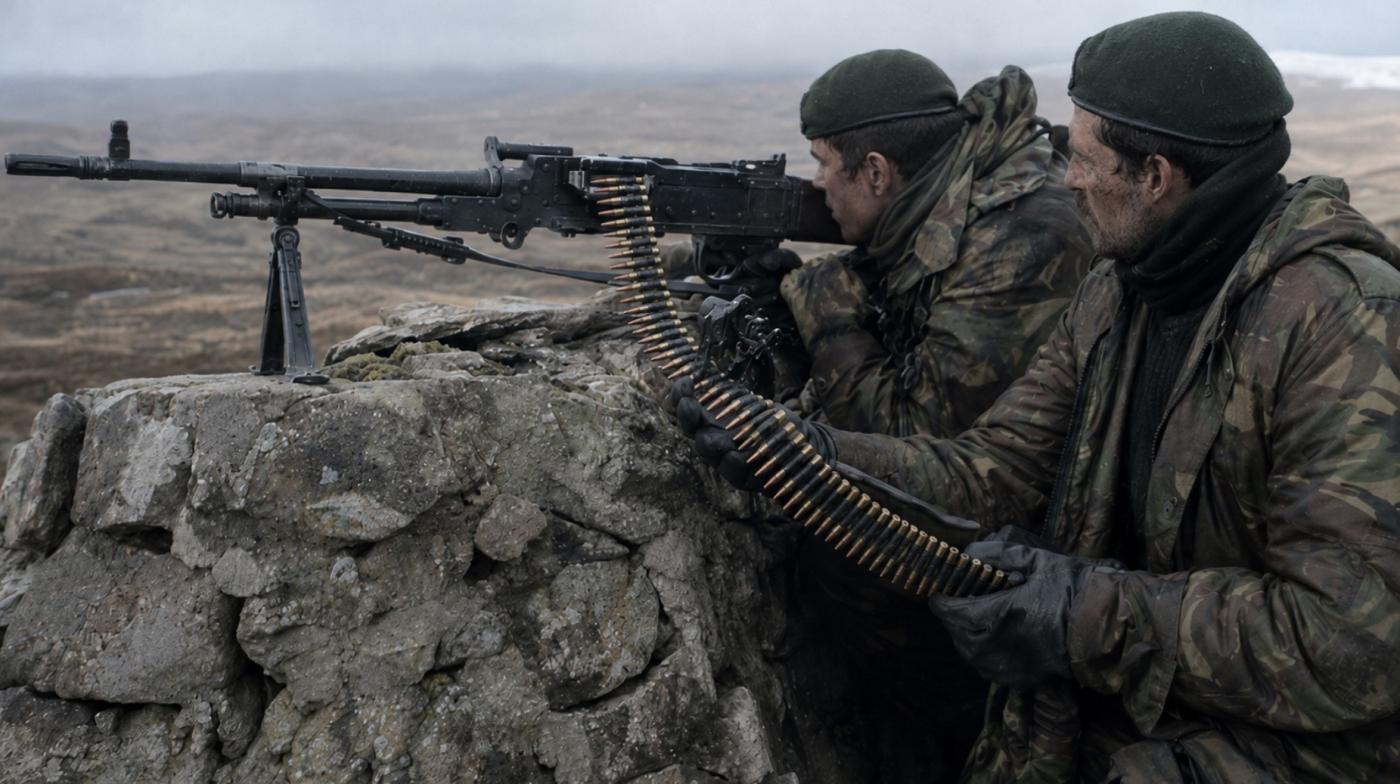
On the night of 11 to 12 June 1982, as the Falklands War was reaching its final stage, the Royal Marines were given two of the key mountain objectives guarding the approaches to Stanley. These were Mount Harriet and Two Sisters, two rocky, windswept features that formed part of the Argentine defensive ring west of the capital. They were not huge mountains by world standards, but in the Falklands they mattered enormously. Whoever held them could observe movement, direct artillery, and block the final British advance towards Stanley.
By this point the British land campaign had already come a long way. After the landings at San Carlos on 21 May, 3 Commando Brigade had fought and marched its way across East Falkland in miserable conditions. The men had endured cold, wet ground, heavy loads, lack of sleep, and the constant threat of air attack and artillery fire. The final push towards Stanley required a series of night attacks on the high ground. On the same night that 3 Para attacked Mount Longdon, the Royal Marines attacked Mount Harriet and Two Sisters.
Mount Harriet was assigned to 42 Commando Royal Marines, commanded by Lieutenant Colonel Nicholas “Nick” Vaux. Vaux was an experienced Royal Marine officer and his plan for Harriet was bold but carefully thought out. A direct attack from the west would have meant advancing straight into prepared Argentine positions, minefields and machine-gun fire. Instead, 42 Commando made a wide right hook, moving south and then east so that the Marines could come in from an unexpected direction. It was a classic Commando approach: avoid the obvious route, make a difficult night march, and surprise the enemy where he felt most secure.
The Argentine defenders on Mount Harriet were mainly from the 4th Infantry Regiment, the Regimiento de Infantería 4, including men from B Company and other elements of the regiment. They were under the wider command structure of Lieutenant Colonel Diego Soria, with local positions held by officers such as Captain Carlos Arroyo and junior leaders including Sub-Lieutenant Lautaro Jiménez-Corbalán. These Argentine troops were not simply a rabble of frightened conscripts, as some early British newspaper accounts suggested. They had dug in, laid mines, placed machine guns, and were defending rocky ground that naturally favoured the defender.
The British attacking force at Mount Harriet was built around 42 Commando, especially K Company and L Company, with J Company used in a diversionary and reserve role. They were supported by artillery from 29 Commando Regiment Royal Artillery, engineers from 59 Independent Commando Squadron Royal Engineers, and naval gunfire from HMS Yarmouth. In broad terms, the British assault force was several hundred Royal Marines, while the Argentine defenders numbered around a few hundred men. Exact numbers vary by account, but about 300 Argentine prisoners were taken after the battle, which gives a good idea of the scale of the defensive position.
The attack began after a difficult night approach. The Marines had to move silently over rough ground, in darkness, carrying weapons, ammunition, radios and equipment. The Falklands terrain was punishing: stone runs, peat bog, cold wind, and sharp rock underfoot. The plan was for K Company to attack the eastern end of Mount Harriet, followed by L Company against the western end. J Company helped create the impression that the main attack was coming from elsewhere.
The fighting on Mount Harriet was fierce and at times confused. The Marines had surprise, but the Argentines resisted strongly once the attack was under way. There were bursts of machine-gun fire, grenades, mortar and artillery fire, and close-quarter fighting among rocks and sangars. The Argentine positions were well sited, and in places the defenders fought with determination. Some British veterans later made a point of saying that the enemy on Harriet had fought properly and bravely, especially once the battle became close and personal.
One of the striking features of Mount Harriet was that 42 Commando’s plan worked, but it did not make the fight easy. Surprise helped the Marines get into the Argentine rear and flank, yet the battle still took longer than expected. The original hope had been that after taking Harriet, 42 Commando might press on towards Mount William, but by the time Mount Harriet was secured the men were tired, low on ammunition, and had taken casualties. The mountain was won, but the next move had to wait.
British losses at Mount Harriet were comparatively light for such an important position, though every casualty was deeply felt. Two Royal Marines, Corporal Laurence Watts and Corporal Jeremy Smith, were killed, and around thirty were wounded. Argentine losses are usually given as around eighteen killed, with a number wounded and about 300 taken prisoner. The result was a clear British victory. Mount Harriet had fallen, the Argentine line south-west of Stanley was broken, and 42 Commando had opened the way for the next stage of the advance.
Nick Vaux was later awarded the Distinguished Service Order for his leadership during the campaign, including the Mount Harriet operation. Other Marines also received awards for bravery. The battle became one of the strongest examples of Royal Marine planning and night assault during the war: a difficult march, a clever approach route, good use of deception, and disciplined fighting under pressure.
At roughly the same time, another Royal Marine battle was being fought nearby at Two Sisters. This feature, as its name suggests, consisted of two linked rocky peaks or ridges. It sat north of Mount Harriet and west of Mount Tumbledown, forming another part of the defensive belt protecting Stanley. Two Sisters was assigned to 45 Commando Royal Marines, commanded by Lieutenant Colonel Andrew Whitehead.
Whitehead’s men had already endured a gruelling advance across East Falkland. Like the rest of 3 Commando Brigade, 45 Commando had “yomped” long distances in terrible conditions, carrying heavy loads after the loss of helicopter lift caused by the sinking of Atlantic Conveyor. By the time they reached the approaches to Stanley, they were exhausted but still capable of hard night fighting. Their objective at Two Sisters was defended mainly by Argentine troops from the 4th Infantry Regiment, with elements also linked to the 6th Infantry Regiment. The local Argentine commander most often associated with the defence was Major Ricardo Cordón.
The British force at Two Sisters was about 600 Royal Marines from 45 Commando, supported by six 105mm guns from 29 Commando Regiment Royal Artillery and naval gunfire from HMS Glamorgan. The Argentine defenders are usually estimated at around 350 men. As at Mount Harriet, the figures vary between accounts, partly because units were spread across rocky positions and because some men were detached, moved, wounded or captured during the wider battle.
45 Commando’s companies had different tasks in the attack. X Company, commanded by Captain Ian Gardiner, played a central role in the assault. Y Company and Z Company were also involved, with their own objectives across the ridge. The attack required the Marines to move at night over broken ground and then close with a defender who had the advantage of height, cover and prepared positions.
The fight for Two Sisters became one of the most intense Royal Marine actions of the Falklands War. The terrain made control difficult. The ridges, rocks and false crests meant that a position could seem clear one moment and then erupt with fire from another angle. Argentine machine guns and rifles opened up from sangars, while British artillery and naval gunfire tried to suppress the defences. The Marines used small-unit tactics, grenades, light anti-armour weapons, machine guns and bayonets as they pushed through.
Captain Ian Gardiner’s X Company has become especially associated with the battle. Gardiner later wrote and spoke about the fighting, describing the difficulty of attacking in darkness against an enemy who was not only dug in but often hard to locate. One of the interesting details of Two Sisters is how much depended on junior leaders and small groups of men making decisions in the dark. The grand plan mattered, but once the shooting started, the battle was often decided by corporals, sergeants, lieutenants and captains keeping their men moving forward.
There had also been important reconnaissance before the attack. Patrols from 45 Commando had probed the Argentine positions in the days before the battle, sometimes clashing with defenders. These patrols gave the Marines a better understanding of the ground and enemy layout, but they also showed that the fight would not be simple. The Argentine soldiers on Two Sisters were alert, armed and prepared to resist.
HMS Glamorgan provided naval gunfire support during the battle, but Two Sisters is also remembered because of what happened to the ship shortly afterwards. In the early hours of 12 June, after supporting the land battle, Glamorgan was hit by an Argentine Exocet missile fired from a shore-based launcher. Fourteen of her crew were killed. This was not part of the mountain fighting itself, but it is closely linked to the story of Two Sisters because the destroyer had been supporting 45 Commando’s attack before she was struck.
British casualties at Two Sisters were heavier than at Mount Harriet. The usual figure given for the land battle is around four Royal Marines killed and many more wounded, though some summaries include the HMS Glamorgan dead when discussing the wider Two Sisters action, giving a much higher British death toll. Argentine casualties are generally given as about twenty killed, around fifty wounded, and more than fifty captured. The battle ended in a British victory, with 45 Commando taking the feature and forcing the defenders back.
The capture of Two Sisters was vital because it opened the northern side of the final approach to Stanley and helped unhinge the Argentine defensive line. Along with the fall of Mount Harriet and Mount Longdon that same night, it meant the first belt of high ground west of Stanley had been broken. The Argentines still held positions such as Mount Tumbledown, Wireless Ridge and Mount William, but the pressure was now closing in fast.
The two battles also showed the character of the final phase of the Falklands War. These were not easy victories won simply because the British troops were professional and the Argentines were conscripts. The Royal Marines had better training, stronger small-unit leadership and excellent artillery support, but the Argentine defenders often fought hard from strong positions. The British had to climb, crawl, fight and clear ground in darkness, in freezing weather, against men who had no intention of simply walking away.
Mount Harriet and Two Sisters were both won by planning, endurance and aggression. At Harriet, Nick Vaux’s 42 Commando used a clever flanking attack to surprise the defenders from an unexpected direction. At Two Sisters, Andrew Whitehead’s 45 Commando fought a tougher and more direct battle over broken ridges, with companies such as Ian Gardiner’s X Company pushing through strong resistance. Both battles were part of the same night’s work, and both helped decide the campaign.
By the morning of 12 June, the British were much closer to Stanley. The Argentine outer defences had been badly damaged, prisoners were being brought in, and the final collapse of the garrison was only days away. On 14 June 1982, Argentine forces in the Falklands surrendered. The Royal Marines’ battles for Mount Harriet and Two Sisters had played a major part in making that surrender inevitable.
Today these actions remain among the most important Royal Marine battles of the Falklands War. They are remembered not only for the victory, but for the conditions in which the men fought: the long marches, the cold nights, the dangerous ground, the confusion of battle, and the courage shown on both sides. Mount Harriet and Two Sisters were small places on the map, but in June 1982 they became decisive steps on the road to Stanley.