On this day in military history…
By 8 June 1944, two days after D-Day, the Allied landings in Normandy had entered a dangerous new phase. The first battle had been to get ashore. The next was to stay there.
The Germans had failed to throw the Allies back into the sea on 6 June, but the battle was far from won. Across the Normandy front, British, Canadian and American troops were still trying to link their beachheads, push inland, and secure key ground before German reinforcements could arrive in strength. The Germans, meanwhile, were recovering from the shock of the invasion and trying to mount counter-attacks wherever they could.
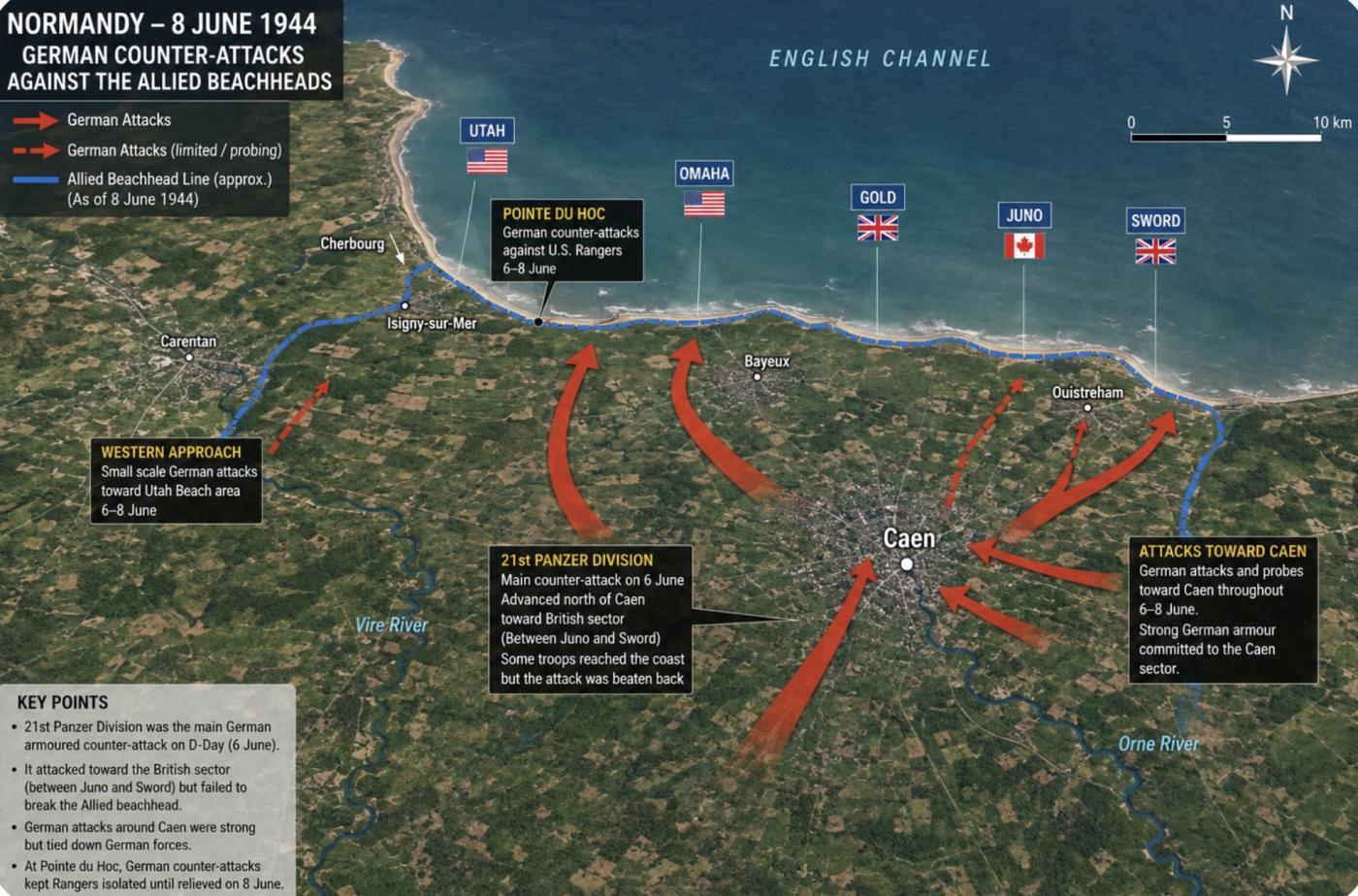
The most important early German counter-attack came from 21st Panzer Division. This was the only major German armoured formation close enough to strike the invasion beaches quickly. Its position near Caen made it a potential threat to the British and Canadian landings at Sword and Juno.
But the German reaction was slow and confused. Command arrangements were complicated, senior commanders were not all at their posts, and the Allies had achieved surprise despite years of German preparation along the Atlantic Wall. When 21st Panzer finally moved, it was already afternoon on 6 June.
The division attacked north of Caen toward the British sector. Some German troops managed to push into the gap between Juno and Sword beaches, and a few even reached the coast. For a moment, this looked like a serious danger. If the Germans had been able to split the Allied beachheads, they might have isolated part of the invasion force.
But the attack was not strong enough, fast enough, or well supported enough to succeed. British troops blocked the advance, Allied air power threatened German movement, and the landing beaches remained in Allied hands. Rather than a decisive counter-blow, the attack became a missed opportunity.
By 8 June, the meaning of that failure was becoming clear. The Germans had struck, but they had not broken the invasion.
While this first counter-attack failed to destroy the beachhead, the struggle around Caen was only beginning. The city was one of the great prizes of the Normandy campaign. It was a road and communications centre, and the open country around it was useful for tanks. The Allies had hoped to take Caen on D-Day, but the city remained in German hands.
This failure shaped the whole campaign.
The Germans understood Caen’s importance and poured strong forces into the area. British and Canadian troops advancing inland met fierce resistance. The Germans committed some of their best troops and many of their tanks to hold the Caen sector. What began as an Allied attempt to seize a city became a prolonged battle of attrition.
For the British and Canadians, the fighting around Caen was hard, slow and costly. Villages, ridges and road junctions became bitterly contested. German armour and anti-tank guns made every advance difficult. The defenders used the ground well and counter-attacked when opportunities appeared.
Yet there was another side to this struggle. By holding so much German attention and armour around Caen, the British and Canadians helped shape the wider Allied plan. German tanks drawn into the eastern part of the bridgehead were tanks not being used against the Americans farther west. This mattered later, when the Americans broke out of Normandy.
So Caen was both a frustration and a trap. The Allies had failed to capture it quickly, but the battle forced the Germans to spend their strength defending it.
Farther west, another desperate battle was being fought at Pointe du Hoc.
On D-Day, U.S. Rangers had climbed the cliffs between Omaha and Utah beaches to attack a German gun position believed to threaten both landing areas. The assault was one of the most dramatic actions of the invasion. The Rangers scaled the cliffs under fire and reached the top, only to discover that the main guns had been moved from their prepared positions.
They later found and disabled the guns inland, but then faced a new problem: survival.
For two days the Rangers were isolated. They held their position under German counter-attacks, short of ammunition, food and medical supplies. Their situation was grim. They had achieved their mission, but they were surrounded and badly depleted.
On 8 June, relief finally arrived from forces advancing from Omaha Beach. By then, the Rangers had suffered heavily. Only a fraction of the original assault force remained fit to fight. Their stand at Pointe du Hoc became one of the most remembered episodes of D-Day not simply because of the climb, but because they held on afterwards.
Their experience shows the nature of the battle after the landings. D-Day was not over when men reached the beaches. Small groups still had to survive isolated fights, hold key ground, and wait for the beachheads to expand.
Across Normandy, the German army was far from beaten in the days after D-Day. Its soldiers fought hard, defended skilfully, and counter-attacked repeatedly. But the response was fragmented.
The Germans had expected the invasion, but not necessarily in Normandy. Allied deception had encouraged them to believe that a larger landing might still come in the Pas-de-Calais area. This hesitation affected the movement of reserves. Panzer divisions that might have been used earlier were held back or delayed.
At the front, German units often fought with determination, but they were being forced into local reactions rather than one coordinated strategic blow. At Sword and Juno, 21st Panzer attacked but failed to split the landings. Around Caen, German armour slowed the British and Canadians but became tied down. At Pointe du Hoc, German counter-attacks punished the Rangers but could not restore the coastal defences.
By 8 June, the Allies had not yet won the Battle of Normandy. But they had survived the most dangerous opening phase. The beachheads were linking. Reinforcements were arriving. German counter-attacks had caused serious losses, but they had not destroyed the invasion.
The story of 8 June is therefore not one of easy Allied success. It is the story of a narrow but vital survival. The Germans reacted with skill and force, but too late and too unevenly. The Allies, despite heavy casualties and missed objectives, held their ground.
From that point on, the battle became a grinding contest of endurance. The fight for Caen would continue for weeks. The Americans would struggle through the bocage. German forces would launch further counter-attacks. But the chance to defeat the invasion at the water’s edge had passed.
By 8 June 1944, Normandy had become a bridgehead. And once the Allies had a bridgehead, the liberation of Western Europe had truly begun.