On this day in military history…
By 9 June 1944, three days after the first assault waves had crossed the Channel, the Battle of Normandy had changed character. On 6 June, the great question had been whether the Allies could get ashore at all. By D+3, the question was different: could they link the separate lodgements, deepen them fast enough, and prevent the Germans from crushing the invasion before it became a proper front?
The beaches were no longer isolated scenes of desperate assault in the same way they had been on D-Day morning. Utah, Omaha, Gold, Juno and Sword had all been entered and held, but the map still looked dangerous. The Allies had not landed as one continuous army. They had come ashore in separate sectors, divided by rivers, marshes, flooded fields, villages, German strongpoints and stubborn pockets of resistance. The job on 9 June was to turn five beachheads into one battlefield, and then one bridgehead.
This was especially urgent in the American sector. Utah Beach, on the eastern side of the Cotentin Peninsula, had been a comparatively successful landing, helped by airborne troops of the 82nd and 101st Airborne Divisions who had dropped inland during the night before D-Day. Omaha Beach, farther east, had been far bloodier. Between them lay low, wet country and the important town of Carentan. Until Carentan was taken, the Americans at Utah and Omaha were not properly joined. That gap mattered enormously. If the Germans could hold or reinforce it, they might split the American forces and perhaps threaten one beachhead at a time.
Carentan therefore became one of the key objectives after D-Day. On 9 June, the 101st Airborne Division was preparing for the attack that would begin in earnest on 10 June. The division had already been fighting since the night drop, scattered across the flooded Norman countryside, holding road junctions, causeways and river crossings. Around Carentan, the enemy included German paratroopers of Fallschirmjäger-Regiment 6, experienced and determined troops under Friedrich von der Heydte. German reinforcements, including elements of the 17th SS Panzergrenadier Division, were moving or expected to move toward the area, although Allied air power and transport difficulties delayed them. For the Americans, Carentan was not just another town. It was the hinge between Utah and Omaha.
To the north and west of Carentan, U.S. VII Corps was pushing inland from Utah Beach. The 4th Infantry Division, which had landed at Utah on D-Day, was now fighting through the Cotentin countryside toward Montebourg and toward the German coastal batteries that still threatened the landing area. One of the most important of these was the Azeville battery. It had four 105 mm guns in concrete positions and had fired on Utah Beach and nearby areas after the landings. On 9 June, after previous attacks had failed, the 22nd Infantry Regiment of the 4th Infantry Division attacked Azeville again with artillery, infantry, engineers and close assault methods. The battery was finally taken that day. Its capture helped make the Utah sector safer and allowed the Americans to push farther north and inland.
Nearby, the Crisbecq battery remained another problem, and the struggle against German coastal positions showed how D-Day had not ended once men reached the sand. Some German guns, bunkers and strongpoints survived the initial naval and air bombardments. They had to be reduced one by one by infantry, tanks, engineers, naval gunfire and artillery. The battlefield had become a mixture of village fighting, bunker clearing, road fighting and hedgerow combat.
Farther west, U.S. forces were also fighting for Montebourg. This was part of the drive northward in the Cotentin, eventually aimed at Cherbourg, the deep-water port the Allies badly needed. The beaches could receive men and vehicles, but a major army required ports, fuel, ammunition, repair facilities, roads and depots. Cherbourg was the great prize in the American sector, but before the Americans could reach it, they had to widen and secure the Utah lodgement and defeat German troops defending the approaches.
Between Omaha and Utah, another important action took place at Maisy. The Maisy battery complex, near Grandcamp-Maisy, had been one of the German artillery positions capable of firing toward the Allied landing areas. On 9 June, men of the U.S. 5th Ranger Battalion, supported by elements of the 2nd Rangers, attacked the position. The fight lasted several hours and involved trenches, tunnels, gun pits and close-quarter clearing. The site included artillery positions such as 155 mm platforms and extensive fieldworks. The assault demonstrated again that the Allied task after D-Day was not simply to march inland, but to dig out a prepared defensive system that had survived the opening blow.
On the Omaha side, the U.S. 29th Infantry Division was advancing westward. One of its main objectives was Isigny-sur-Mer, a town near the Vire estuary and an important road centre between Omaha and Carentan. The 175th Infantry Regiment of the 29th Division, supported by tanks including the 747th Tank Battalion, entered and captured Isigny on 9 June. The town had been damaged and was still dangerous, but its capture mattered because it helped open the route from Omaha toward Carentan. It was a physical step toward joining the American beachheads.
The U.S. 1st Infantry Division, which had suffered heavily at Omaha on D-Day, was also moving west of Bayeux. On 9 June, American troops liberated villages including Tour-en-Bessin, Étréham and Blay. These were not large places, but in Normandy small villages mattered. Each village could contain a crossroads, a church tower observation point, a stone-walled defensive position, or a route through the bocage. The Germans could hold a village with machine guns, mortars, anti-tank guns and a few well-sited troops, forcing the Allies to fight field by field.
This was one of the surprises and frustrations of Normandy. The Allied armies had trained for the assault, but now they were entering bocage country: small fields divided by high earth banks, hedges, sunken lanes and orchards. Tanks could not always see. Infantry could be ambushed at close range. German defenders could hide anti-tank guns and machine guns behind hedgerows and then fall back to the next line. By 9 June, the war had become a close, grinding battle for lanes, bridges, orchards and crossroads.
In the British and Canadian sectors, the situation was different but equally serious. The British Second Army had landed on Gold and Sword, while the Canadians had landed on Juno. Their early objectives had included Bayeux, the road network inland, the airfields, and above all Caen. Caen was supposed to be taken early, ideally on D-Day itself, but German resistance and armoured counter-moves prevented that. By 9 June, Caen was still in German hands, and its importance had grown.
Caen mattered because it sat on important roads and more open ground leading south and southeast. If the British and Canadians could break through there, they might get into country better suited to tanks. If the Germans held Caen, they could block the eastern half of the Allied lodgement and keep the British and Canadians compressed near the coast. The Germans understood this. As a result, some of their strongest armoured formations were drawn toward the Caen front.
The German 21st Panzer Division had already fought near the British sector on D-Day. The 12th SS Panzer Division Hitlerjugend, made up largely of young soldiers led by experienced officers and NCOs, was fighting the Canadians around villages west and northwest of Caen. Panzer Lehr Division, one of the best-equipped German armoured divisions in France, was also moving into the Normandy battle. These formations helped make the Caen sector the great magnet for German armour.
This had an important consequence for the whole campaign. The British and Canadians were taking on a large share of the German panzer strength around Caen, while the Americans fought to link Omaha and Utah and push into the Cotentin. In simple terms, the eastern flank was absorbing German armour, while the western flank was trying to secure the American bridgehead and open the way to Cherbourg. The two efforts were connected. If the Germans had been able to move their armoured divisions freely against the Americans, the battle around Carentan and the Utah-Omaha gap might have become even more dangerous.
On 9 June, Canadian troops were involved in bitter fighting around places such as Bretteville-l’Orgueilleuse and Norrey-en-Bessin, where German attacks by the 12th SS Panzer Division had to be stopped. The Canadians had already suffered sharp fighting after Juno Beach, and now they were facing some of the most aggressive German counter-attacks in Normandy. These villages were small, but they guarded routes toward Caen and the Allied lodgement. Holding them helped prevent the Germans from driving a wedge between Juno and Sword.
The British were also fighting through the area west of Caen and south of Bayeux. Tilly-sur-Seulles became a contested area involving British troops, including formations such as the 50th Northumbrian Division and armoured units, against German forces including Panzer Lehr. Bayeux itself had been liberated earlier, but the country beyond it remained active and dangerous. The fighting here was not the dramatic beach assault of D-Day, but the start of a long and costly inland battle.
Meanwhile, on the far eastern flank, the British 6th Airborne Division continued to hold the area east of the Orne River and the Caen Canal. Their job was to protect the flank of Sword Beach, hold the bridges captured in the opening hours of D-Day, and prevent German forces from attacking the invasion area from the east. Places such as Bénouville, Ranville and the Orne bridgehead remained vital. If that flank collapsed, the whole eastern end of the Allied lodgement would be threatened.
By D+3 the scale of Allied power ashore was growing quickly. Nearly 160,000 Allied troops had landed on D-Day itself, including American, British, Canadian and other Allied forces, as well as more than 23,000 airborne troops. The naval armada had involved thousands of ships and landing craft, while Allied air forces flew in overwhelming numbers. By 9 June, the beaches were not quiet rear areas; they were working military gateways. Landing ships, landing craft, DUKW amphibious trucks, engineers, bulldozers, cranes, beach groups, medical units, anti-aircraft guns, tanks, artillery, fuel dumps and ammunition stacks were all part of the new battle.
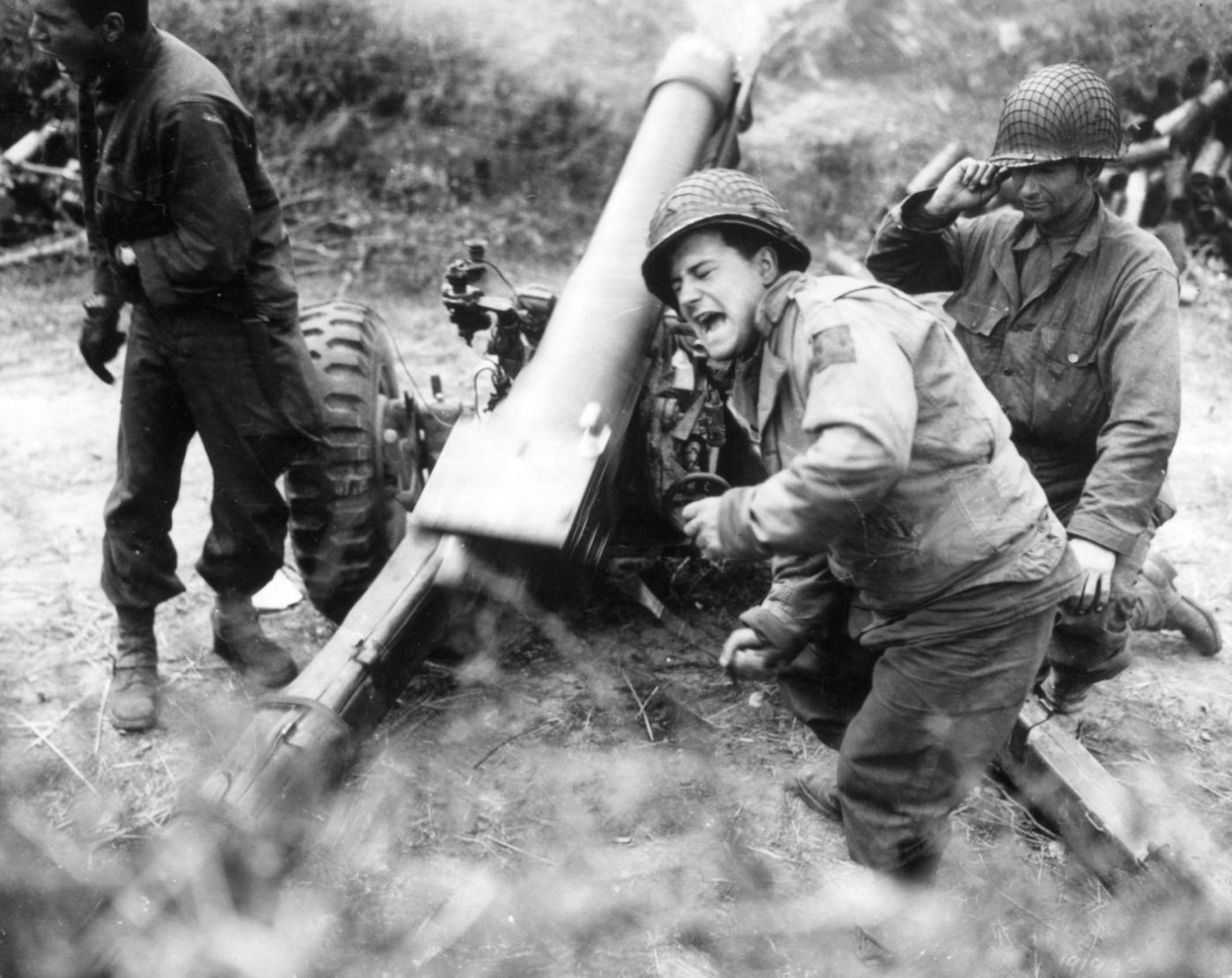
The equipment now in use reflected the shift from assault to expansion. Infantry still carried rifles, Bren guns, Sten guns, M1 Garands, BARs, grenades, mortars and bazookas, but heavier weapons were coming ashore in growing numbers. Sherman tanks, Churchill tanks, self-propelled guns, anti-tank guns, 25-pounder field guns, American 105 mm howitzers, bulldozers, jeeps, half-tracks, trucks and radio vehicles were becoming essential. Engineers were clearing mines, building exits from the beaches, repairing roads and bridging obstacles. Naval guns still supported the troops inland when targets were within range. Allied fighter-bombers, including Typhoons, Thunderbolts, Mustangs and Spitfires, attacked German movement and made daylight travel dangerous for German reinforcements.
The supply figures show how quickly the invasion was turning into a continental campaign. Within forty-eight hours, over 130,000 American troops and about 17,000 vehicles had come ashore in the U.S. sector. By 11 June, roughly five days after D-Day, around 326,000 Allied troops, 54,000 vehicles and 104,000 tons of supplies had landed in Normandy. These numbers matter because the fighting on 9 June depended not only on courage but on throughput. Every attack on a village needed ammunition. Every tank needed fuel. Every wounded man needed evacuation. Every captured battery required engineers, explosives and follow-up troops. The Allies were winning the build-up race, but only just, and only because the beaches kept functioning.
The Mulberry harbours and open-beach supply system were part of this effort. The Allies had not yet captured a major port, so they had to land supplies directly over the beaches. Artificial harbours, floating roadways, landing ships and beach organisation kept the armies alive. On 9 June, this logistical battle was as important as the fighting inland. If the beaches became blocked or the weather broke badly, the front could starve of ammunition and fuel.
The Germans, for their part, were trying to prevent exactly this consolidation. Their aim was to contain the beachheads, hold key towns and road junctions, and counter-attack before Allied numbers became overwhelming. But they faced serious problems. Allied air superiority made movement by day extremely dangerous. Bridges, railways and road junctions had been bombed before and after D-Day. German units often arrived late, short of fuel, or in fragments. Command confusion and Hitler’s control over armoured reserves had also slowed the initial response.
This did not mean the Germans were beaten. On the ground, German units fought hard and skilfully. Their machine guns, mortars, artillery, anti-tank guns and armoured counter-attacks made every advance costly. Around Caen, the presence of German panzer divisions made rapid Allied progress impossible. Around Carentan, German paratroopers and reinforcements threatened the American link-up. In the Cotentin, batteries and strongpoints delayed the advance. The Germans could not easily throw the Allies back into the sea, but they could make the expansion of the bridgehead slow and bloody.
That is why 9 June 1944 is such an important date in the story of D-Day. It was no longer the day of landing craft ramps dropping in the surf, but it was still part of the same battle. The beaches had to be joined. Roads had to be opened. Batteries had to be silenced. Towns such as Isigny, Carentan, Montebourg and Tilly-sur-Seulles mattered because they controlled movement. Villages such as Bretteville-l’Orgueilleuse, Norrey-en-Bessin, Tour-en-Bessin, Étréham and Blay mattered because they formed the living edge of the Allied bridgehead.
The landings had succeeded, but success was not yet secure. On D+3, the Allies were still close enough to the sea to be vulnerable. Their tanks, guns and supplies were arriving in huge quantities, but the army was not yet free to manoeuvre. The Germans still held Caen, still contested the Cotentin, and still stood between Utah and Omaha at Carentan. The battle had become a race: Allied build-up against German containment.
By the end of 9 June, the Allies had made important progress. Isigny had fallen. Azeville had been captured. Maisy had been attacked and cleared by Rangers. The push toward Carentan was taking shape. The front west of Bayeux was moving. The Canadians and British were holding against German armour around Caen. The beachheads were becoming stronger, wider and more connected.
Yet the hard truth was that Normandy would not be won quickly. The fighting of 9 June showed what the campaign would become: not one dramatic day, but a grinding battle of linked beachheads, battered towns, hedgerows, artillery, armour, air power and logistics. D-Day had opened the door. D+3 was about forcing that door wide enough for an army to pass through.