On this day in military history…
The Battle of Midway did not begin with two fleets accidentally finding each other in the vast Pacific. It began because both sides were trying to set a trap, and on 4 June 1942 those traps collided. Japan wanted to draw out and destroy the remaining American aircraft carriers that had escaped the attack on Pearl Harbor. The United States, helped by intelligence, codebreaking, luck, courage, and some brilliant improvisation, was waiting for the Japanese fleet near Midway Atoll.
By the spring of 1942, Japan had won a string of victories across the Pacific and Southeast Asia. Its forces had taken the Philippines, Malaya, Singapore, the Dutch East Indies, and many island bases. The Imperial Japanese Navy had also inflicted enormous damage at Pearl Harbor on 7 December 1941. But Pearl Harbor had not destroyed the American carrier fleet, because the carriers were not in port when the attack came. For Admiral Isoroku Yamamoto, commander of Japan’s Combined Fleet, this was a dangerous unfinished job. Battleships had been damaged or sunk at Pearl Harbor, but aircraft carriers were becoming the real striking arm of naval warfare.
The Doolittle Raid on Tokyo in April 1942 added urgency to Japanese thinking. Although the raid caused limited physical damage, it shocked Japanese leaders because American bombers had reached the home islands. Yamamoto believed Japan needed to push its defensive perimeter farther east and force the U.S. Pacific Fleet into a decisive battle. Midway Atoll, a small but strategically important American base roughly 1,300 miles northwest of Hawaii, became the chosen target. If Japan captured Midway, it could threaten Hawaii more directly and perhaps lure the American carriers into battle under conditions favourable to Japan.
Yamamoto’s plan was complex and ambitious. Japanese forces would approach Midway in several widely separated groups. Vice Admiral Chūichi Nagumo’s powerful carrier striking force, known as the Kidō Butai, would attack Midway from the northwest. Other forces would support an invasion of the island. At the same time, a Japanese operation against the Aleutian Islands in the North Pacific would distract the Americans. Yamamoto expected the U.S. carriers to rush out after Midway was attacked, at which point the Japanese fleet would crush them.
The great weakness of the Japanese plan was that it depended on surprise and precise timing. It also scattered Japanese strength across a huge area of ocean. Yamamoto’s main battleship force, including the giant battleship Yamato, was too far behind Nagumo’s carriers to help during the crucial hours. The plan assumed the Americans would react after the attack began, not that they would already be waiting.
The Americans were waiting because of one of the most important intelligence successes of the war. U.S. Navy codebreakers, especially the team at Station HYPO in Hawaii under Commander Joseph Rochefort, had been working on Japanese naval communications. They could not read everything, but they had enough fragments to understand that Japan was planning a major operation against a place code-named “AF.” Rochefort and others believed “AF” meant Midway, but they needed proof.
The famous “water shortage” trick provided that proof. Midway was told to send an uncoded message saying that its water distillation plant was damaged and that the island was short of fresh water. Soon afterward, American codebreakers intercepted a Japanese message reporting that “AF” was short of water. That confirmed Midway as the target. Admiral Chester W. Nimitz, commander of the U.S. Pacific Fleet, now knew roughly where the Japanese were coming, when they were coming, and what they intended to do.
Nimitz had very little time and not many carriers. USS Lexington had been lost at the Battle of the Coral Sea in May 1942. USS Saratoga was unavailable after being torpedoed earlier in the year. That left USS Enterprise and USS Hornet under Rear Admiral Raymond Spruance, and USS Yorktown under Rear Admiral Frank Jack Fletcher. Yorktown had been badly damaged at Coral Sea, and the Japanese believed she was out of action. In one of the remarkable efforts before Midway, American shipyard workers at Pearl Harbor patched Yorktown quickly enough to send her back to sea. Repairs that might normally have taken weeks were compressed into a few frantic days.
By early June, the American carriers were positioned northeast of Midway, hidden and ready. The island itself was reinforced with Marine fighters, Army bombers, Navy patrol aircraft, anti-aircraft guns, and every available aircraft that could be gathered. The American force was still outnumbered in experience and quality in some important ways, especially in fighter performance. The Japanese Zero was faster and more manoeuvrable than many of the aircraft defending Midway. Japanese carrier pilots were among the most experienced in the world. But the Americans had the advantage of knowing the attack was coming.
The first contact came before dawn on 4 June. Even before the main carrier battle opened, American PBY Catalina flying boats from Midway had searched the ocean through the night. One PBY attacked a Japanese transport force with a torpedo in the early hours, showing that the Japanese approach had been detected. The main drama began soon afterward when Nagumo launched his first strike against Midway.
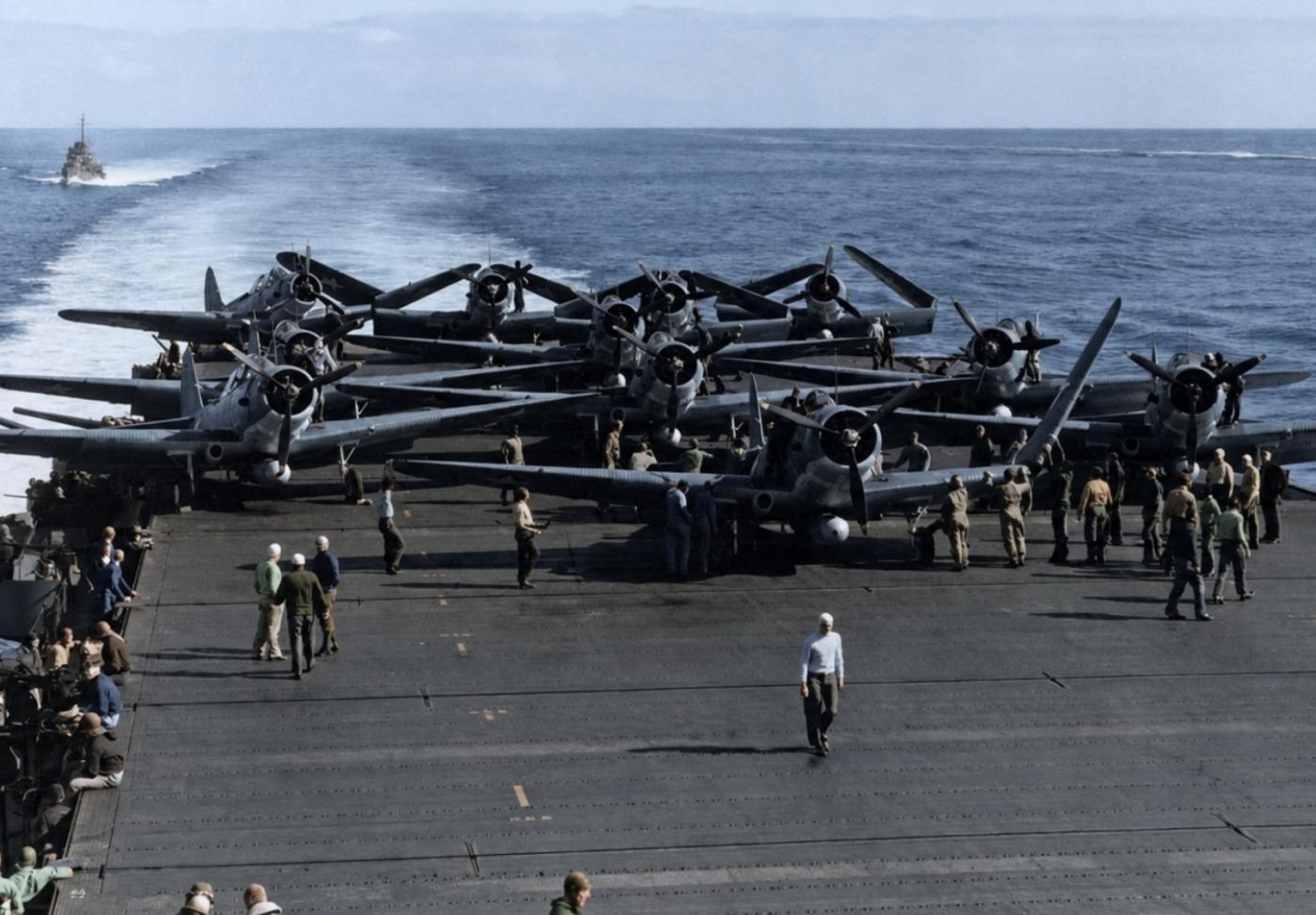
At about 4:30 in the morning, Japanese carriers Akagi, Kaga, Sōryū, and Hiryū began launching aircraft. The strike included dive bombers, torpedo bombers, and Zero fighters. Their target was Midway’s airfields, fuel tanks, aircraft facilities, and defences. Nagumo’s aim was to smash the island’s ability to resist before Japanese invasion forces arrived. He also kept a reserve force aboard his carriers, armed in case American ships were discovered.
Midway’s radar detected the incoming Japanese aircraft. This was crucial. The defenders had warning, and many American aircraft were launched before the Japanese arrived. That meant the Japanese did not find Midway’s aircraft neatly parked on the ground, as they might have hoped. The Marine fighters rose to intercept, but they suffered badly. Many were older F2A Buffalo fighters and F4F Wildcats facing the elite Zero pilots. The American pilots fought bravely, but the Japanese escorts cut through them. Midway was bombed and damaged, but it was not knocked out.
One of the most important details of the morning was the report from the Japanese strike leader that a second attack on Midway was necessary. The first raid had damaged the base but had not silenced it. This report placed Nagumo in a difficult position. His reserve aircraft, which had been kept ready for possible attacks on American ships, now seemed needed for another strike on the island. At around 7:15, Nagumo ordered aircraft to be rearmed with bombs for another attack on Midway.
At almost the same time, American aircraft from Midway began attacking the Japanese carriers. These attacks came in separate groups and were often poorly coordinated, but they were relentless. B-26 Marauders, TBF Avengers, Marine dive bombers, Army B-17 Flying Fortresses, and other aircraft tried to strike Nagumo’s carriers. Most missed. Some were shot down. The Japanese combat air patrol of Zeros and the ships’ anti-aircraft fire were deadly. Yet these attacks mattered because they kept the Japanese carriers manoeuvring, disrupted flight operations, and forced Japanese fighters to remain busy at low altitude.
Then came the sighting that changed Nagumo’s problem completely. A delayed Japanese scout plane from the cruiser Tone reported American ships to the east. At first, the report was incomplete and did not clearly identify carriers. Nagumo had just ordered planes to be rearmed for a second attack on Midway. Now he had to consider changing them back to torpedoes and armour-piercing bombs for use against ships. This created the famous “Nagumo’s dilemma.” His hangar decks became crowded with aircraft being armed, rearmed, fuelled, and moved. The Japanese carriers were highly efficient offensive weapons, but they were also vulnerable when aircraft, fuel hoses, bombs, and torpedoes were exposed.
Meanwhile, the American carriers had already launched their own strikes. Fletcher and Spruance knew they had to hit the Japanese carriers before the Japanese could hit them. Enterprise, Hornet, and Yorktown sent out torpedo bombers, dive bombers, and fighters. The American air groups did not all find the enemy together. Navigation over open ocean was difficult, communications were limited, and the formations became separated.
The first American carrier attacks were carried out by torpedo squadrons flying low and slow toward the Japanese carriers. These men flew Douglas TBD Devastators, an aircraft already becoming obsolete. They attacked without enough fighter protection, and they had to fly straight into intense anti-aircraft fire and swarms of Zeros. Torpedo Squadron 8 from Hornet was almost completely wiped out. Ensign George Gay was the sole survivor from his squadron’s aircraft crews in that attack, later watching parts of the battle from the ocean. Torpedo Squadron 6 from Enterprise and Torpedo Squadron 3 from Yorktown also suffered terribly. Their torpedoes were unreliable, and they scored no hits.
At first glance, the sacrifice of the torpedo squadrons looked like a disaster. But their attacks helped pull Japanese fighters down to low altitude and kept the carriers turning defensively. They also occupied Japanese attention at the most critical moment. High above, American dive bombers were approaching.
One of the most dramatic moments came when Lieutenant Commander C. Wade McClusky, leading Enterprise dive bombers, could not initially find the Japanese carriers. Fuel was running low. Instead of turning back immediately, he continued searching and noticed the Japanese destroyer Arashi racing northward. Arashi had been delayed after attacking the American submarine USS Nautilus and was hurrying to rejoin Nagumo’s force. McClusky followed its course, and this decision helped lead the American dive bombers to the Japanese carriers.
At around 10:20 to 10:25 in the morning, the decisive blow fell. Dive bombers from Enterprise and Yorktown attacked almost simultaneously. Sōryū was hit by Yorktown’s bombers. Kaga was struck heavily by Enterprise aircraft. Akagi, Nagumo’s flagship, was hit by bombs that ignited aircraft, fuel, and ordnance. In only a few minutes, three of Japan’s four fleet carriers at Midway were burning wrecks. The damage was catastrophic because the carriers were caught during the dangerous process of recovering, refuelling, and rearming aircraft.
The destruction was not simply the result of lucky bombing, although luck played a part. It came from the combination of intelligence, timing, persistence, and pressure. American codebreaking put the carriers in the right place. Midway’s aircraft and the torpedo squadrons kept the Japanese off balance. The delayed scout report, the rearming confusion, and the need to recover aircraft created a narrow window of vulnerability. The dive bombers arrived inside that window.
The battle was not over. Hiryū, the fourth Japanese carrier, remained operational. Under Rear Admiral Tamon Yamaguchi, she launched counterstrikes against Yorktown. Japanese aircraft found Yorktown and hit her with bombs. American damage-control teams worked so effectively that when a later Japanese strike arrived, the attackers mistook Yorktown for an undamaged carrier. Torpedo hits then crippled her. Yorktown would later be abandoned and eventually sunk after being torpedoed by a Japanese submarine.
But Hiryū’s survival was brief. Later on 4 June, American aircraft located and attacked her. Dive bombers from Enterprise, including aircraft from Yorktown that had landed aboard Enterprise after their own carrier was damaged, struck Hiryū and left her burning. By the end of the day, all four of Nagumo’s carriers, Akagi, Kaga, Sōryū, and Hiryū, had been fatally damaged.
The opening of the Battle of Midway on 4 June is fascinating because it shows how modern naval war had changed. The opposing surface fleets never fought a traditional gun battle. The decisive attacks were carried out by aircraft launched from carriers hundreds of miles apart. Commanders made life-or-death decisions based on incomplete reports, delayed scouting messages, and guesses about enemy intentions. A few minutes of timing decided the fate of fleets.
It is also fascinating because Midway was not a simple story of one brilliant move. It was a chain of events. The American codebreakers had to identify the target. Nimitz had to trust their intelligence. Yorktown had to be repaired in time. The carriers had to be placed correctly. Midway’s defenders had to launch before being destroyed on the ground. The torpedo squadrons had to press home attacks against terrible odds. McClusky had to keep searching when he might have turned back. The dive bombers had to arrive at exactly the right moment.
For Japan, the battle began as an operation to complete the destruction left unfinished at Pearl Harbor. For the United States, it began as a dangerous ambush with no guarantee of success. When the sun rose on 4 June 1942, Japan still possessed one of the most powerful carrier forces in the world. By sunset, that force had been broken. Midway did not end the Pacific War, which would continue for more than three brutal years, but it changed its direction. After 4 June, Japan never again held the same freedom to expand across the Pacific. The battle began with Japanese aircraft heading toward a tiny American island, but it became the moment when the tide of the Pacific War began to turn.