On this day in military history…
On the morning of June 3, 1942, the war that had seemed so distant to many people in Alaska suddenly arrived out of the grey northern sky. Japanese aircraft descended on Dutch Harbor, on Amaknak Island near Unalaska, and began one of the most unusual and often forgotten attacks of the Second World War. It was not an isolated raid by a few wandering aircraft, but part of a larger Japanese operation in the North Pacific, linked in timing to the great battle then unfolding around Midway. While the world would remember Midway as one of the decisive turning points of the Pacific War, the attack on Dutch Harbor marked the beginning of the Aleutian Islands Campaign and brought combat directly to American territory in Alaska.
Dutch Harbor was a vital American base because of its position in the Aleutian chain, a long arc of storm-beaten islands stretching westward from Alaska toward Asia. The Aleutians were cold, remote, fogbound, and difficult to defend, but their geography made them strategically important. To American planners, they were a northern shield for Alaska and the North Pacific. To Japanese planners, they offered a possible route from which the United States might one day threaten northern Japan. In 1942, with Japan still expanding across the Pacific after Pearl Harbor, the Japanese high command wanted to weaken American power wherever it could and create confusion about its true intentions.
The attack was carried out by aircraft from a Japanese carrier striking force under Rear Admiral Kakuji Kakuta. His force formed part of the wider Japanese plan that also included the attack on Midway. The Aleutian operation has often been described as a diversion, intended to draw American attention and naval strength away from Midway, although it also had its own strategic purpose. The Japanese hoped to neutralize Dutch Harbor, disrupt American operations in Alaska, and then occupy positions farther west in the Aleutians. Within days, Japanese troops would land on Kiska and Attu, making them the only parts of North American soil occupied by Japanese forces during the war.
Dutch Harbor itself was not an ordinary town. It was a busy military and naval installation, with the Dutch Harbor Naval Operating Base and the U.S. Army’s Fort Mears nearby. These were among the westernmost American military bases in Alaska. Yet the area was harsh and difficult. The weather could change quickly; fog, low clouds, rain, and fierce winds were common. The same weather that made Japanese attack difficult also made American defense difficult. Aircraft could be hidden by cloud, radar was still limited, and pilots on both sides had to fight the climate as much as each other.
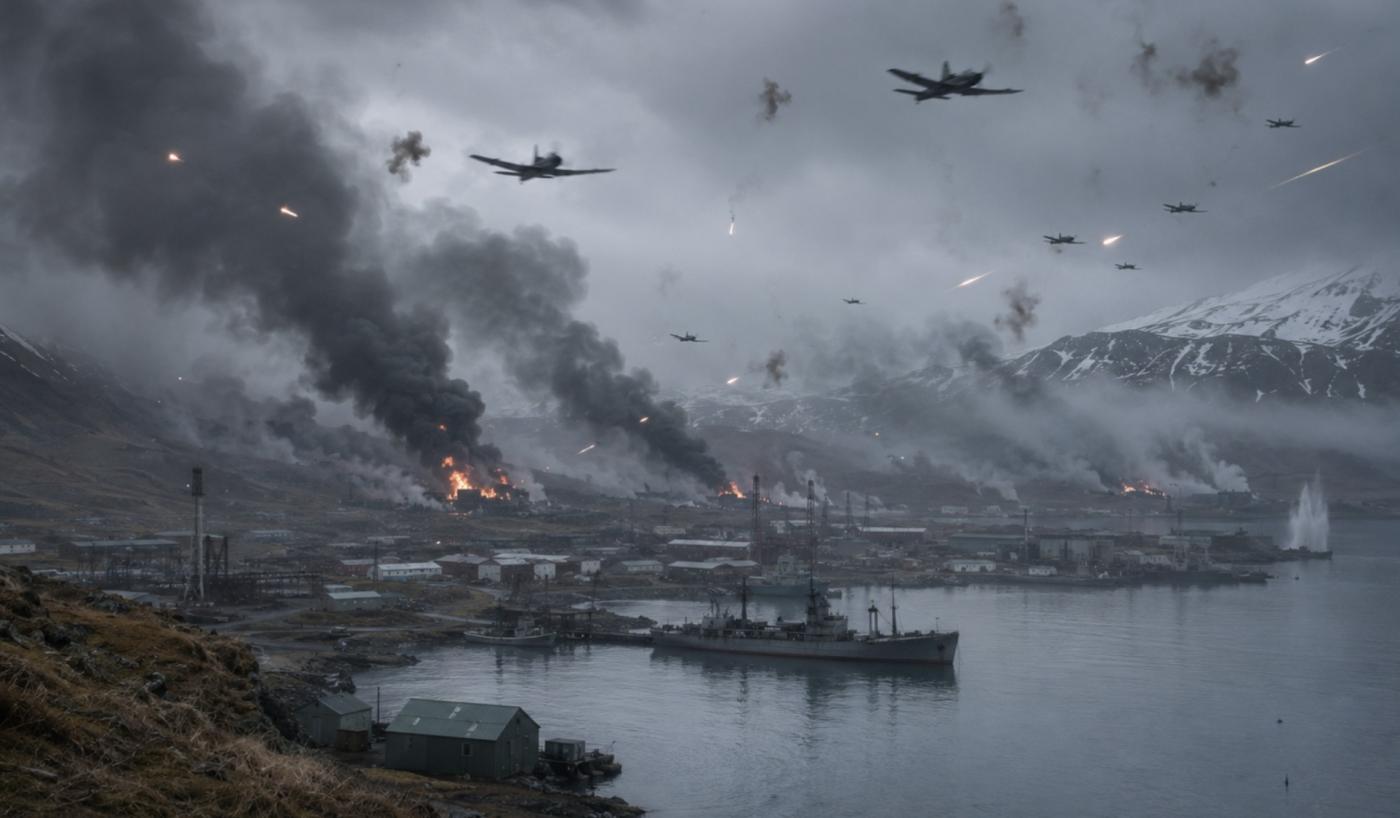
The first attack came early on June 3. Japanese aircraft appeared over Dutch Harbor at about 5:45 in the morning. The attackers included bombers and fighters, and their targets were military installations, fuel tanks, radio facilities, ships, and barracks. The Americans had warning that an attack was possible, partly because U.S. codebreakers had learned enough from Japanese communications to know that something was planned in the North Pacific. Even so, the exact timing and location of the blow could not be known with certainty. The defenders were alert, but the conditions were chaotic. Anti-aircraft guns opened fire, men rushed to battle stations, and the people on the ground watched aircraft vanish and reappear through cloud and smoke.
One of the striking details of the Dutch Harbor attack was the confusion caused by the landscape. Japanese pilots expected to find a major airfield near the harbor, but the Americans had built some of their important airfields elsewhere because Dutch Harbor itself had little flat land suitable for runways. Important American aircraft facilities were at places such as Umnak and Cold Bay. This meant that the Japanese attackers did not find quite what they expected. They bombed Fort Mears, the naval base, and nearby installations, but the raid did not destroy American air power in Alaska.
The first day’s attack caused damage, but it was not a crippling blow. Bombs hit buildings, barracks, and military facilities. Fires broke out, and smoke rose over the harbor. Men were killed and wounded, and the sudden violence shook the military personnel and civilians who had lived with the knowledge that Alaska might be attacked but had never before experienced it. The raid also hit psychologically. Pearl Harbor had shown that Japan could strike across the Pacific, but Dutch Harbor showed that even the far northern American frontier was not beyond reach.
Later that same day, a second attack came at about 7:34 in the evening. This second raid was made by a larger group of Japanese aircraft and added to the destruction and alarm. Again, American anti-aircraft crews fought back. The weather, so often a curse in the Aleutians, helped and hindered both sides. Clouds could conceal Japanese aircraft, but they also broke up formations and made accurate bombing more difficult. The defenders’ gunfire was fierce, and although the Japanese caused damage, they did not achieve a clean or decisive victory.
The attack continued on June 4. Japanese aircraft returned, and this second day produced some of the most memorable images of the battle. Bombs struck the old steamer SS Northwestern, which had been used as a barracks ship. The vessel caught fire, and photographs of the burning ship became among the most famous images of the Dutch Harbor raid. The Seims-Drake warehouse also burned. The flames and smoke gave the scene a dramatic quality, but the actual military effect was still limited. Dutch Harbor had been hurt, not destroyed.
The SS Northwestern was an interesting relic in itself. Before the war, it had a long career in northern waters, and by 1942 it was no longer a front-line vessel but still served a practical military purpose. Its destruction symbolized the vulnerability of the base and the sudden transformation of a remote harbor into a battlefield. For those who were there, the sight of familiar structures burning must have been unforgettable. In the Aleutians, where the environment already made daily life difficult, fire and bombing added a new level of fear.
American forces did manage to hit back. Anti-aircraft fire damaged and destroyed some Japanese aircraft, and American fighters attempted to intercept the attackers where weather allowed. One of the most important results of the raids was the later recovery of a Japanese Mitsubishi A6M Zero fighter that had crash-landed on Akutan Island after being damaged during the operation. The pilot, Tadayoshi Koga, was killed in the crash, but the aircraft remained largely intact. American forces later recovered it, repaired it, and tested it. Known as the Akutan Zero, it became one of the most valuable intelligence prizes of the Pacific War because it allowed American pilots and engineers to study the strengths and weaknesses of Japan’s famous fighter.
The Zero had gained a terrifying reputation early in the war. It was fast, agile, and deadly in the hands of experienced Japanese pilots. Before intact examples were available for study, American pilots often had to learn how to fight it through painful experience. The Akutan Zero helped reveal that the aircraft, while highly maneuverable, had weaknesses in protection, durability, and performance under certain conditions. That knowledge contributed to improved American tactics. In this way, one damaged aircraft from the Dutch Harbor operation had consequences far beyond Alaska.
Casualties from the Dutch Harbor attack were significant but not catastrophic compared with larger battles in the Pacific. American personnel were killed and wounded, aircraft were lost, and facilities were damaged. Japanese losses were smaller in number but included aircraft and trained aircrew, which Japan could less easily replace over time. The greatest effect of the raid was strategic and psychological. It proved that the Aleutians were not a forgotten edge of the map. The region was now an active war zone.
Only a few days after the attack on Dutch Harbor, Japanese forces occupied Kiska and Attu. These landings shocked the American public and military leadership. The idea that enemy troops were occupying American territory, even remote islands far out in the Aleutian chain, was deeply disturbing. The occupation also had tragic consequences for the Native Unangax̂ people of the region. On Attu, villagers were taken by the Japanese to Japan, where many suffered terribly. Elsewhere in the Aleutians, American authorities evacuated Unangax̂ communities, often to poor conditions in southeast Alaska. The Aleutian war was therefore not only a military campaign; it was also a story of civilian displacement and suffering.
The geography of the Aleutians made the campaign that followed extraordinarily difficult. Soldiers, sailors, airmen, and civilians endured cold, mud, wind, fog, isolation, and constant uncertainty. Machines broke down. Aircraft disappeared in bad weather. Ships faced rough seas and poor visibility. Supplying bases was a struggle. In many ways, the Aleutian Campaign was fought as much against the environment as against the enemy. Veterans later remembered the miserable weather, the loneliness, and the sense of fighting in a place that the rest of the world barely understood.
The Japanese attack on Dutch Harbor also exposed weaknesses in American readiness in Alaska, but it accelerated a massive military buildup. Airfields, roads, barracks, fuel storage sites, and defensive positions expanded rapidly. American forces pushed westward along the island chain, establishing bases from which they could bomb Japanese-held Kiska and Attu. The United States could not allow Japan to remain in the Aleutians, partly for military reasons and partly because of the symbolic importance of removing an enemy from American territory.
In May 1943, American forces landed on Attu. The battle there became one of the bloodiest and most brutal fights of the Pacific War in proportion to the numbers involved. Japanese troops fought almost to the last man, and American soldiers suffered heavily from combat and exposure. In August 1943, American and Canadian forces landed on Kiska, expecting another savage battle, only to find that the Japanese had secretly evacuated under cover of fog. Even without enemy troops present, the Kiska operation still produced casualties from accidents, mines, and friendly fire, showing again how treacherous the Aleutian environment could be.
Looking back, the Dutch Harbor attack can seem small compared with Pearl Harbor, Midway, Guadalcanal, or Iwo Jima. Yet it deserves attention because it was part of the same vast struggle for control of the Pacific. It showed Japan’s willingness to stretch the war across enormous distances. It forced the United States to defend and develop Alaska as a major military region. It led directly into the occupation of Attu and Kiska, the suffering of Aleutian civilians, and a long, costly campaign in one of the world’s most difficult battlefields.
The attack also had a powerful symbolic meaning. On June 3, 1942, bombs fell not on a distant colonial outpost, but on American territory. Dutch Harbor became one of the few places in North America directly attacked by Japanese aircraft during the Second World War. For the people who were there, the war was not something heard about on the radio or read about in newspapers. It was the sound of engines in the clouds, anti-aircraft guns firing from the hills, explosions among familiar buildings, ships burning in the harbor, and the realization that even the cold, remote Aleutians were part of a global conflict.
Today, Dutch Harbor and the surrounding sites remain important places of memory. The Dutch Harbor Naval Operating Base and Fort Mears have been recognized for their historic significance, and the Aleutian Islands World War II National Historic Area preserves the memory of the campaign. The story of June 3, 1942, is a reminder that the Second World War reached into unexpected places and affected communities far from the famous battlefields. The attack on Dutch Harbor was not the largest battle of the war, but it was dramatic, unusual, and deeply important. It opened the war in Alaska, helped shape the Aleutian Campaign, and left behind stories of courage, confusion, loss, endurance, and survival in one of the most remote theatres of the Pacific War.