On this day in military history…
Operation Piledriver began on 1 June 1951, during the final mobile phase of the Korean War. By this stage, the conflict was changing from sweeping advances and retreats into a war of fixed lines, patrols, artillery duels and bitter local battles. It formed part of the wider United Nations counteroffensive after the failure of the Chinese Spring Offensive, and its purpose was to secure stronger defensive ground north of the Kansas Line and push forward toward the Wyoming Line.
By spring 1951, the war had already seen dramatic reversals. North Korea’s invasion had almost driven South Korean and UN forces into the sea at Pusan. The Inchon landing then changed the course of the war, allowing UN forces to advance deep into North Korea. Chinese intervention reversed that success and forced a difficult retreat. By early 1951, however, the Eighth Army had recovered under commanders such as Matthew Ridgway and James Van Fleet, using artillery, air power and steady pressure to regain ground near the 38th Parallel.
The operation followed earlier UN advances such as Thunderbolt, Killer, Ripper, Rugged and Dauntless. These had worn down Chinese and North Korean forces and restored UN control over important ground. When the Chinese Spring Offensive of April and May 1951 lost momentum, the UN command moved to exploit the opportunity. The aim was not a reckless drive north, but a controlled advance to strengthen the front and deny the enemy useful terrain.
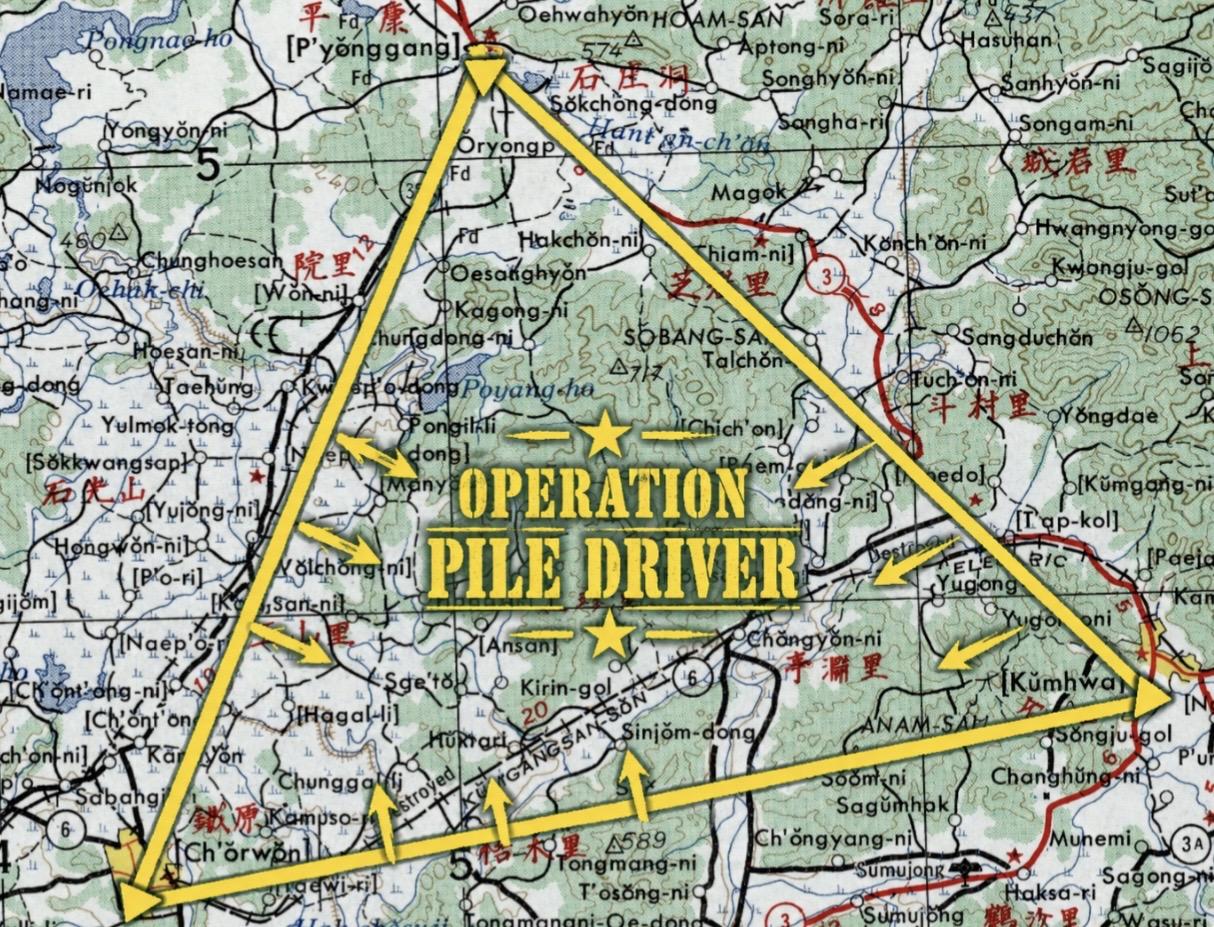
The geography mattered greatly. The Kansas Line was a defensive position north of the 38th Parallel in several sectors. The Wyoming Line was a forward bulge beyond it, leading toward Chorwon and Kumhwa. These areas formed the southern approaches to the Iron Triangle, a key Communist supply and movement zone bounded by Chorwon, Kumhwa and Pyonggang. Its roads and valleys allowed Chinese and North Korean forces to move men and supplies toward the front, so threatening it reduced their ability to launch another major offensive.
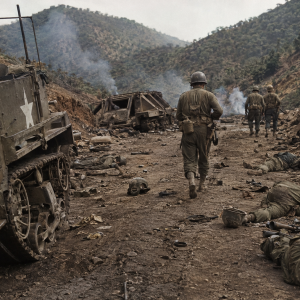
The fighting was shaped by Korean terrain. Hills, ridges, narrow valleys, poor roads and bad weather made movement slow and exhausting. Units often had to fight for high ground rather than towns. Tanks and infantry worked together where the ground allowed, while artillery and air support were used to suppress enemy positions. This was not a single dramatic battle, but a grinding advance to seize defensible ground and keep pressure on retreating Communist forces.
The main UN formations involved were U.S. I Corps and IX Corps, operating along the western and central front with American and allied troops. Their task was to move toward the Wyoming Line and threaten the Iron Triangle. Chorwon and Kumhwa were key objectives and were captured on 11 June 1951. Two tank-infantry task forces later reached Pyonggang, the northern point of the triangle, on 13 June. The town was found deserted, but the surrounding high ground remained dangerous, so UN forces did not try to hold it permanently.
The capture of Chorwon and Kumhwa was significant because it forced the enemy away from ground they valued. UN forces had not destroyed the Chinese and North Korean armies, but they had pushed them back and reduced their ability to use the Iron Triangle as a forward base. The advance also gave the UN stronger defensive terrain, which was vital in Korea, where ridgelines dominated movement and observation.
This campaign marked a turning point in the Korean War. It was among the last periods when the front moved substantially. After June 1951, the war increasingly became a positional conflict. Armistice talks began in July, but fighting continued for two more years over outposts, ridges and limited objectives such as Bloody Ridge, Heartbreak Ridge, Old Baldy, Pork Chop Hill and the Hook.
The operation did not end the war or bring a decisive victory. Its importance was practical. It helped stabilize the UN line, secured better defensive positions and reduced the chance of another successful Communist breakthrough. It also showed that UN aims had become more limited: defend South Korea, improve the line and negotiate from a position of strength.
For the soldiers involved, it was another hard campaign in a brutal war. It lacked the fame of Inchon, Chosin Reservoir or the Pusan Perimeter, but it played an important role in shaping the final course of the conflict. The gains were measured not in spectacular breakthroughs, but in ridgelines taken, road junctions secured and enemy routes disrupted.
By mid-June 1951, the UN had strengthened its front, threatened the Iron Triangle and helped create the conditions for the long stalemate that followed. The war would continue until 27 July 1953, but after this advance the front had largely settled into the pattern that dominated the final two years: fortified lines, limited attacks, artillery exchanges and a costly struggle for tactical advantage.