On this day in military history…
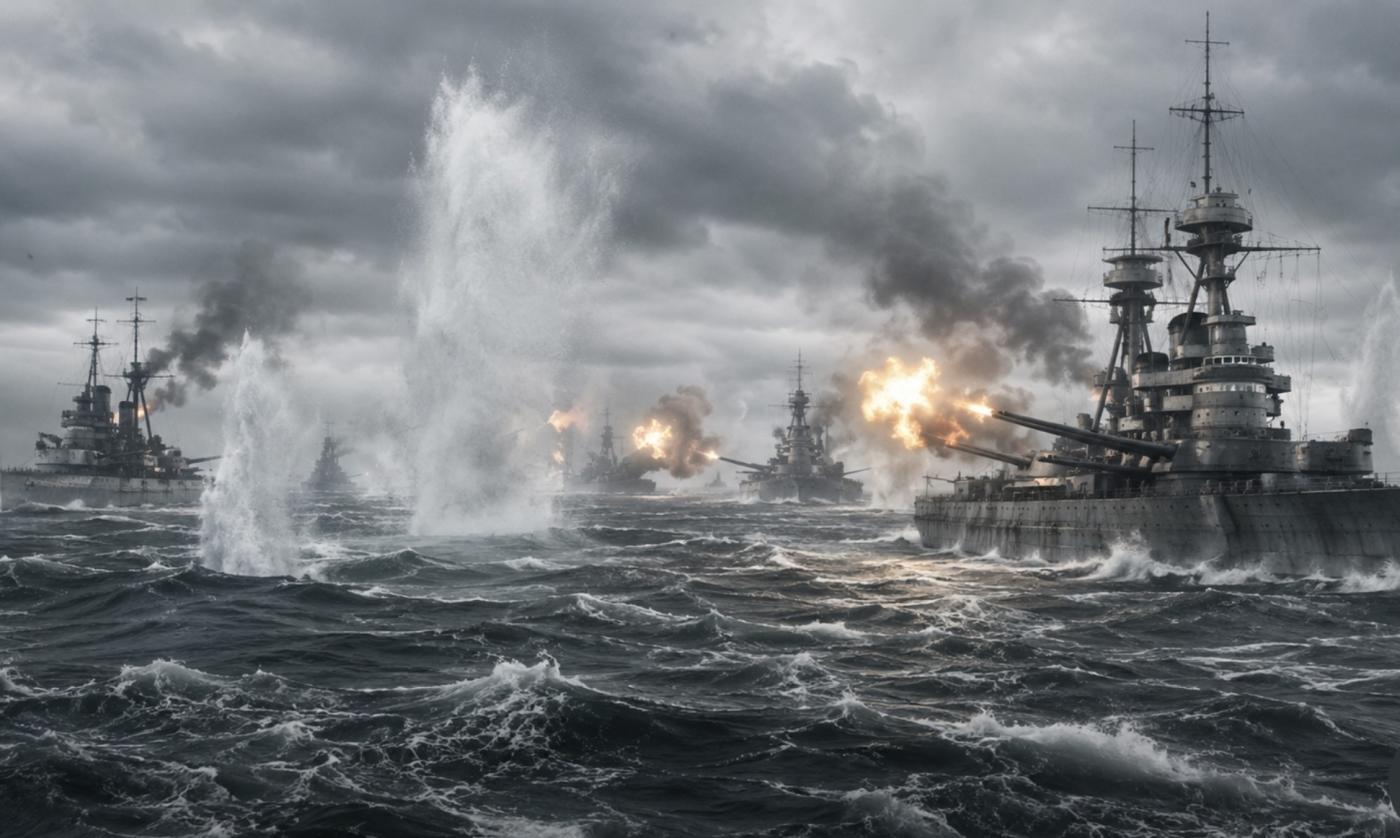
The Battle of Jutland was the largest naval battle of the First World War and the only full-scale clash between the British Grand Fleet and the German High Seas Fleet. It was fought in the North Sea, off the coast of Denmark’s Jutland peninsula, from 31 May to 1 June 1916. Although the battle ended without the clear, crushing victory that either side wanted, it became one of the most debated naval engagements in history. Britain lost more ships and men, yet Germany failed to break the British naval blockade or alter the wider balance of sea power. In strategic terms, Jutland confirmed Britain’s command of the seas; in human terms, it was a costly and traumatic encounter fought by thousands of sailors in steel ships, smoke, darkness and confusion.
At the outbreak of the First World War in 1914, Britain possessed the most powerful navy in the world. The Royal Navy’s Grand Fleet, based mainly at Scapa Flow in the Orkney Islands, existed to prevent Germany from gaining control of the North Sea and threatening Britain’s trade, coastline and imperial communications. Germany’s High Seas Fleet, based at ports such as Wilhelmshaven, was smaller but modern, well trained and dangerous. Admiral Reinhard Scheer, commander of the High Seas Fleet, knew that Germany could not easily defeat the entire Grand Fleet in a straightforward battle. Instead, the German plan was to lure out and destroy isolated portions of the British fleet, gradually reducing British superiority.
The British naval blockade was one of the main reasons Germany sought action. Britain used its control of the sea to restrict supplies reaching Germany, placing increasing pressure on the German economy and civilian population. For Germany, breaking or weakening that blockade was essential. For Britain, maintaining the blockade was central to the war effort. This meant that even before Jutland, the North Sea had become a vast strategic battlefield, watched by submarines, cruisers, destroyers, mines and wireless intelligence.
A major advantage for Britain was intelligence. The Admiralty’s codebreaking unit, known as Room 40, had broken important German naval codes and could often detect German fleet movements. In late May 1916, British intelligence learned that a major German operation was under way. The German plan involved Vice-Admiral Franz von Hipper leading a force of battlecruisers northward to lure British ships into a trap, with Scheer’s main battle fleet following behind. However, the British also put to sea, and Admiral Sir John Jellicoe, commander of the Grand Fleet, sailed with the main British force to intercept the Germans. Vice-Admiral Sir David Beatty, commanding the British Battle Cruiser Fleet, moved ahead as the advanced striking force.
The battle began on the afternoon of 31 May when scouting forces from both sides made contact. Beatty’s battlecruisers encountered Hipper’s battlecruisers, and the two forces began what became known as the “run to the south.” Hipper deliberately led Beatty toward the approaching German main fleet. The British battlecruisers opened fire, but German gunnery was accurate and deadly. HMS Indefatigable was hit and exploded, with the loss of almost her entire crew. Soon afterward, HMS Queen Mary suffered the same fate, blowing up after German shells penetrated her armour and ignited ammunition. These catastrophic losses shocked the British fleet. Beatty is famously reported to have remarked, “There seems to be something wrong with our bloody ships today.”
The destruction of the British battlecruisers revealed serious weaknesses in British design and ammunition-handling practices. Battlecruisers had heavy guns and high speed but sacrificed armour compared with battleships. More dangerously, British crews had sometimes prioritised rapid firing by keeping anti-flash safety doors open and storing cordite charges in ways that increased the risk of explosion. When German shells reached turrets or ammunition passages, fire could flash down into magazines and destroy an entire ship within seconds. German ships also suffered severe damage, but their armour protection and flash-control systems generally proved more effective.
As Beatty continued southward, he eventually sighted the main body of the German High Seas Fleet. Realising the danger, he turned north in an attempt to draw the Germans toward Jellicoe’s approaching Grand Fleet. This phase became known as the “run to the north.” Beatty’s force, now joined by the fast battleships of the 5th Battle Squadron under Rear-Admiral Hugh Evan-Thomas, came under heavy pressure. The Queen Elizabeth-class battleships of the 5th Battle Squadron were among the most powerful warships in the world, with 15-inch guns, and they gave the British a much-needed increase in firepower. Even so, communication problems and signalling delays caused confusion during the manoeuvre.
The decisive moment came in the early evening when Jellicoe deployed the Grand Fleet into battle line. This was an extremely difficult command decision. The Grand Fleet consisted of many battleships spread across the sea in columns, and Jellicoe had to form them into a single line at the right moment and in the right direction. If he deployed wrongly, the British fleet could be exposed to torpedo attack or fail to bring its guns to bear. Jellicoe’s deployment was later praised as a superb piece of fleet handling. As the British line formed, Scheer suddenly found himself facing the full weight of the Grand Fleet.
For a short period, the German fleet was in great danger. The British battleships crossed the German line of advance, allowing many British guns to fire while the Germans had fewer guns bearing in reply. This was the classic naval manoeuvre known as “crossing the T.” Scheer responded by ordering a sudden battle turn away, a well-practised German manoeuvre in which the entire line reversed course almost simultaneously. This saved the High Seas Fleet from possible destruction. Later, Scheer turned back and again encountered the British line, forcing him to order another emergency turn away. To cover the retreat, he sent battlecruisers and destroyers into a dangerous attack, including torpedo attacks that compelled Jellicoe to turn away rather than risk losing battleships to torpedoes.
This decision has been debated ever since. Some critics argued that Jellicoe was too cautious and missed a chance to annihilate the German fleet. Others have pointed out that he commanded Britain’s most important military asset. Winston Churchill later wrote that Jellicoe was the only man on either side who could lose the war in an afternoon. If the Grand Fleet had been badly damaged or destroyed, Britain’s blockade, security and global position could have been gravely threatened. Jellicoe’s caution was therefore not simple timidity; it reflected the enormous strategic responsibility placed upon him.
As darkness fell, the battle entered a confused and brutal night phase. Night fighting at sea in 1916 was extremely difficult. Ships struggled to identify friend from foe. Wireless messages, searchlights, gun flashes, smoke and darkness created chaos. The German fleet crossed behind the British and fought several sharp actions with British cruisers and destroyers. HMS Black Prince was destroyed after blundering close to German battleships. The armoured cruiser HMS Defence had already exploded earlier in the battle, and HMS Warrior was fatally damaged. Destroyers on both sides launched torpedo attacks at close range. The German pre-dreadnought battleship Pommern was torpedoed and exploded, with the loss of all aboard.
By the morning of 1 June, Scheer had succeeded in bringing the High Seas Fleet back toward German waters. Jellicoe, not fully aware of the German fleet’s exact position during the night, did not force a renewed daylight battle. Both sides claimed success. Germany pointed to the heavier British losses as evidence of a tactical victory. Britain argued that the German fleet had retreated and that the strategic situation remained unchanged. In raw numbers, the British lost 14 ships and more than 6,000 men, while the Germans lost 11 ships and more than 2,500 men. British losses included three battlecruisers: Indefatigable, Queen Mary and Invincible. The Germans lost the battlecruiser Lützow, which was so badly damaged that she had to be scuttled.
The result of Jutland depends on how victory is measured. Tactically, Germany inflicted heavier losses and demonstrated excellent gunnery, ship design and damage control. The High Seas Fleet had performed with skill and courage against a larger opponent. However, strategically, Britain achieved the more important result. The Grand Fleet remained dominant. The blockade continued. The High Seas Fleet never again sought a full fleet battle on the same scale. German surface naval power remained largely confined, and Germany increasingly turned to unrestricted submarine warfare as its main naval weapon.
Jutland also exposed weaknesses in the Royal Navy. British shells often failed to detonate properly after striking German armour, reducing their destructive effect. Communications between British squadrons were imperfect, and Beatty’s battlecruiser tactics came under criticism. The vulnerability of British battlecruisers led to serious concern about armour protection and ammunition safety. At the same time, the battle showed the professionalism and endurance of British sailors, many of whom fought under terrifying conditions while trapped inside steel compartments filled with smoke, cordite fumes and the constant threat of sudden explosion.
For Germany, Jutland brought pride but not freedom of action. The battle proved that the High Seas Fleet could challenge the Royal Navy, but it also confirmed the danger of doing so. Scheer’s fleet had escaped destruction, but only narrowly. The German navy could not afford repeated battles of that scale, especially because Britain could replace losses more easily than Germany. The battle therefore deepened the German leadership’s belief that submarines offered a better chance of defeating Britain by attacking merchant shipping. This helped lead to the resumption of unrestricted submarine warfare in 1917, a decision that contributed to the United States entering the war.
The human experience of Jutland was grim. Sailors served in cramped, deafening and dangerous conditions. A single shell hit could flood compartments, ignite fires, disable turrets or kill entire gun crews. When ships exploded, men often had no chance of escape. Survivors could be left in cold North Sea waters, surrounded by oil, wreckage and darkness. Many families in Britain and Germany received news of losses only after uncertainty and delay. The scale of death was immense, and because the battle did not produce an obvious Trafalgar-style victory, many people struggled to understand what the sacrifice had achieved.
In Britain, public reaction was initially uneasy. Early reports suggested heavy losses, and German claims of victory caused concern. The Royal Navy had long been seen as Britain’s shield, and the idea that it had suffered more severely than expected was disturbing. Over time, however, the strategic interpretation became clearer. The German fleet had not broken the blockade. British sea control endured. The Grand Fleet continued to dominate the North Sea. In that sense, Jutland was not a defeat for Britain, even though it was far from the decisive victory the public had hoped for.
The Battle of Jutland remains important because it marked the climax of the battleship age. It was fought by enormous dreadnoughts and battlecruisers whose power symbolised national strength in the early twentieth century. Yet the battle also showed the limits of such fleets. Mines, torpedoes, submarines, night fighting, poor visibility and imperfect communications all reduced the chance of a clean decisive engagement. The great fleets had been built for a modern Trafalgar, but modern naval warfare proved more complex and less conclusive.
In the end, Jutland was a tactical disappointment for Britain, a tactical success for Germany, but a strategic British victory. The High Seas Fleet survived, but it did not change the course of the naval war. The Royal Navy suffered grievous losses, but it retained command of the sea. The battle’s legacy lies not only in ships sunk or shells fired, but in the way it demonstrated the brutal uncertainty of industrial warfare at sea. It was a battle of courage, confusion, engineering, command decisions and national strategy, fought over two days in the grey waters of the North Sea, and remembered as one of the defining naval engagements of the First World War.