On this day in military history…
The first “thousand bomber” raid of the Second World War took place on the night of 30/31 May 1942, when RAF Bomber Command attacked the German city of Cologne. The operation was called Operation Millennium, and it became one of the most famous bombing raids of the war. It was not just important because of the damage it caused, but because it marked a new stage in the air war. For the first time, Britain sent more than a thousand bombers against a single German city in one night.
The man behind the raid was Air Marshal Sir Arthur “Bomber” Harris, the commander of RAF Bomber Command. Harris had only taken command earlier in 1942, and he wanted to prove that a large bomber force could cause serious damage to Germany. At that time, some people in the British government were questioning whether Bomber Command was worth the huge amount of men, aircraft, fuel and money being given to it. Harris believed that if he could gather a massive force and strike one city with overwhelming power, he could show what Bomber Command was capable of.
Cologne was chosen for several reasons. It was a large and important German city on the River Rhine, with a population of about 700,000 people. It was also a major railway, industrial and communications centre. The city had engineering works, chemical plants, factories, railway yards, power facilities and transport links. It was also within range of the British Gee navigation system, which helped aircraft find their way at night. This made Cologne a suitable target for such a large and complicated operation.
At the time, Bomber Command did not normally have anything close to a thousand aircraft ready for one raid. Its regular front-line strength was only about 400 bombers. To reach the famous total, Harris had to gather almost every available aircraft that could fly. He used aircraft from operational squadrons, training units, conversion units and reserve sources. Instructors were brought in, experienced crews were used, and some trainees were sent on the operation as well. This made the raid impressive, but also risky, because not all the crews had the same level of experience.
In total, 1,047 bombers were sent out against Cologne. The force was made up of many different types of aircraft. The largest number were Vickers Wellingtons, with 602 taking part. These were twin-engined medium bombers and formed the backbone of Bomber Command at that stage of the war. There were also 131 Handley Page Halifaxes, 88 Short Stirlings, 79 Handley Page Hampdens, 73 Avro Lancasters, 46 Avro Manchesters and 28 Armstrong Whitworth Whitleys.
This list of aircraft shows how different Bomber Command was in 1942 from the later years of the war. The Lancaster, which later became the most famous British heavy bomber, was still only present in fairly small numbers. The Wellington was still the main aircraft. The Manchester, which had troublesome engines and was later replaced by the Lancaster, was still in use. Older aircraft such as the Whitley and Hampden were also included because Harris needed every machine he could get.
The plan was not simply to send a thousand aircraft wandering across Germany. The raid was carefully organised. One of the most important ideas was the use of the bomber stream. Instead of aircraft flying in small groups over a wide area, they were sent along a planned route in a concentrated flow. They crossed enemy territory in a fairly short period of time, one after another, at different heights and intervals.
This was designed to overwhelm the German night-fighter defences. At that time, Germany’s night defence system was organised in zones. Each zone had radar, searchlights, anti-aircraft guns and night fighters, but it could only deal with a limited number of bombers at once. By sending a huge number of aircraft through the same general corridor in a short time, the RAF hoped that many bombers would get through before the Germans could react properly.
The bombing itself was planned to last about 90 minutes. This was a major change from earlier raids, which often took place over several hours and were less concentrated. The idea was to hit Cologne so heavily and so quickly that the city’s fire services and rescue teams would be overwhelmed.
The bomb load was a mixture of high explosive bombs and incendiary bombs. The high explosives were used to smash buildings, break open roofs, crater roads, destroy water mains and make it harder for firefighters to work. The incendiaries were then used to start fires inside the damaged buildings. Once roofs were opened and streets were blocked, the fires could spread more easily.
Around 1,455 tons of bombs were dropped on Cologne. A large part of the load was incendiary material, because fire was expected to cause much of the destruction. Some aircraft carried large high explosive bombs, including the 4,000 lb “cookie” or “blockbuster” bomb. These huge bombs were designed to blast buildings open rather than make deep craters. Smaller high explosive bombs and thousands of incendiaries followed, spreading fires across the city.
The raid began shortly after midnight. The bombers crossed the North Sea and flew over occupied Europe toward Germany. The crews faced anti-aircraft fire, searchlights, night fighters, mechanical problems and the danger of collision in the crowded bomber stream. Many of the men were flying in darkness, under great strain, knowing that German defences were waiting for them.
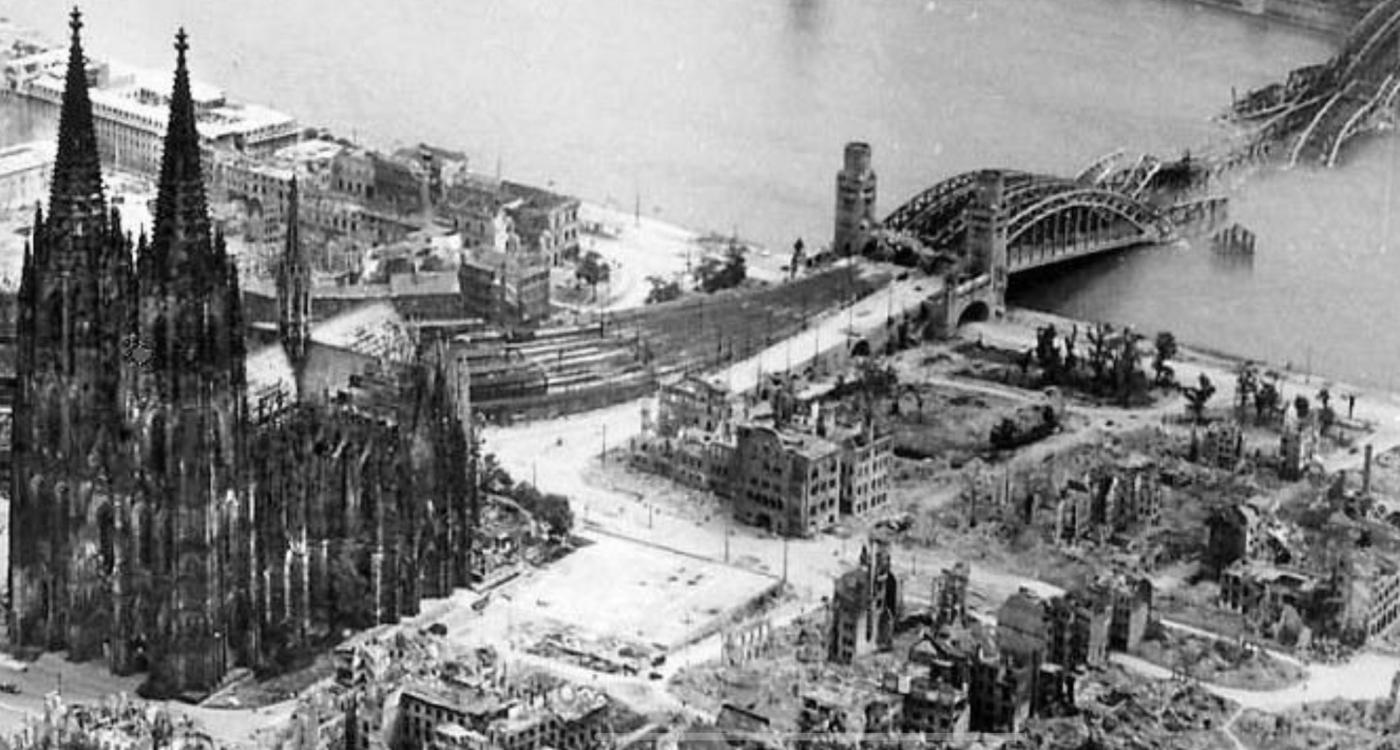
Over Cologne, the attack was intense. Aircraft arrived in rapid succession. Bombs fell across the city centre and surrounding areas. High explosives tore through streets, factories, houses and public buildings. Incendiaries set roofs, shops, warehouses and homes alight. The glow from the fires could be seen from many miles away. Smoke rose high above the city, and the fires spread so quickly that German fire crews could not control them all.
About 868 aircraft are believed to have reached and bombed the target. The raid started roughly 2,500 separate fires, of which around 1,700 were classed as large fires. Cologne did not become a single complete firestorm like Hamburg did in 1943, but the damage was still enormous. Fire destroyed or badly damaged large parts of the city.
Almost 13,000 buildings were destroyed. Thousands more were damaged. Homes, factories, churches, schools, hospitals, shops, offices, railway buildings and public buildings were hit. More than 2,500 industrial and commercial buildings were destroyed or badly damaged. Electricity, gas, water and transport services were disrupted. Railway yards and communications were damaged. Streets were blocked by rubble, broken glass, fallen masonry and unexploded bombs.
The human cost was severe. Around 469 people were killed and about 5,000 were injured. The death toll, terrible though it was, was lower than might have been expected from such a huge raid. This was partly because Cologne had air-raid shelters and the population had some warning. Many people survived underground in shelters and cellars while the city burned above them. Even so, more than 45,000 people were made homeless in one night, and many others fled the city afterwards.
For the people of Cologne, the raid was a terrifying experience. The sound of hundreds of aircraft overhead, the searchlights, the explosions, the fires and the collapse of buildings created scenes of chaos. Families emerged from shelters to find their homes gone. Streets they knew had disappeared under rubble. Fires burned through the night and into the next day. Emergency workers struggled to rescue the trapped and injured while trying to control fires that were breaking out everywhere.
Bomber Command also suffered losses. Forty-one bombers failed to return from the Cologne raid itself. Some were shot down by flak, some by night fighters, and some crashed because of damage, weather, navigation problems or accidents. Considering the size of the force, the loss rate was about four per cent, which Harris considered acceptable for such a large operation. But behind that percentage were hundreds of airmen killed, wounded or captured.
One of the most famous stories from the raid was that of Flying Officer Leslie Manser of No. 50 Squadron. He was flying an Avro Manchester, an aircraft known for its unreliable engines. His bomber was badly damaged, but he kept it flying long enough for his crew to escape. Manser was killed, and he was later awarded the Victoria Cross for his courage. His sacrifice became one of the best-known acts of bravery connected with Operation Millennium.
In Britain, the raid was treated as a great success. Newspapers called it the biggest air attack of the war. Winston Churchill congratulated Bomber Command, and the raid gave the British public a sense that Germany was now feeling the kind of destruction that British cities had suffered during the Blitz. For many people in Britain, Cologne seemed like proof that the RAF could strike back with real power.
For Harris, the raid achieved much of what he wanted. It showed that Bomber Command could organise and control a massive night attack. It proved the value of the bomber stream. It showed that German night defences could be overwhelmed by concentration and timing. It also helped Harris argue that Bomber Command deserved more aircraft, more crews and more support.
But the raid also raised difficult moral questions that have never gone away. Cologne was an industrial and transport target, but the method used was area bombing. That meant large parts of the city were attacked, including homes and civilian districts. Civilians were killed, injured and made homeless. The raid showed the terrible power of modern air warfare, where factories, railways, military targets and civilian life were all mixed together inside the same city.
Operation Millennium did not knock Germany out of the war. Cologne continued to function in some ways, and German industry recovered from many raids more quickly than British planners hoped. But the attack forced Germany to spend huge effort on air defence, fire services, repairs, shelters, anti-aircraft guns and night fighters. It also showed German leaders and civilians that Britain’s bombing campaign was growing more dangerous.
The first thousand bomber raid was therefore a landmark in the air war. It brought together old and new aircraft, experienced crews and trainees, heavy bombers and medium bombers, careful planning and great risk. It caused enormous destruction in Cologne and gave Bomber Command a powerful propaganda success. It also pointed toward the much larger bombing battles that would come later over the Ruhr, Hamburg, Berlin and Dresden.