On this day in military history…
Operation Dynamo was the code name for the evacuation of Allied troops from Dunkirk and the surrounding beaches of northern France between 26 May and 4 June 1940. It was one of the most dramatic military operations of the Second World War, not because it was a victory in the ordinary sense, but because it rescued a defeated army from destruction and allowed Britain to continue the war.
In May 1940, the British Expeditionary Force, usually known as the BEF, was in France and Belgium as part of the Allied attempt to stop the German invasion in the west. Britain had sent a professional army across the Channel, supported by French and Belgian forces. The British Expeditionary Force numbered around 390,000 men in total in France by the spring of 1940, though not all were trapped at Dunkirk. These troops represented the core of Britain’s trained army. If they were lost, Britain would be left dangerously exposed, with little ability to defend itself or carry on the war.
The crisis began when Germany launched its offensive in the west on 10 May 1940. The Allies expected the main German blow to come through Belgium, as it had in 1914. In response, British and French forces moved north and east into Belgium to meet the attack. But the Germans had prepared a far more daring plan. While Allied attention was drawn into Belgium, German armoured forces pushed through the Ardennes, a region the Allies had wrongly believed was unsuitable for a major tank advance. The German breakthrough came with astonishing speed.
By 20 May, German forces had reached the Channel coast near Abbeville. This meant that the British Expeditionary Force, along with large numbers of French and Belgian troops, had been cut off from the main French armies to the south. The BEF was now trapped in a shrinking pocket in northern France and Belgium, with the sea behind it and German forces closing in from the land. The ports of Boulogne and Calais were attacked. Dunkirk became the last major port through which the trapped Allied troops might still escape.
The plan to evacuate the army was not the result of long preparation. It was formed quickly because events were moving too fast for anything else. On 19 May, even before the full scale of the disaster was clear, the possibility of evacuation was being considered in London. Admiral Bertram Ramsay, based at Dover, was placed in charge of planning the withdrawal. His headquarters were in tunnels beneath Dover Castle, a fittingly bleak setting for an operation born out of emergency rather than confidence.
The operation was given the code name Dynamo, reportedly from the dynamo room in the Dover tunnels where some of the planning took place. Ramsay and his staff faced an almost impossible task. They had to bring back a large army from a port under bombing attack, with German forces advancing, limited shipping available, and little time to organise anything. The original expectation was grim. Some estimates suggested that perhaps only 30,000 to 45,000 men might be rescued. The idea that hundreds of thousands could be saved would have seemed wildly optimistic at the start.
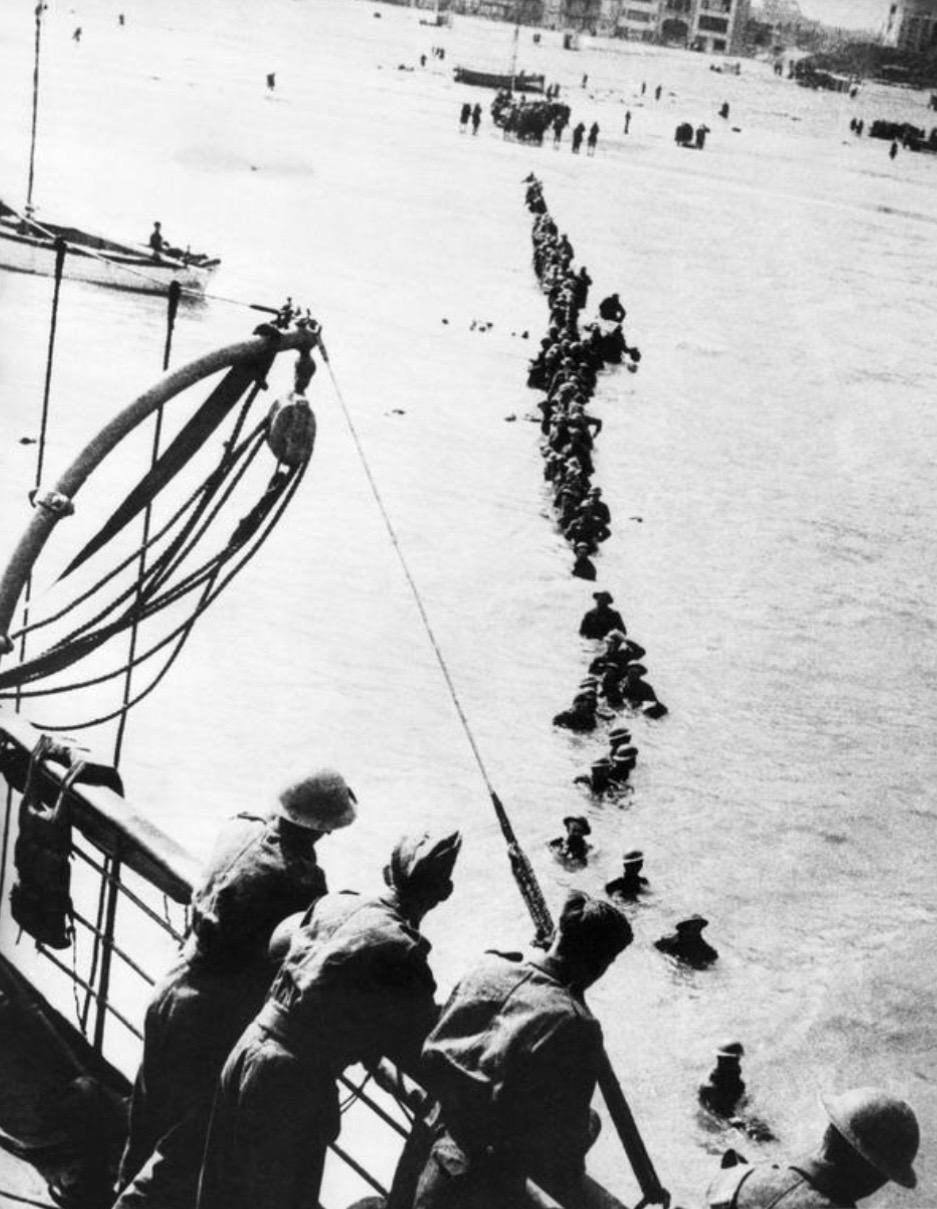
The evacuation began on 26 May 1940. At first, the plan relied mainly on taking troops out through Dunkirk harbour. A harbour was far more efficient than open beaches because soldiers could board larger ships directly from quays and moles. But Dunkirk was heavily bombed by the Luftwaffe, and the port facilities were badly damaged. Smoke, fire, wreckage and confusion filled the town. The beaches, wide and shallow, were also difficult places from which to evacuate men. Large ships could not come close inshore because the water was too shallow, meaning soldiers had to wait in long lines and then wade out to smaller craft.
One of the most important features of the evacuation was the use of the eastern mole at Dunkirk. A mole is a long breakwater, not designed as a passenger pier, but it became a vital lifeline. Ships were able to come alongside it, and tens of thousands of soldiers were taken off from there. Captain William Tennant, sent to Dunkirk to organise the loading of troops, played a major role in making the evacuation work. Without the use of the mole, the numbers rescued would have been far lower.
The famous “little ships” also became part of the story. These were civilian vessels gathered from British rivers, harbours and coastal waters. They included fishing boats, pleasure steamers, lifeboats, motor yachts, barges and other small craft. Some were crewed by naval personnel, while others were taken across by their civilian owners or crews. Their role has sometimes been romanticised, but they were genuinely important. Many could get closer to the beaches than destroyers and larger ships. They ferried men from the shore to bigger vessels waiting offshore, and some carried troops all the way back to England.
The operation was improvised under extreme pressure. Ships arrived, loaded, left, returned, and loaded again. Naval officers, soldiers and civilians had to solve problems hour by hour. The beaches were crowded with exhausted men who had marched and fought for days, often under air attack. Many had thrown away heavy equipment simply to keep moving. Vehicles, artillery, ammunition, fuel and stores were abandoned in huge quantities. Britain was saving the men, but leaving behind much of the army’s material strength.
German pressure on the Dunkirk perimeter was intense, though one of the most debated moments of the campaign was the German halt order. On 24 May, German armoured units were ordered to pause their advance for a time. The reasons are still debated by historians. It may have been due to concerns about marshy ground, the need to rest and repair tanks, the desire to let infantry catch up, or confidence that the Luftwaffe could destroy the trapped troops from the air. Whatever the motive, the pause gave the Allies precious time to form a defensive perimeter and begin the evacuation.
The defence of that perimeter was crucial. The men on the beaches could only be rescued because other Allied soldiers held the line. British and French units fought hard to keep German forces away from Dunkirk. French troops in particular played a major part in defending the perimeter during the later stages of the evacuation. Their resistance helped give the ships the time they needed. The evacuation was not simply a naval miracle; it was made possible by soldiers fighting on land, sailors at sea, and airmen above.
The Royal Air Force also played a vital role, though many soldiers on the beaches believed they had been abandoned by the RAF because much of the air fighting took place inland or out of sight. Fighter Command, flying mainly from bases in southern England, fought the Luftwaffe over the Channel and northern France. The RAF could not stop all bombing attacks, and the beaches and ships suffered heavily, but it prevented the Luftwaffe from having complete freedom. This mattered enormously. If German aircraft had been able to attack without opposition, the evacuation might have collapsed.
The numbers rescued grew far beyond the early estimates. On the first full day, the results were modest. But as the system improved, the pace increased. By the end of the operation, 338,226 Allied troops had been evacuated from Dunkirk. Of these, around 198,000 were British and about 140,000 were French and other Allied soldiers. The figure was far greater than almost anyone had expected when the operation began.
The evacuation did not come without heavy cost. Around 68,000 members of the British Expeditionary Force were killed, wounded, missing or captured during the wider campaign in France and Flanders. The Royal Navy lost ships, including destroyers, and many vessels were damaged. The RAF lost aircraft and pilots. The British Army left behind thousands of vehicles, hundreds of guns, tanks, motorcycles, supplies and vast quantities of ammunition. The army returned home alive, but in many cases without the equipment needed to fight another major battle immediately.
The final stages were especially difficult. By early June, many British troops had already been evacuated, but French forces continued to hold the perimeter and large numbers still needed to be rescued. On the night of 2–3 June and into 4 June, the last evacuations took place. German forces entered Dunkirk on 4 June 1940. The operation was over. The beaches that had been packed with men, wreckage, smoke and abandoned equipment fell into German hands.
In Britain, the evacuation was greeted with immense relief. Newspapers and newsreels presented it as a miracle. The phrase “the Dunkirk spirit” came to mean courage, endurance and national unity in the face of disaster. Small boats crossing dangerous waters under air attack became a powerful symbol of ordinary people helping to save the nation. Yet Winston Churchill, who had become Prime Minister only on 10 May, was careful not to let relief turn into delusion. In his speech to the House of Commons on 4 June 1940, he reminded the country that “wars are not won by evacuations.” Dunkirk had saved the army, but it had not defeated Germany.
That was the true significance of Operation Dynamo. It turned a military catastrophe into a chance of survival. Had the British Expeditionary Force been captured, Britain might have faced enormous pressure to seek terms with Hitler. Instead, the return of the army meant Britain could rebuild, defend itself against invasion, and remain in the war. The men rescued from Dunkirk would later form the basis of Britain’s expanding wartime army.