On this day in military history…
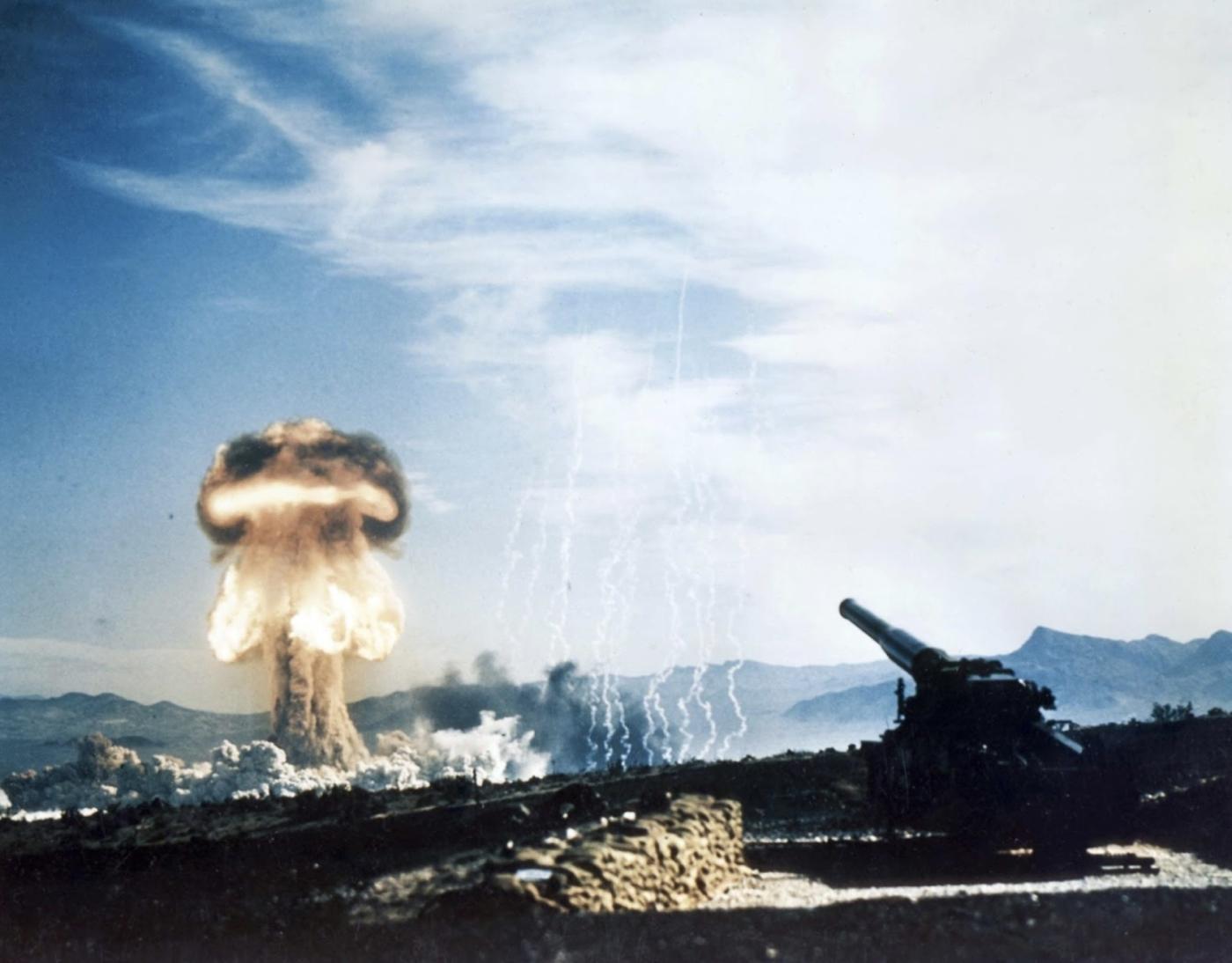
Atomic Annie is the nickname most people remember, but the test itself was officially called Grable. It took place at 8:30 a.m. Pacific Daylight Time on May 25, 1953, at the Nevada Test Site, now the Nevada National Security Site. It was the tenth shot in Operation Upshot-Knothole, a series of eleven U.S. nuclear tests carried out during the tense early years of the Cold War. What made Grable extraordinary was not just the explosion, but the way the weapon was delivered: a 280-millimeter artillery cannon fired a nuclear shell downrange, where it detonated in the air above Frenchman Flat with a yield of 15 kilotons. It remains the only nuclear device ever fired from a cannon.
The gun was the M65 atomic cannon, a huge mobile artillery piece nicknamed Atomic Annie. The idea behind it had grown out of the U.S. Army’s desire for a long-range, mobile heavy weapon that could attack communications centers, fortifications, and enemy artillery. After the Second World War, that ambition merged with the new atomic age: if a nuclear warhead could be made small enough to fit inside an artillery shell, then nuclear firepower could be brought directly to the battlefield instead of relying only on aircraft or strategic bombers. The hard part was miniaturization. A nuclear device had to be engineered into a projectile that could survive the shock of being fired from a cannon, fly accurately, and detonate at the chosen point.
By 1952, the United States had produced what was then the largest mobile artillery piece it had ever built. The cannon cost about $800,000, weighed around 88 tons, and was moved between two specially designed transporter vehicles. Despite its size, the carriage was ingeniously arranged so the weapon could be moved by road at up to about 40 miles per hour, at least on suitable surfaces. It could reportedly be set up and made ready to fire in about 10 to 15 minutes, which was impressive for something so massive. Even so, its great weight was also one of its weaknesses. It needed good roads or prepared surfaces, and that limitation would later help make the system obsolete.
For the Grable test, two 280-millimeter cannons were shipped by rail from Fort Sill, Oklahoma, to Las Vegas, along with a 28-man artillery crew. From there they were taken to the Nevada Test Site, about 65 miles northwest of Las Vegas. The crews spent roughly a month conducting practice firing before the live nuclear round was used. One Army private later recalled that engineers had to bulldoze a packed dirt road strong enough to take the weight of the guns. The two cannons were placed side by side east of Mercury Highway, about seven miles south of Frenchman Flat.
The shell fired that morning was a Mark 9 nuclear artillery projectile. It traveled about seven miles before detonating 524 feet above Frenchman Flat. The burst produced the familiar fireball and mushroom cloud, but unlike tower shots or air-dropped bombs, this one began as an artillery firing. The cannon itself was fired remotely, partly for safety and partly because this was not a normal battlefield exercise. It was a demonstration of a new concept: nuclear artillery as a tactical weapon.
The yield, 15 kilotons, was in the same general range as the Hiroshima bomb, which made the sight especially dramatic. The comparison also shows the strange direction military thinking had taken by 1953. Less than eight years after Hiroshima and Nagasaki, the United States was experimenting with ways to make nuclear weapons usable not only as strategic city-destroying bombs but as battlefield tools. The word “tactical” could make such weapons sound limited, but a 15-kiloton airburst was still an enormous explosion by any conventional standard.
Grable was also part of the Army’s Desert Rock V exercises, in which troops observed nuclear detonations and took part in maneuvers intended to study how soldiers might operate on an atomic battlefield. Operation Upshot-Knothole as a whole involved military participation, weapons effects studies, and civil defense experiments. These tests reflected the period’s belief that nuclear war might be survivable, manageable, and even integrated into ordinary military planning. Troops, equipment, structures, vehicles, and instruments were placed at varying distances to study blast, heat, radiation, and shock effects.
The test also had a public and political dimension. Senior officials, including military leaders and government observers, attended. The image of a cannon firing a nuclear shell was a powerful Cold War symbol: it suggested that the United States could place atomic power in the hands of field commanders, not just bomber crews or strategic planners. In 1953, the Korean War was still fresh in the public mind, the Soviet Union had already tested nuclear weapons, and American defense policy was increasingly focused on nuclear deterrence at every level.
The name Grable followed the test-series practice of using names, but it carried an extra layer of meaning. It is often explained as a phonetic hint at “G” for “gun,” since the projectile was fired from a cannon. It has also often been linked informally to Betty Grable, the famous actress and wartime pin-up, though the official significance lay in the test’s role as a gun-fired atomic projectile. The cannon’s nickname, Atomic Annie, became far more famous than the test name itself, partly because it sounded like something out of a comic book and partly because the weapon looked so visually unmistakable.
The success of the shot proved that a nuclear artillery shell could be fired from a large cannon and detonated as intended. Yet the success also revealed the system’s limits. Atomic Annie was enormous, difficult to move, dependent on good roads, and vulnerable in a real war. Its range was far shorter than that of aircraft, rockets, or later missiles. Once smaller nuclear artillery shells were developed for more practical weapons, including 8-inch and 155-millimeter systems, the giant 280-millimeter cannon quickly lost much of its military appeal.
Twenty of the 280-millimeter atomic cannons were eventually made, but the weapon’s practical life was short. It was a prestige weapon as much as a battlefield solution: impressive, frightening, and technically remarkable, but overtaken by smaller, more flexible nuclear delivery systems. Today, surviving examples are museum pieces rather than weapons of war. The original Atomic Annie is associated with Fort Sill, while other surviving cannons have been displayed at places including Albuquerque, Fort Riley, and Aberdeen Proving Ground.
The Grable test also belongs to the broader and more troubling history of atmospheric nuclear testing. Operation Upshot-Knothole included tower shots, airdrops, and the cannon-fired Grable shot. Grable itself was a 15-kiloton, 524-foot airburst in Area 5, while the whole series included yields ranging from small fizzles to the 61-kiloton Climax shot. These tests helped weapons designers and military planners gather data, but they also exposed personnel and downwind communities to radiation risks that became far more controversial in later decades.
Seen from a distance, the May 25, 1953 firing can look almost theatrical: a giant cannon in the Nevada desert, a flash on the horizon, and a mushroom cloud rising over Frenchman Flat. But behind that image was a serious attempt to reshape warfare around nuclear weapons. Atomic Annie represented a moment when military planners imagined that atomic explosions could be treated as another form of artillery fire, scaled up but still controlled by battlefield doctrine. The fact that it was never repeated with another cannon-fired nuclear round says just as much as the test’s success. It worked, but the world was already moving past it.
In the end, Atomic Annie stands as one of the strangest symbols of the nuclear age. It was both an engineering achievement and a warning sign, a machine that compressed the destructive power of a city-killing bomb into the familiar form of a field gun. On May 25, 1953, it did exactly what it was designed to do: fire a nuclear projectile seven miles into the desert sky.