Churchill Avre
The Churchill AVRE “Flying Dustbin” tank was one of the most unusual and useful armoured vehicles used by Britain during the Second World War. It was not built to fight like an ordinary tank. Its job was to get close to the hardest and most dangerous obstacles on the battlefield and help smash a way through them. Where a normal tank might be stopped by a concrete bunker, a sea wall, a crater, a minefield, a roadblock or an anti-tank ditch, the Churchill AVRE was designed to give the Royal Engineers a fighting chance of clearing the way while under armour.
The name AVRE stood for Armoured Vehicle Royal Engineers. It was, in simple terms, a tank made specially for assault engineers. The men inside were not just tank crewmen; they were soldiers trained to deal with demolitions, obstacles and battlefield engineering. This made the AVRE a very different machine from a standard Churchill. It was not there simply to shoot at enemy tanks. It was there to open roads, destroy strongpoints, bridge gaps, fill ditches, clear routes and help infantry and armour keep moving forward.
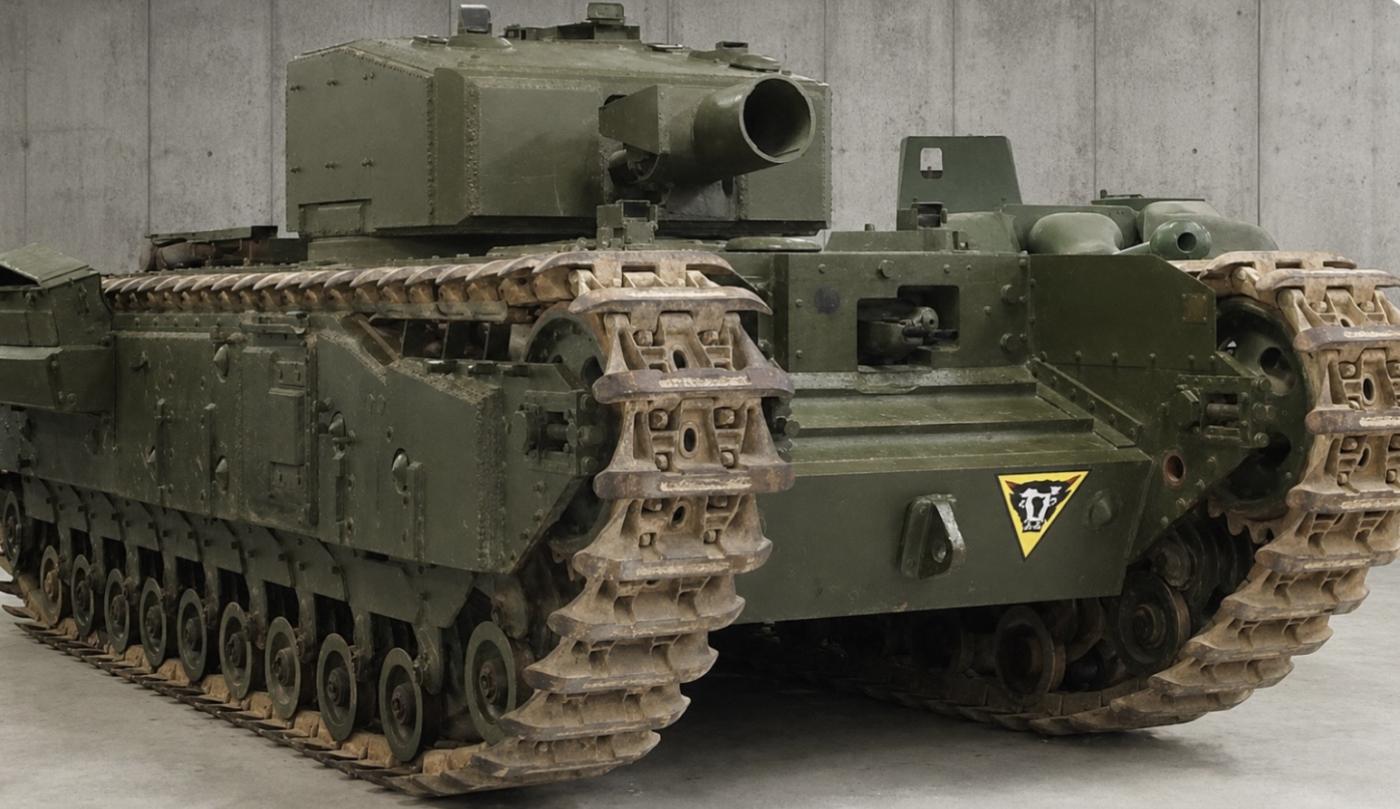
The Churchill tank was a good choice for this kind of work. It was slow, but it was heavily armoured, strong, roomy and very good at crossing rough ground. One of its most useful features was its side doors. These allowed Royal Engineer sappers to get in and out of the vehicle with more protection than they would have had climbing over the top. In the middle of battle, that mattered enormously. An engineer trying to place an explosive charge against a wall, bunker or obstacle was in terrible danger, and the Churchill gave him at least some cover while doing it.
The most famous feature of the Churchill AVRE was its strange and powerful weapon, the Petard mortar. This was the weapon that gave rise to the nickname “Flying Dustbin”. Instead of firing a long, sleek shell like a normal tank gun, the Petard fired a big, squat demolition bomb. The bomb looked rather like a dustbin flying through the air, and the name stuck. It was not elegant, but it was very effective.
The “Flying Dustbin” bomb weighed about 40 pounds and carried a heavy explosive charge. Its purpose was to smash concrete, brickwork, steel obstacles, roadblocks and fortified positions. It was a short-range weapon, so the AVRE had to get dangerously close to its target before firing. That was one of the reasons the Churchill’s heavy armour was so important. The crew had to drive towards some of the most heavily defended parts of the battlefield, often under machine-gun fire, artillery fire, mortar fire and anti-tank fire.
The Petard was a spigot mortar rather than a conventional gun. This meant the bomb was fitted onto a projecting spigot instead of being fired through a normal barrel. When fired, the weapon lobbed the large demolition bomb at the target. It did not have the range or speed of a proper tank gun, but that was not what it was meant for. It was meant to break things that were stopping an attack. A bunker, a wall or a defended building could be hit with a charge far heavier than an ordinary tank shell.
Reloading the Petard was one of the most awkward and dangerous parts of using the AVRE. The bomb was too large to be handled like normal ammunition. The turret had to be turned into the correct position, and a crewman had to load the round through a hatch from inside the tank. This kept him from having to stand fully outside in the open, but it was still risky. The vehicle had to be close to the enemy, and even a brief exposure could be deadly if bullets or shell fragments were flying around.
The Churchill AVRE usually carried a crew of six. Inside the tank, some of the ordinary ammunition storage and internal fittings were removed so that the vehicle could carry engineer stores. These might include explosive charges, detonators, fuses, tools and other equipment needed for demolitions and obstacle clearance. This made the AVRE much more than a tank with a big mortar. It was a moving armoured toolbox for the Royal Engineers.
The AVRE became famous as one of “Hobart’s Funnies”, the specialist armoured vehicles developed under Major-General Sir Percy Hobart for the invasion of Normandy. These strange-looking machines were designed to solve the problems expected on D-Day. The Allies knew that the German beach defences would include mines, wire, concrete bunkers, anti-tank obstacles, ditches, sea walls and fortified exits from the beaches. Ordinary infantry and tanks could be badly delayed or destroyed if they had no way through these defences. The answer was a collection of special vehicles, each built for a particular job.
Among these were swimming tanks, mine-clearing flail tanks, flamethrower tanks, bridge-laying tanks and carpet-laying tanks. The Churchill AVRE was one of the most valuable of them all because it could be adapted to do so many different things. It could fire its Petard mortar at strongpoints, carry demolition stores, push or carry equipment, lay fascines into ditches, carry small bridges and help create routes across broken or defended ground.
One of the AVRE’s useful attachments was the fascine. This was a huge bundle of wooden poles or pipes carried on the front of the tank. When the AVRE reached a ditch, crater or anti-tank trench, it could drop the fascine into the gap, creating a rough crossing point for other vehicles. It was a simple idea, but on a battlefield simple ideas often saved lives. A ditch that might stop an attack could suddenly become passable.
Another important attachment was the small box girder bridge. This allowed the AVRE to bridge gaps or help tanks and other vehicles cross obstacles. There were also AVREs fitted with carpet-laying equipment, sometimes called Bobbin equipment. These carried a roll of matting that could be laid down over soft sand, mud or weak ground. On a beach or in muddy conditions, this could prevent heavy vehicles from sinking or becoming trapped.
The Churchill AVRE was especially important in Normandy. The fighting there was often close, difficult and brutal. The bocage countryside, with its thick hedgerows, narrow lanes and hidden German positions, made movement slow and dangerous. German defenders used concrete, earthworks, mines and roadblocks to delay the Allied advance. The AVRE was exactly the kind of machine needed in such conditions. It could blast strongpoints, help cross obstacles and give engineers a protected way to work near the front line.
Its role on D-Day and afterwards was not glamorous in the usual sense. It was not racing across open country or fighting dramatic tank duels. Instead, it was doing the hard, dirty, dangerous work that allowed other troops to move. It attacked bunkers, helped open beach exits, dealt with obstacles and supported infantry in places where the enemy had prepared strong defences. Without vehicles like the AVRE, many attacks would have been slower, costlier and more chaotic.
The “Flying Dustbin” itself had a powerful psychological effect. Imagine being inside a concrete bunker and seeing one of these heavily armoured Churchills come lumbering towards you. Then, from close range, it fires a huge demolition bomb at your position. Even if the bomb did not completely destroy the structure, the blast could stun defenders, smash embrasures, collapse walls or make the position impossible to hold. For troops facing it, the AVRE was a frightening machine.
There were limits, of course. The AVRE was slow, and the Petard mortar had a short range. It could not stand off at a safe distance and destroy targets like artillery. It had to approach, often under fire, and that required courage from the crew and good support from nearby infantry and tanks. Reloading was slow and awkward, so it could not keep up a rapid bombardment. It was not a perfect vehicle, but it was a very practical one.
The Churchill AVRE also shows how much thought went into the Allied preparations for D-Day. The landings were not simply a matter of putting men and tanks ashore. The Allies had to think about every obstacle between the water’s edge and the roads inland. They needed machines to clear mines, crush wire, bridge ditches, cross soft sand, destroy bunkers and break through walls. The AVRE was part of that careful planning. It existed because someone had looked at the battlefield and asked what would actually stop an attack.
The idea behind the AVRE had been influenced by bitter experience. Earlier raids and operations had shown how disastrous it could be when tanks and infantry met obstacles they could not quickly overcome. A blocked route could become a killing ground. Men could be pinned down in front of a wall or bunker. Tanks could be trapped on a beach or in a narrow lane. The AVRE was designed to prevent that. It brought engineers, explosives and armour together in one vehicle.
The Churchill chassis continued to prove useful because of its strength and adaptability. It could carry awkward loads, push equipment, climb difficult ground and absorb punishment. Although it was not fast, speed was less important for the AVRE than protection and reliability. It was an assault tool, meant to operate at the most dangerous point of contact with the enemy. In that role, the Churchill’s toughness was a major advantage.
The AVRE continued to serve after D-Day as the Allies fought through France, Belgium, the Netherlands and into Germany. Wherever there were fortified villages, defended towns, rivers, roadblocks, bunkers or minefields, vehicles like the AVRE remained useful. It was not a one-day invention for the Normandy beaches. It became part of the Allied method of breaking through prepared defences.
One of the most interesting things about the Churchill AVRE is that it looked almost comic but served a deadly serious purpose. The nickname “Flying Dustbin” sounds humorous, and the bomb did indeed look clumsy, but the weapon was a serious demolition tool. It could open gaps, destroy obstacles and save lives by doing in seconds what might otherwise have required engineers to crawl forward with charges under enemy fire.
The men who operated these vehicles needed great courage. They were expected to drive close to bunkers, minefields and obstacles, often while the enemy was concentrating fire on them. The engineers might then have to leave the vehicle, place charges, connect fuses or work with bridging equipment while still under threat. The armour helped, but it did not remove the danger. The AVRE crews and sappers were doing some of the most hazardous work on the battlefield.
In many ways, the Churchill AVRE was a perfect example of British wartime improvisation. It was not sleek or elegant. It did not look like the popular idea of a powerful battle tank. It was a heavy, slow, odd-looking engineering tank with a huge demolition mortar and a range of peculiar attachments. Yet it solved real problems, and that made it invaluable. It helped turn beaches, ditches, walls and bunkers from impossible barriers into obstacles that could be overcome.
The “Flying Dustbin” tank deserves to be remembered because it was a lifesaver as much as a weapon. Its purpose was to protect engineers, support infantry and keep the attack moving. Every gap blown in a wall, every ditch filled with a fascine, every bunker smashed by a Petard bomb and every route opened through a defended area could mean fewer men killed in the open. It was a machine built not for glory, but for the grim practical business of getting soldiers through the strongest defences the enemy could build.