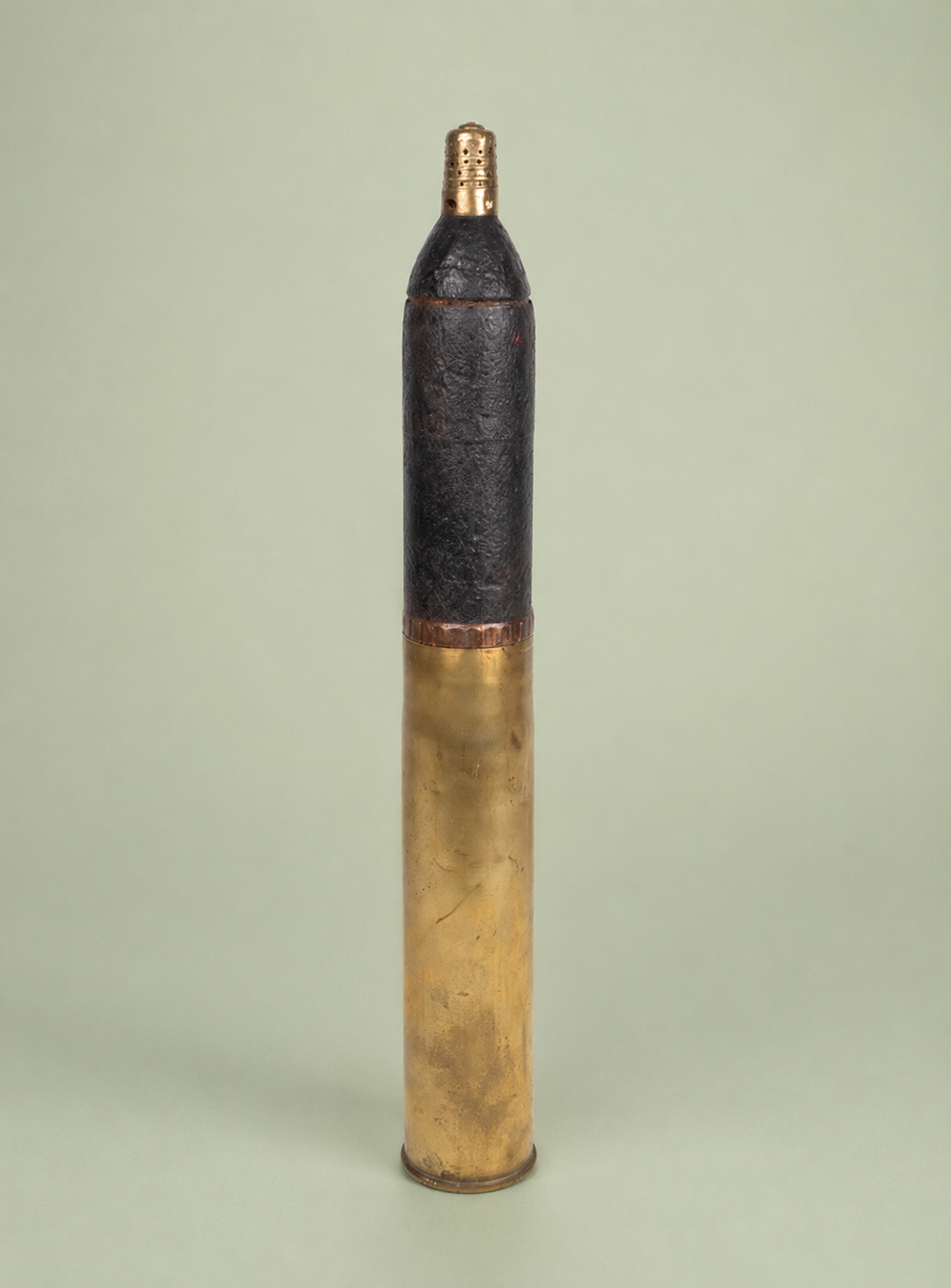
Bee Hive Artillery Shell
The French 75 mm “Beehive” round of the First World War was one of the most feared anti-personnel projectiles fired from the famous Canon de 75 modèle 1897. Although the nickname “Beehive” is often used by collectors today because of the mass of small projectiles packed inside the shell, the French normally described this type of ammunition as an obus à balles, literally a “shell with balls”. In British terminology it would generally be recognised as a form of shrapnel shell. Rather than relying on a large explosive charge to blast its target apart, its purpose was to burst in the air and throw hundreds of metal balls forward over an area occupied by enemy soldiers.
The ammunition had been developed for the revolutionary French 75 mm field gun introduced in 1897. The gun itself was created through the work of French artillery officers including Albert Deport, Étienne Sainte-Claire Deville and Émile Rimailho, and became one of the most important artillery weapons of the First World War. Its hydro-pneumatic recoil system allowed the barrel to recoil while the carriage remained almost stationary, meaning a trained crew could fire extremely rapidly without having to relay the gun after every shot. In ideal circumstances, a crew could fire well over a dozen aimed rounds a minute, and considerably faster rates were possible for short periods.
When the 75 entered French service, anti-personnel shrapnel ammunition was considered one of its principal battlefield weapons. Before armies became trapped behind deep trench systems, artillery doctrine expected infantry and cavalry to operate much more openly. A shell capable of bursting above advancing soldiers and sweeping the ground with hundreds of projectiles therefore appeared devastatingly effective.
The Model 1897 ball shell weighed approximately 7.25 kilograms when fully loaded. Inside its relatively thin steel body were around 261 hardened lead balls weighing approximately 12 grams each. These were not tiny shotgun pellets; each individual ball was a substantial projectile capable of causing severe or fatal wounds when travelling at high velocity. The balls were generally made from lead hardened with antimony, and their combined weight alone exceeded three kilograms, effectively turning each shell into an enormous airborne shotgun cartridge.
An important feature was the relatively small explosive charge. In one widely documented version of the 75 mm ball shell, approximately 110 grams of F3 black powder was positioned towards the rear of the projectile. The purpose of this powder was not primarily to create blast damage but to act as an expelling charge. When the fuse functioned, the powder rapidly generated gas pressure that drove the internal balls forwards out of the shell body. Because the shell itself was already travelling at several hundred metres per second, the balls retained much of the projectile's forward velocity and continued towards the target in a widening cone.
This explains why describing its 110-gram powder filling simply as a “destructive charge” can be misleading. Its real destructive element was the mass of 261 projectiles carried inside it. The powder opened the shell and dispersed them; the balls did most of the killing. The effect could be horrifying against troops caught in the open. Correctly timed, a shell would burst above and slightly in front of an infantry formation. Instead of fragments being thrown equally in every direction, hundreds of balls continued forwards and downwards across the ground. Several guns firing together could therefore sweep a considerable area within seconds.
French artillerymen controlled the point at which the projectile burst by setting its time fuse before loading. The standard 75 mm shrapnel ammunition could use a double-effect fuse that allowed either timed operation during flight or percussion operation on impact. Special fuse-setting equipment enabled the crew to adjust the delay according to the calculated range. A typical muzzle velocity for the Model 1897 ball shell was around 535 metres per second, while its maximum range was approximately 8,500 metres. Anti-personnel shrapnel was normally used at ranges where the gun crew could calculate an effective burst position in front of or above the enemy.
The principle was remarkably similar to firing an enormous shotgun through the sky. A normal explosive shell depended on blast and fragments produced when its steel casing shattered, whereas the ball shell already contained its fragments in carefully manufactured form. Each projectile was deliberately included to travel forwards when the shell opened.
There were several variations of French 75 mm shrapnel ammunition. The early Model 1897 type known as the M shell used a different internal arrangement in which the powder and balls were more closely mixed. Experience led to the development and wider use of the Type A arrangement, with the propelling charge positioned behind the projectiles. Moving the powder to the rear helped push the contents forward more efficiently and produced a more useful pattern against troops on the ground. The growing importance of aircraft also resulted in modified versions being developed for anti-aircraft use. The basic principle remained similar, although longer-running fuses were required because aircraft could be engaged at greater altitude and distance.
At the beginning of the First World War, France possessed approximately 4,000 of its famous 75 mm field guns, with enormous ammunition stocks built around the weapon. Once the fighting became industrialised in 1914 and 1915, demand for 75 mm ammunition reached levels that French planners had never imagined. During particularly intense fighting, batteries could expend hundreds or thousands of rounds in remarkably short periods. The consumption of ammunition during the opening months of the war created what became known as the French shell crisis, and factories, arsenals and private industry were mobilised on a massive scale to maintain supplies.
Millions upon millions of 75 mm projectiles were consequently manufactured during the conflict. Establishing one exact production figure specifically for the ball or “Beehive” shell is difficult because French wartime records frequently grouped ammunition by calibre and changing projectile type rather than under the modern collector's nickname. Production also changed dramatically as the war progressed. The approximately 30,000 Canon de 75 modèle 1897 guns eventually manufactured for France and other users give some indication of the enormous industrial system supporting the weapon. French state arsenals, including Bourges, were heavily involved with artillery manufacture, while ammunition components were produced and assembled at numerous government and commercial establishments around France. Shell cases can still be encountered bearing markings identifying arsenals including Rennes and other French manufacturing centres, reflecting the dispersed nature of production, since no single factory could possibly satisfy wartime demand.
The United States later became another major producer of 75 mm ammunition after entering the war. American industry manufactured more than seven million 75 mm shrapnel projectiles before the Armistice alone, although these figures represent American production rather than the total French output. They nevertheless demonstrate the extraordinary scale on which this type of ammunition existed by the final years of the conflict.
At first, the shrapnel shell seemed ideally suited to warfare. During the mobile battles of 1914, infantry often crossed relatively open ground where air-bursting projectiles could be devastating. French 75 batteries became famous for rapid concentrations of fire capable of breaking up exposed formations. Trench warfare gradually exposed the shell's limitations. A soldier standing or moving across open ground was extremely vulnerable to the hundreds of balls thrown from a correctly placed shell, but a soldier several metres below ground inside a reinforced dugout was another matter entirely. The balls had excellent anti-personnel effect but relatively poor ability to destroy earthworks, reinforced shelters, barbed wire and deep trenches.
High-explosive ammunition consequently became increasingly important. French 75 mm explosive shells containing substances such as mélinite could blast apart structures and produce irregular steel fragments capable of damaging equipment as well as personnel. Later in the war, the 75 also fired smoke, incendiary, armour-piercing and chemical ammunition. Nevertheless, shrapnel remained useful throughout the conflict. It could still be highly effective against troops forming for an attack, working above ground, moving along roads, occupying shallow positions or retreating across open country.
The psychological effect must also have been considerable. Soldiers hearing the characteristic approach of artillery fire had little opportunity to determine exactly which ammunition was incoming. A properly timed shrapnel burst could suddenly fill the air above them with hundreds of fast-moving balls. Unlike the spectacular explosion associated with a large high-explosive shell, the bursting charge itself was relatively modest. What followed it was the real danger: an invisible cloud of projectiles travelling through the air at lethal velocity.
One French battery containing four guns could theoretically put more than a thousand shrapnel balls into the air with a single four-gun salvo. A rapid series of salvos could therefore produce many thousands of individual projectiles across a relatively small area. This enormous concentration of firepower helps explain why the French 75 acquired such a fearsome reputation during the war.
The shell also illustrates an interesting transitional period in artillery development. The idea behind shrapnel ammunition dated back more than a century before the First World War, yet the French combined that old principle with one of the most technologically advanced field guns then in existence. Its rapid-firing recoil mechanism, accurately adjustable fuse and carefully manufactured ammunition produced a weapon system that would have been almost unimaginable to artillerymen only a few decades earlier.
The changing nature of the battlefield eventually reduced the dominance of shrapnel ammunition. Deep trenches, concrete shelters and extensive fortifications demanded increasingly powerful high-explosive shells and much heavier artillery. Even so, the French 75 mm ball shell remains one of the most fascinating pieces of First World War ammunition. Inside a projectile only 75 mm in diameter were more than 260 separate killing projectiles together with their fuse and expelling charge. Rather than producing destruction through one huge explosion, the shell transformed itself in mid-air into hundreds of individual missiles.
More than a century later, examples survive in museums and collections, sometimes cut away to reveal the tightly packed balls inside. Their unusual appearance is probably responsible for the modern “Beehive” description. It is an appropriate nickname: once opened in the air, the shell released a dense swarm of projectiles towards the battlefield below. It was simple in principle, sophisticated in execution and brutally effective against exposed troops, making the French 75 mm shrapnel shell one of the characteristic anti-personnel weapons of the First World War.