Admiral Bertram Home Ramsay
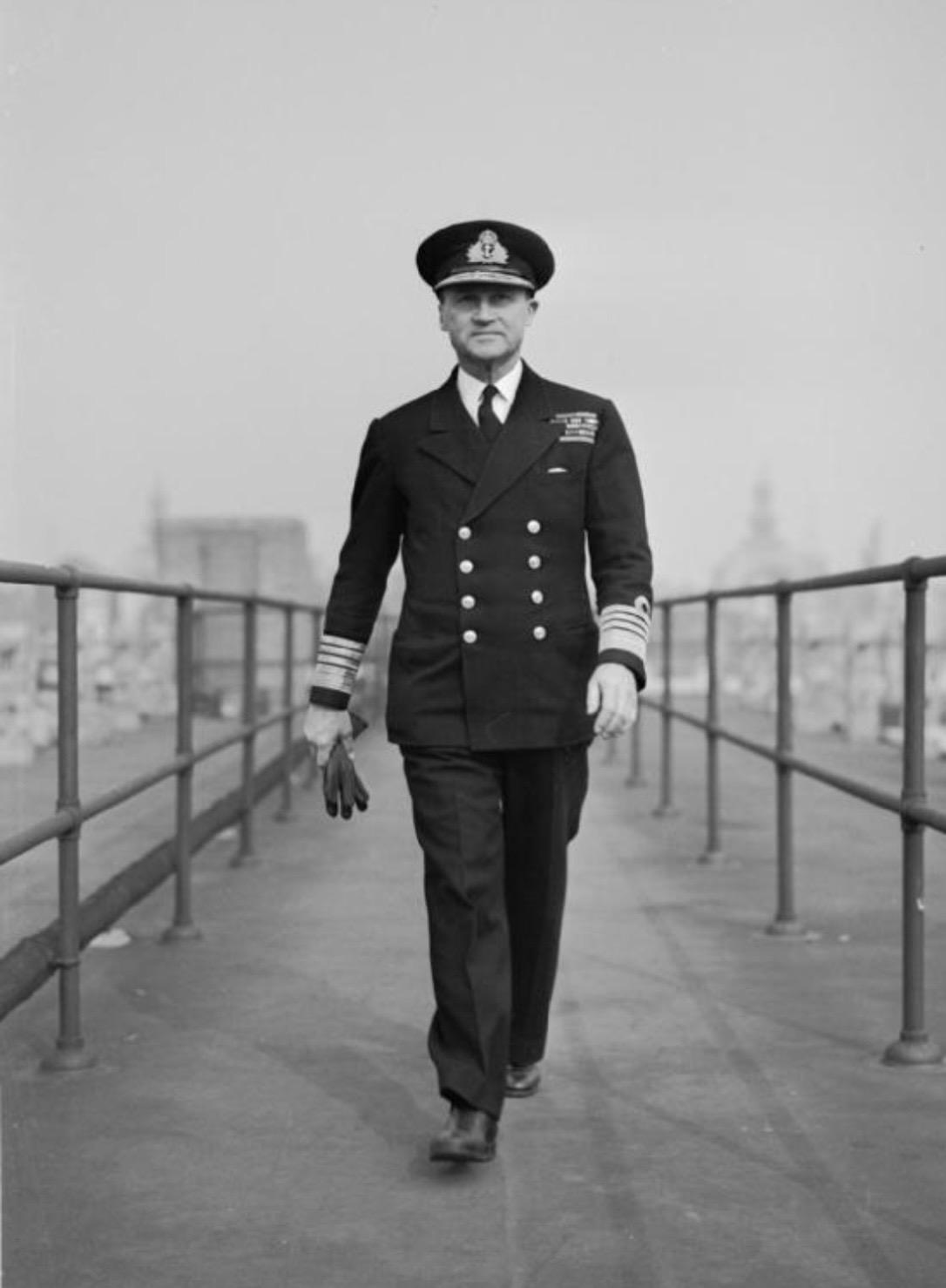
Bertram Home Ramsay was one of the most important British naval commanders of the Second World War, although he is not always remembered as widely as the generals and politicians with whom he worked. He was not a flamboyant figure and did not seek publicity, but he possessed qualities that proved invaluable in moments of crisis: calm judgement, superb organisation, practical seamanship and the ability to coordinate huge numbers of ships, men and supplies under extreme pressure. His greatest achievements came not in traditional fleet battles, but in the planning and command of complex maritime operations, especially the evacuation from Dunkirk in 1940 and the naval side of the Normandy landings in 1944.
He was born on 20 January 1883 at Hampton Court, Middlesex, into a family with strong military connections. His father, William Alexander Ramsay, was an officer in the British Army, and the atmosphere of duty, discipline and public service shaped his early life. Britain at that time depended heavily on the Royal Navy. The empire, its trade routes and its security all rested on sea power, and a naval career offered a young man adventure, status and responsibility.
He entered the Royal Navy as a cadet in 1898, still in his teens. His early training took place during a period of rapid change. The old age of sail had gone, steam power dominated, and new weapons such as torpedoes, submarines and mines were altering naval warfare. Wireless communication, improved gunnery and the arrival of the dreadnought battleship were transforming the service. These years gave him a thorough professional grounding in navigation, discipline, ship-handling, signalling and command.
Promotion came steadily rather than dramatically. He became a lieutenant in 1904 and served in a variety of ships, earning a reputation as a serious, capable and dependable officer. His early career did not bring great public attention, but it built the skills that later made him so effective. He learned the habits of precision and preparation that would define his wartime service.
During the First World War, he served in the Dover Patrol, one of the most active and dangerous naval commands around Britain. The Dover Strait was strategically vital because it connected the North Sea and the English Channel. German submarines, mines and surface craft threatened Allied shipping and the movement of troops and supplies to France. Service there gave him direct experience of coastal warfare, minesweeping, patrol work and operations in narrow, heavily contested waters.
This experience proved extremely important later. Unlike officers whose careers centred mainly on battleships and grand fleet manoeuvres, he became deeply familiar with the practical problems of controlling the Channel, protecting shipping and coordinating many small and medium-sized vessels. He was promoted to commander in 1916 and emerged from the war as a highly efficient officer with strong operational and administrative ability.
After 1918, he continued his naval career during a difficult period for the Royal Navy. Defence cuts, naval treaties and economic pressures reduced opportunities, and promotion was highly competitive. He nevertheless advanced, becoming a captain in 1923. His interwar appointments included ship commands and important staff posts, all of which strengthened his reputation as a skilled organiser.
One significant command was the aircraft carrier HMS Furious. Naval aviation was still developing, and carriers were beginning to change the nature of sea power. Although he was not primarily an aviation specialist, this appointment gave him useful experience in coordinating ships and aircraft, something that later became vital in amphibious operations.
He also served as Chief of Staff to the Commander-in-Chief of the Mediterranean Fleet. This was a demanding post in one of Britain’s most important strategic regions, linking Britain with Egypt, the Suez Canal, India and the Far East. It required planning ability, diplomacy and sound judgement. By this stage, his gift for staff work was clear. He was not merely a competent seagoing officer; he was a planner of unusual talent.
His career, however, was not without frustration. In the late 1930s he disagreed with aspects of Admiralty policy and retired from the Royal Navy in 1938 with the rank of vice-admiral. At that point, his career might have ended as respectable but not famous. The approach of war changed everything. Britain urgently needed experienced commanders, especially men who understood the Channel and the defence of the south-east coast. He was recalled to service in 1939 and appointed Flag Officer Commanding Dover.
This appointment placed him in charge of one of Britain’s most sensitive naval areas. Dover controlled the narrow sea route to France and later faced German-occupied Europe directly. It proved to be a crucial decision, because his knowledge of the area and his calm, methodical temperament made him ideally suited to the emergency that followed.
His first great achievement came in May and June 1940 during Operation Dynamo, the evacuation of Allied troops from Dunkirk. After the German breakthrough in France, the British Expeditionary Force and many French troops were trapped near the Channel coast. The situation was desperate. If the army had been captured, Britain’s ability to continue the war would have been gravely weakened.
The evacuation was directed from naval headquarters inside the cliffs at Dover, in tunnels originally used during the Napoleonic era. When the operation began on 26 May 1940, expectations were low. Some believed that only 30,000 to 45,000 men might be rescued. The beaches were exposed, Dunkirk harbour was badly damaged, German aircraft attacked constantly, and the waters were dangerous with mines, wrecks and enemy action.
Every available vessel was gathered: destroyers, minesweepers, ferries, trawlers, drifters, merchant ships, lifeboats and the famous “little ships”. These small civilian craft helped ferry soldiers from the beaches to larger ships offshore. The operation demanded constant adjustment as conditions changed. Routes had to be altered, losses replaced, and the flow of vessels kept moving despite bombing and confusion.
The result became one of the defining episodes of the war. More than 338,000 Allied soldiers were rescued, including about 198,000 British troops and roughly 140,000 French and other Allied troops. Militarily, the campaign in France had been lost, but the evacuation saved the core of the British Army. For his role in organising this extraordinary rescue, he was knighted.
After Dunkirk, he remained central to the defence of the Channel. In 1940, German invasion seemed a real possibility. Operation Sea Lion, Hitler’s planned invasion of Britain, depended on crossing the same waters he knew so well. Although the invasion never happened, British naval planning had to prepare for attacks on invasion barges, coastal defence, mine warfare and rapid response to enemy movements. Dover was also within range of German guns and aircraft after the occupation of France, making the command especially hazardous.
As the war turned in the Allies’ favour, his skills became just as important for offence as they had been for evacuation and defence. Britain and its allies needed to learn how to return to enemy-held territory by sea. Amphibious warfare was immensely complicated. It involved landing craft, escorts, minesweepers, bombardment ships, air cover, beach organisation, intelligence, deception and supply planning. Few officers were better suited to this type of work.
In 1942, he played an important part in Operation Torch, the Allied landings in North Africa. This was the first major Anglo-American amphibious operation of the war and involved landings in Morocco and Algeria. Serving as Deputy Naval Commander under Admiral Sir Andrew Cunningham, he helped plan and coordinate the naval aspects of the operation. Torch brought American forces into the European and Mediterranean war in strength and provided valuable lessons for later invasions.
In 1943, he was again heavily involved in amphibious planning for Operation Husky, the invasion of Sicily. This huge operation moved British, American and Canadian forces across the Mediterranean and placed them ashore on a defended island. Weather, navigation, beach conditions and enemy resistance all created difficulties. The capture of Sicily contributed to the fall of Mussolini and opened the way for the Italian campaign.
His greatest achievement came with Operation Neptune, the naval part of Operation Overlord, the invasion of Normandy on 6 June 1944. By then he had been appointed Allied Naval Commander-in-Chief for the invasion. This made him responsible for one of the largest and most complex naval operations in history.
The task was enormous. The Allies had to transport armies across the Channel, land them on five beaches, protect them from German naval and air attack, clear mines, bombard coastal defences, maintain communications and then keep the troops supplied once ashore. Thousands of vessels were involved: battleships, cruisers, destroyers, minesweepers, landing ships, landing craft, merchant ships, tugs and support vessels.
The invasion fleet carried British, American, Canadian and other Allied troops to Utah, Omaha, Gold, Juno and Sword beaches. Naval gunfire supported the landings, minesweepers opened safe channels, and landing craft delivered infantry, tanks, vehicles and equipment. The whole plan depended on timing, weather, tides, moonlight and surprise. Bad weather forced a postponement from 5 June to 6 June, and the final decision to go required confidence that the naval forces could cross successfully in difficult conditions.
The landings were not flawless. Omaha Beach in particular saw terrible fighting and heavy casualties. Yet the operation succeeded. The Allies established a foothold in France, and from there began the liberation of Western Europe. Without the naval operation, the armies could not have landed or survived. His planning ensured that the Channel crossing, bombardment, landing craft movements and early supply effort worked together as part of one vast machine.
After D-Day, the work continued. An invasion was not simply a single day’s landing; it was an ongoing maritime supply operation. The armies in Normandy needed ammunition, fuel, food, vehicles, reinforcements and medical support. Artificial harbours, known as Mulberries, were used to help unload supplies, while beach organisation and sea routes remained essential. Keeping the flow of material moving across the Channel was as important as getting the first troops ashore.
His personality helped explain his success. He was disciplined, reserved and methodical rather than dramatic. He expected high standards and could be firm, but he inspired confidence because he knew his work thoroughly. In a coalition war involving British and American forces, trust and clarity were essential. He worked effectively with senior figures such as Eisenhower, Montgomery and Cunningham while maintaining firm control of his own responsibilities.
One of the most interesting aspects of his life is that his greatest service came after retirement. Had war not returned, he might have been remembered only as a capable senior officer of the interwar navy. Instead, his recall placed him at the centre of Dunkirk, North Africa, Sicily and Normandy. The experience he had gained in the First World War and in staff appointments between the wars suddenly became exactly what Britain needed.
He did not live to see final victory. On 2 January 1945, while travelling to a conference with General Montgomery in Brussels, his Lockheed Hudson aircraft crashed shortly after take-off near Toussus-le-Noble, south-west of Paris. He and several others on board were killed. He was 61 years old.
Because he died before the end of the war, there was no long retirement, no memoir and no chance to shape his own public reputation. This partly explains why he is less famous than Churchill, Eisenhower, Montgomery or other wartime leaders. His work was also less visible because it centred on planning, logistics and coordination rather than speeches or battlefield drama. Yet armies depend on exactly those things: ships assembled, routes cleared, tides calculated, supplies delivered and commands coordinated.
He was buried at the Commonwealth War Graves Commission cemetery at Saint-Germain-en-Laye in France. His grave is a reminder that he died on active service, still contributing to the liberation of Europe.
His legacy is immense. At Dunkirk, he helped save the British Army from destruction. In North Africa and Sicily, he helped develop the Allied skill in amphibious warfare. At Normandy, he commanded the naval operation that carried the liberation armies back into Western Europe. Few naval officers were connected with so many decisive operations.
Admiral Sir Bertram Home Ramsay deserves to be remembered as one of the quiet architects of Allied victory. His career linked the narrow waters of the Dover Strait with the greatest seaborne invasion in history. He was not a showman, but a master of planning and command whose calm efficiency altered the course of the war.