6 Day War Ends
The Six-Day War of June 1967 ended with one of the most dramatic military outcomes in modern Middle Eastern history. In less than a week, Israel defeated the combined forces of Egypt, Jordan, and Syria, captured large areas of territory, and transformed the political and strategic map of the region. The war ended not through a single peace agreement, but through a series of ceasefires arranged under international pressure, especially through the United Nations and the two Cold War superpowers, the United States and the Soviet Union.
The war began on 5 June 1967, after weeks of rising tension between Israel and its Arab neighbours. Egypt had moved troops into the Sinai Peninsula, expelled United Nations peacekeepers from the area, and closed the Straits of Tiran to Israeli shipping. Israel regarded the closure of the straits as a major threat and, fearing that war was imminent, launched a pre-emptive air strike against Egypt. This opening attack destroyed much of the Egyptian air force while it was still on the ground, giving Israel almost complete control of the skies. That air superiority was one of the decisive reasons why the war developed so quickly in Israel’s favour.
After Egypt was struck, Jordan and Syria became involved in the fighting. Jordanian forces attacked Israeli-held West Jerusalem and other positions, while Syrian forces continued shelling northern Israel from the Golan Heights. Israel then fought on several fronts at once. In the south, Israeli troops advanced rapidly through the Sinai Peninsula and pushed Egyptian forces back toward the Suez Canal. In the east, Israeli forces fought Jordanian troops in and around Jerusalem and across the West Bank. In the north, Israel eventually launched an assault on Syrian positions on the Golan Heights.
The first major step toward ending the war came when Egypt’s defeat in Sinai became unavoidable. Egyptian forces were retreating, and Israeli troops had reached the eastern bank of the Suez Canal. The speed and scale of the Egyptian collapse shocked the Arab world. Egypt accepted a ceasefire on 8 June, although some fighting and confusion continued in certain areas. Jordan, having lost East Jerusalem and the West Bank, accepted a ceasefire around the same time. Syria continued fighting for a little longer, but after Israeli forces captured the Golan Heights, Syria accepted a ceasefire on 10 June. By then, the main fighting had ended.
The United Nations Security Council helped bring the war to a close by calling for an immediate ceasefire. The United States and the Soviet Union, although they supported different sides politically, both wanted to prevent the war from spreading further. The Soviet Union had close links with several Arab states, especially Egypt and Syria, while the United States was sympathetic to Israel but also concerned about a wider regional crisis. Neither superpower wanted the conflict to grow into a direct Cold War confrontation. This international pressure helped stop the fighting.
For Israel, the war was perceived as a stunning victory for several reasons. First, Israel had defeated three neighbouring Arab states in only six days. Before the war, many Israelis had feared national destruction. Israel was a small country with narrow borders, and Arab leaders had used threatening language in the weeks before the fighting. The sense of danger inside Israel was intense. When the war ended with Israel not only surviving but expanding its control over large territories, many Israelis saw the result as a national rescue as well as a military triumph.
Second, the war greatly improved Israel’s strategic position. Before 1967, Israel’s borders were seen by many Israelis as dangerously vulnerable. At its narrowest point, pre-war Israel was only a few miles wide. After the war, Israel controlled the Sinai Peninsula, the Gaza Strip, the West Bank, East Jerusalem, and the Golan Heights. These territories gave Israel greater depth and more defensible lines from a military point of view. The capture of the Golan Heights was especially important to many Israelis because Syrian forces had previously used the heights to shell Israeli communities below. The capture of Sinai also pushed Egyptian forces far away from Israel’s southern border.
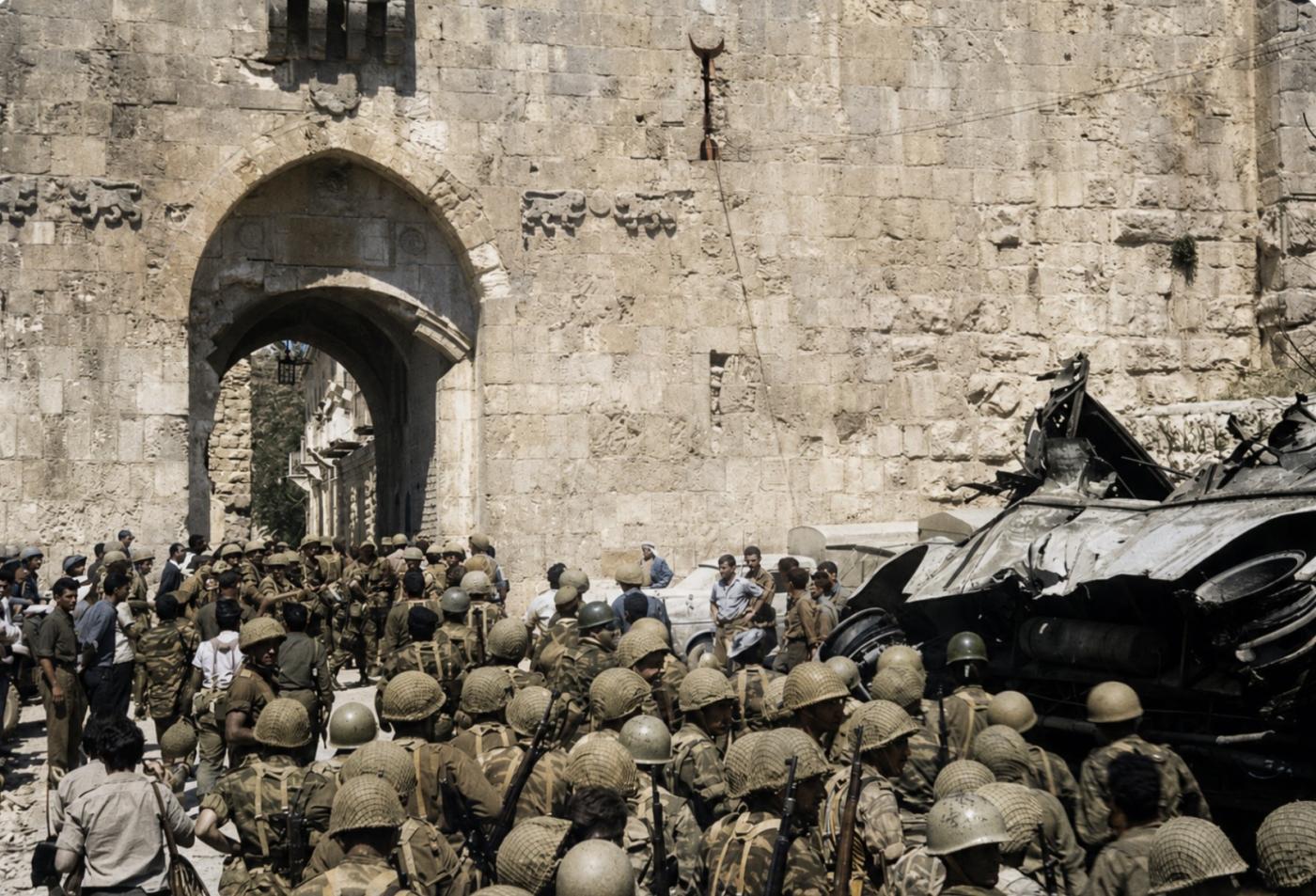
Third, the capture of East Jerusalem had enormous emotional and religious significance. Since the 1948 Arab-Israeli war, Jerusalem had been divided, with West Jerusalem under Israeli control and East Jerusalem, including the Old City, under Jordanian control. During the Six-Day War, Israeli forces captured East Jerusalem and gained access to the Western Wall, one of the holiest sites in Judaism. Images of Israeli soldiers at the Western Wall became some of the most famous symbols of the war. For many Israelis and Jews around the world, the reunification of Jerusalem under Israeli control was seen as a historic and deeply emotional moment.
Fourth, the war changed how Israel was viewed internationally. Before 1967, Israel was often seen as a vulnerable state surrounded by hostile neighbours. After the war, it was increasingly seen as a major regional military power. Its armed forces gained a reputation for speed, coordination, intelligence, and effectiveness. The destruction of enemy air forces, the rapid advance across Sinai, and the capture of Jerusalem and the Golan Heights all contributed to the image of Israel as a highly capable military state.
However, the victory also created new problems that would shape the Middle East for decades. Israel now controlled territories with large Palestinian populations, especially in the West Bank and Gaza Strip. This raised major political, moral, and security questions. Israel had won the war, but it now had to decide what to do with the land and the people living there. Some Israelis believed the territories should be traded for peace with Arab states. Others believed some or all of the territories should be permanently retained for security, religious, or historical reasons. These divisions became central to Israeli politics after 1967.
For Palestinians, the outcome of the war was a disaster. Many Palestinians came under Israeli military occupation in the West Bank and Gaza Strip. The war also created another wave of displacement, as some Palestinians fled or were expelled from areas captured by Israel. The defeat of Arab armies weakened the idea that neighbouring Arab states could easily defeat Israel and restore Palestinian lands. As a result, Palestinian nationalism became more independent and more militant after 1967. Groups such as the Palestine Liberation Organization became more prominent, and the Palestinian issue moved to the centre of the Arab-Israeli conflict.
For the Arab states, the war was experienced as a humiliating defeat. Egypt’s President Gamal Abdel Nasser had been one of the most powerful and symbolic leaders in the Arab world. His vision of Arab nationalism had inspired millions, but the defeat badly damaged his prestige. After the war, Nasser offered to resign, though mass demonstrations in Egypt urged him to remain in power. The defeat became known in the Arab world as the Naksa, meaning “the setback.” It was not simply a military failure; it was a psychological and political shock.
The war also changed the relationship between Arab governments and their populations. Many Arabs had believed that their armies were strong enough to defeat Israel. The sudden collapse of those armies created anger, disbelief, and disillusionment. Arab leaders had to explain how such a major defeat had happened so quickly. In the years that followed, Arab states began rebuilding their militaries, often with Soviet support. Egypt in particular focused on recovering from the defeat and eventually prepared for another war, which came in 1973.
One of the most important consequences of the Six-Day War was United Nations Security Council Resolution 242, passed in November 1967. This resolution became a key diplomatic framework for later peace efforts. It called for the withdrawal of Israeli armed forces from territories occupied in the conflict and for all states in the region to live in peace within secure and recognized boundaries. The wording of the resolution became highly disputed, especially over whether Israel was required to withdraw from all the territories captured in 1967 or from some territories as part of a negotiated peace. This ambiguity shaped decades of diplomacy.
After the war, Arab states met at Khartoum in Sudan and issued what became known as the “three noes”: no peace with Israel, no recognition of Israel, and no negotiations with Israel. This showed that, despite the scale of the defeat, most Arab governments were not ready to accept Israel formally. At the same time, Israel was not ready simply to withdraw from all the territories it had captured without peace agreements and security guarantees. This produced a diplomatic deadlock.
The victory also encouraged the growth of Israeli settlement activity in some of the captured territories. Over time, Israeli civilians began moving into areas such as the West Bank, East Jerusalem, Gaza, Sinai, and the Golan Heights. These settlements became one of the most controversial issues in the conflict. Supporters saw them as strengthening Israel’s security or restoring Jewish presence in historically significant areas. Critics saw them as an obstacle to peace and as a deepening of occupation. The settlement issue became especially important in the West Bank and East Jerusalem.
The Sinai Peninsula followed a different path from the West Bank and Gaza. After the 1973 Yom Kippur War, Egypt and Israel eventually entered negotiations that led to the Camp David Accords in 1978 and the Egypt-Israel Peace Treaty in 1979. As part of that agreement, Israel returned the Sinai Peninsula to Egypt in stages. This showed that land captured in 1967 could be exchanged for peace, but it also highlighted the difficulty of resolving the Palestinian question, which remained unsettled.
The Golan Heights also remained a major issue. Israel captured the territory from Syria in 1967 and later effectively annexed it, though this was not widely recognized internationally for many years. Syria demanded its return, while Israel argued that the Golan was essential for security. The area remained a point of tension between Israel and Syria, even when direct large-scale war between them became less frequent.
In the long term, the Six-Day War created the basic territorial questions that still define much of the Israeli-Palestinian conflict. The status of East Jerusalem, the future of the West Bank, the fate of Gaza, the rights of Palestinians, the question of Israeli settlements, and the demand for secure borders all became linked to the outcome of the 1967 war. Israel’s victory solved its immediate military crisis, but it opened a much larger and longer political struggle.
The war was therefore both a triumph and a turning point. For Israel, it was seen as a victory of survival, military skill, and national confidence. It removed immediate threats on several fronts and gave Israel control over territory that many believed improved its security. The capture of Jerusalem added a powerful emotional and religious dimension to the victory. Yet the same victory also placed Israel in control of millions of Palestinians and created disputes that no ceasefire could resolve.
The Six-Day War ended with ceasefires, not peace. The guns fell silent by 10 June 1967, but the consequences of the war continued to shape the Middle East for generations. Israel emerged stronger and more confident, while the Arab world faced shock, humiliation, and the need to rebuild. Palestinians faced occupation and a transformed national struggle. What followed was not a final settlement, but a new phase of conflict, diplomacy, resistance, and political division. The war’s military outcome was swift and decisive, but its political aftermath proved far more complicated and enduring.