1977 DPM Para Smock
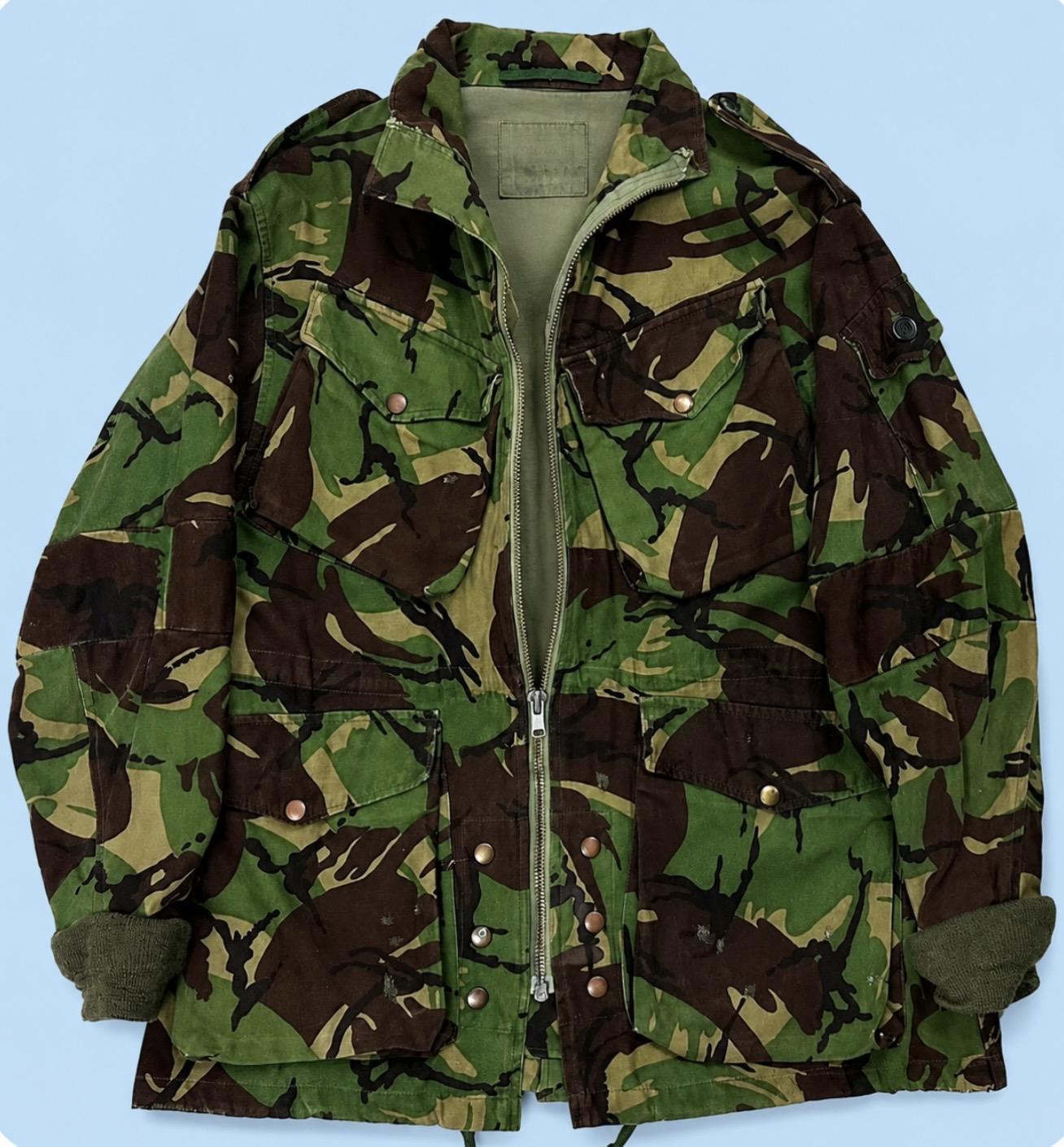
The 1977 DPM parachutist’s smock was a specialist airborne garment, not a Denison smock and not the same item as the standard infantry combat smock. It belonged to the same broad period of British Army DPM clothing, but it was made for troops who had different requirements from ordinary infantry. Its purpose was to give parachute-trained soldiers a smock that worked with parachute harness, airborne equipment and field service, while still using the standard British Disruptive Pattern Material camouflage that had become normal across the Army.
By the late 1970s, British airborne clothing was changing. The old brushstroke Denison smock had served British parachute troops for decades, but the Army was moving fully into DPM clothing. The new parachutist’s smock kept the airborne idea of a loose, practical, jump-suitable oversmock, but it was no longer a Denison. It was a modern DPM garment made under Ministry of Defence contract for airborne use. Its camouflage was the standard British temperate DPM pattern of the period rather than the older hand-painted-looking brushstroke design associated with wartime and post-war Denisons.
The reason the parachutist’s smock was different from the standard infantry version was simple: a parachutist’s clothing had to work in the aircraft, during the exit, under the parachute harness, on landing and then in combat after the drop. A normal infantry combat smock was designed mainly as a field jacket for marching, patrolling and fighting on the ground. It did not need to be anchored to the body in the same way, and it did not have to deal with the same risks of loose clothing being lifted, twisted or displaced by airflow and parachute equipment.
The most obvious difference was the crotch flap, sometimes called the tail. This was the feature that made the garment recognisably a parachutist’s smock. The flap could pass between the legs and fasten at the front, stopping the smock from riding up during a parachute jump or when worn under harness. On the standard infantry combat smock there was no such feature because it was unnecessary for ordinary ground troops. Infantry soldiers did not need their smock secured between the legs before leaving an aircraft by parachute.
The parachutist’s smock was also cut with airborne equipment in mind. It had to be roomy enough to wear over layers and under parachute harness without restricting movement. Airborne troops might be carrying a heavy load, weapon, reserve parachute, webbing, ammunition and personal kit. The smock therefore needed to be practical before and after landing. It had to allow the soldier to move, bend, crawl and fight without the garment becoming a nuisance. The standard infantry smock was also loose and practical, but it was not shaped around the same jumping requirement.
The front fastening was another important distinction. Early DPM parachutist’s smocks usually had a prominent full-length zip front, keeping the design closer in spirit to earlier airborne smocks. Standard infantry combat smocks generally used a different front arrangement, usually with a covered button fastening or storm flap arrangement depending on the exact pattern. The para smock’s zip made it easier and quicker to put on and remove, especially when layered with equipment, though it also meant the front looked plainer and more direct than the normal combat smock.
The cuffs were also part of the airborne character. Knitted cuffs, inherited from earlier parachutist smock practice, helped keep the sleeves controlled and prevented loose cuff material from catching or flapping. On the standard infantry combat smock, cuff arrangements were usually more conventional. For a parachutist, sleeve control mattered because the soldier was operating in aircraft, around rigging lines, weapons, straps and harness. Anything loose could be awkward or dangerous.
The pocket arrangement was another reason airborne soldiers valued the smock. The parachutist’s smock had large practical pockets suitable for carrying maps, gloves, rations, notebooks, field dressings, small tools and other useful items. Standard infantry smocks also had useful pockets, but the para smock’s layout was part of a long airborne tradition in which the smock acted almost as extra load-carrying clothing. Parachute troops often needed vital items close to the body, especially if separated from larger equipment after landing.
The cloth and camouflage linked the smock to the wider Army. The pattern was British temperate DPM, designed to break up the soldier’s outline in woodland, scrub and European field conditions. It was not a special airborne-only camouflage. The important difference was not the printed pattern itself, but the cut and construction of the garment. In other words, the parachutist’s smock used the same general camouflage family as standard Army clothing, but the garment was built for a different job.
The 1977 DPM parachutist’s smock was produced through normal Ministry of Defence clothing contracts. It was not the private invention of a named designer, and there is no good evidence that one single person designed the camouflage pattern specifically for this smock. The DPM pattern was part of the official British military clothing system, developed and adopted through trials, procurement and service use. The smock itself was a specialist airborne adaptation within that system.
Manufacture was carried out by British military clothing contractors working to official specifications. Surviving examples and collector records show that firms such as H. E. Textiles were involved in early production, while other British contractors were associated with late Denison and later smock production. The exact maker of an individual smock depends on its label and contract details. For collectors, the label, date, NATO stock number, contract number, zip type, press studs, stitching and cloth shade are all important clues.
The smock was issued to the Parachute Regiment and other parachute-trained British troops. It was also seen among specialist units that needed airborne or commando-style clothing. It appeared during the period when the Army was trying to standardise clothing but still allowed certain specialist garments for specialist roles. The parachutist’s smock therefore represented both modernisation and continuity. It used modern DPM camouflage, but it preserved the airborne smock concept that British parachute troops had used since the Second World War.
Compared with the standard infantry combat smock, the parachutist’s version was more specialised, more closely fitted to airborne procedure and more symbolic. The ordinary infantry smock was a general-purpose combat garment. The parachutist’s smock was a qualification-linked item associated with airborne troops. This gave it a status beyond its practical use. Wearing one indicated a connection with airborne forces, and for many soldiers that mattered.
The 1977 pattern is especially interesting because it came at a turning point. It followed the Denison era but did not copy it completely. It abandoned the old brushstroke camouflage and adopted standard DPM. Yet it kept the most important parachutist features: the tail, roomy cut, large pockets, practical cuffs and airborne identity. This made it visibly different from the infantry smock even though both belonged to the same British DPM clothing world.
Collectors sometimes confuse the language because they call it a DPM Denison or a late Denison-style smock. That is understandable in casual conversation, because the garment descended from the airborne smock tradition. However, the more accurate name is DPM parachutist’s smock. It should not be described as a Denison smock, because the Denison properly refers to the earlier brushstroke-pattern airborne smock. The 1977 DPM version was its successor, not the same garment.